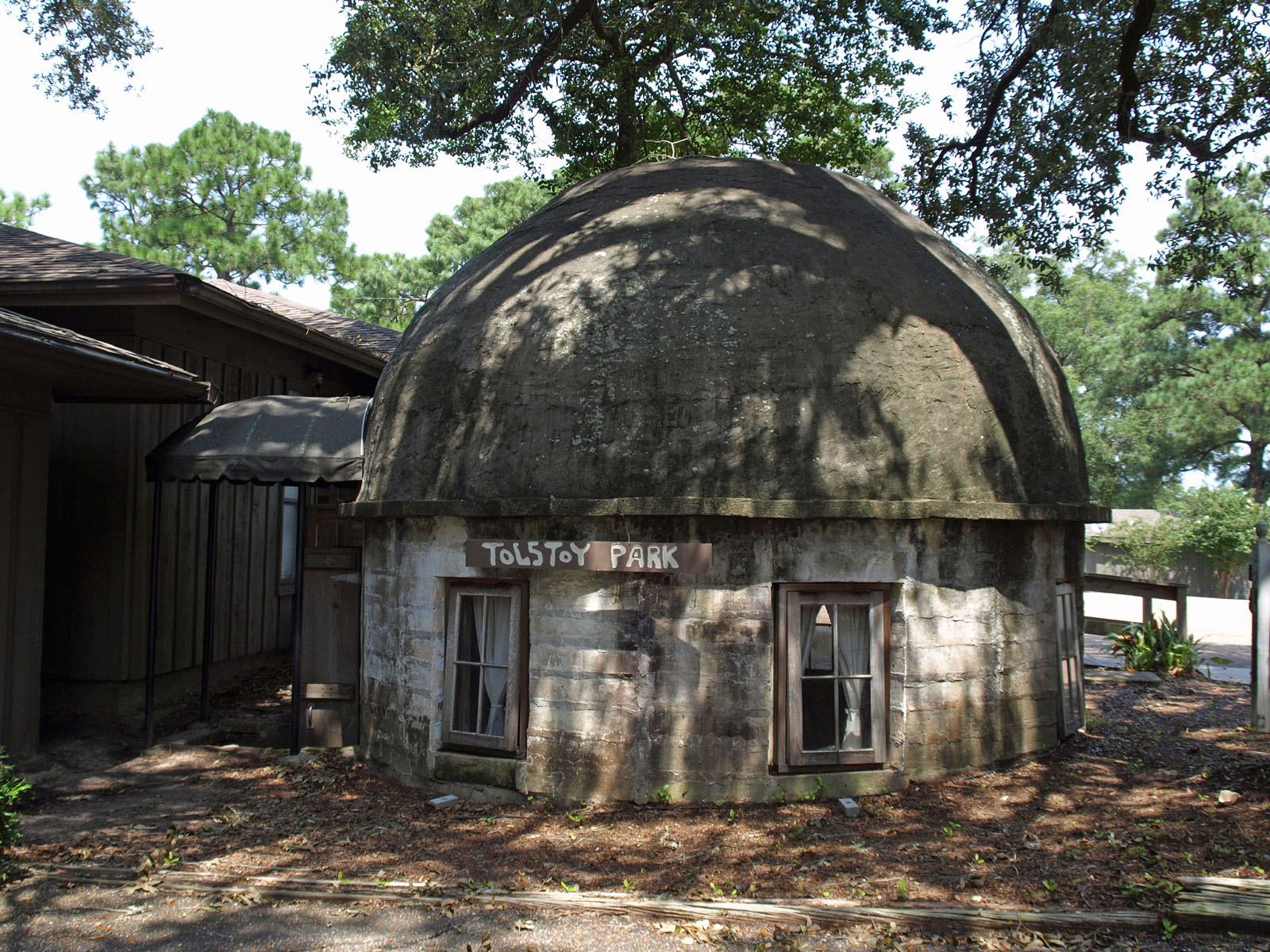
Tolstoy Park
In 1923, a doctor in Nampa, Idaho, told Henry Stuart he was dying. Tuberculosis. The prescription was blunt: move somewhere warm and live out whatever time remained. Stuart was 65 years old, English-born, and had spent decades in the American West. Most people in his position would have moved in with family and waited. Stuart bought ten acres of wooded land outside Fairhope, Alabama, a town he had likely never seen, and named his new property after Leo Tolstoy. Then he started pouring concrete blocks.
A Dome in the Woods
Stuart began construction in 1925, working alone. He mixed and poured every concrete block himself, shaping them into a circular, domed hut just 14 feet in diameter. He sank the structure two feet into the Alabama clay, giving the interior a cool, cave-like quality. Six top-hinged windows circled the building, and two skylights pierced the dome. The hut was small enough to heat with a single body and solid enough to endure decades. A hurricane swept through in September 1926, delaying completion, but Stuart finished within the year. The result looked like nothing else in Baldwin County -- a miniature observatory, or perhaps a concrete igloo, sitting in a clearing among the pines and live oaks of the Gulf Coast lowlands.
The Hermit Who Kept a Guestbook
Stuart named himself a hermit, but his solitude was porous. He grew much of his own food, wove rugs on a loom he had hauled from Idaho, and taught weaving at Marietta Johnson's Organic School in Fairhope. He gave talks in town. And he kept a guestbook at the hut's door. Over two decades, more than 1,300 visitors signed it. The most notable was Clarence Darrow, the famed defense attorney of the Scopes Trial, who visited Stuart's tiny concrete dome not once but six times. What drew the most famous lawyer in America to a hermit's hut on the Gulf Coast is anyone's guess, but the visits speak to Stuart's reputation as a thinker and conversationalist, not merely a recluse. The man who came to Alabama to die had become a local fixture.
Twenty-Two Extra Years
The tuberculosis diagnosis that sent Stuart south turned out to be less of a death sentence than an invitation to a different life. Whether it was the warm Gulf air, the physical labor, or the sheer stubbornness of a man who would pour his own concrete blocks at 67, Stuart outlived his prognosis by more than two decades. He remained at Tolstoy Park until 1944, when he was 86 years old. He then sold his holdings and moved to Oregon to live with his son. Stuart died there in 1946 at the age of 88. The man who had been told to go somewhere warm and wait for the end had instead built a home, planted a garden, welcomed over a thousand guests, and earned the quiet admiration of an entire community.
What Remains
Today, Stuart's concrete dome still stands on Parker Road in Montrose, though the ten acres around it have long since been developed. A parking lot for a real estate office surrounds the hut -- a poignant irony for a man who came to Alabama seeking simplicity. A large oak tree near the dome is the only other surviving element of the original estate. The skylights have been permanently sealed, but the six circular windows and the domed roof remain intact. In 2005, local author Sonny Brewer published The Poet of Tolstoy Park, a novel based on Stuart's life that brought renewed attention to the site. The hut was listed on the National Register of Historic Places in 2006. Community efforts have raised funds to preserve and potentially relocate the structure, ensuring that Henry Stuart's unlikely monument to reinvention endures.
From the Air
Tolstoy Park sits at 30.556N, 87.894W in the small community of Montrose, on the eastern shore of Mobile Bay near Fairhope, Alabama. The site is not easily identifiable from the air -- it is a single small concrete dome surrounded by development along Parker Road. The eastern shore of Mobile Bay itself is the primary visual landmark. Nearest airports are Mobile Regional Airport (KMOB) about 20 miles to the west across the bay, and Jack Edwards National Airport (KJKA) in Gulf Shores to the south. At low altitude (1,500-2,000 feet AGL), the Fairhope waterfront and Montrose community are visible along the bay's eastern shore.