Tomb of Aaron (Jordan)
Three religions, one mountaintop. At 1,350 meters, Jabal Harun is the highest point in the landscape surrounding Petra, and on its summit sits a small sandstone room covered by a white dome that is visible for miles. Jews identify this peak as the biblical Mount Hor, where Moses stripped his brother Aaron of his priestly garments and gave them to Aaron's son Eleazar before Aaron died. Christians adopted the same identification during the Byzantine period and built a monastery just below the summit. Muslims venerate the site as the resting place of the prophet Haroun. The current shrine dates to the early fourteenth century. The mountain has drawn pilgrims for at least two thousand years, and the argument over who Aaron was and what he means has never quite been settled.
Two Mountains, Two Traditions
The Torah gives two different accounts of Aaron's death, and they do not agree on the location. The Book of Numbers places it on Mount Hor, on the edge of Edom, where the people mourned for thirty days. The Book of Deuteronomy says Aaron died at Moseroth -- also called Mosera -- and was buried there. Some scholars identify Mosera with el-Tayibeh, a small fountain at the base of the pass leading to Jabal Harun's ascent. Others argue that the biblical itinerary records seven stages between Mosera and Mount Hor, making it impossible for the two to be the same place. The historian Josephus, writing in the first century, and the church historian Eusebius both placed Mount Hor above the city of Petra. That identification has persisted for nearly two millennia despite the textual tension.
Crusaders and Sultans
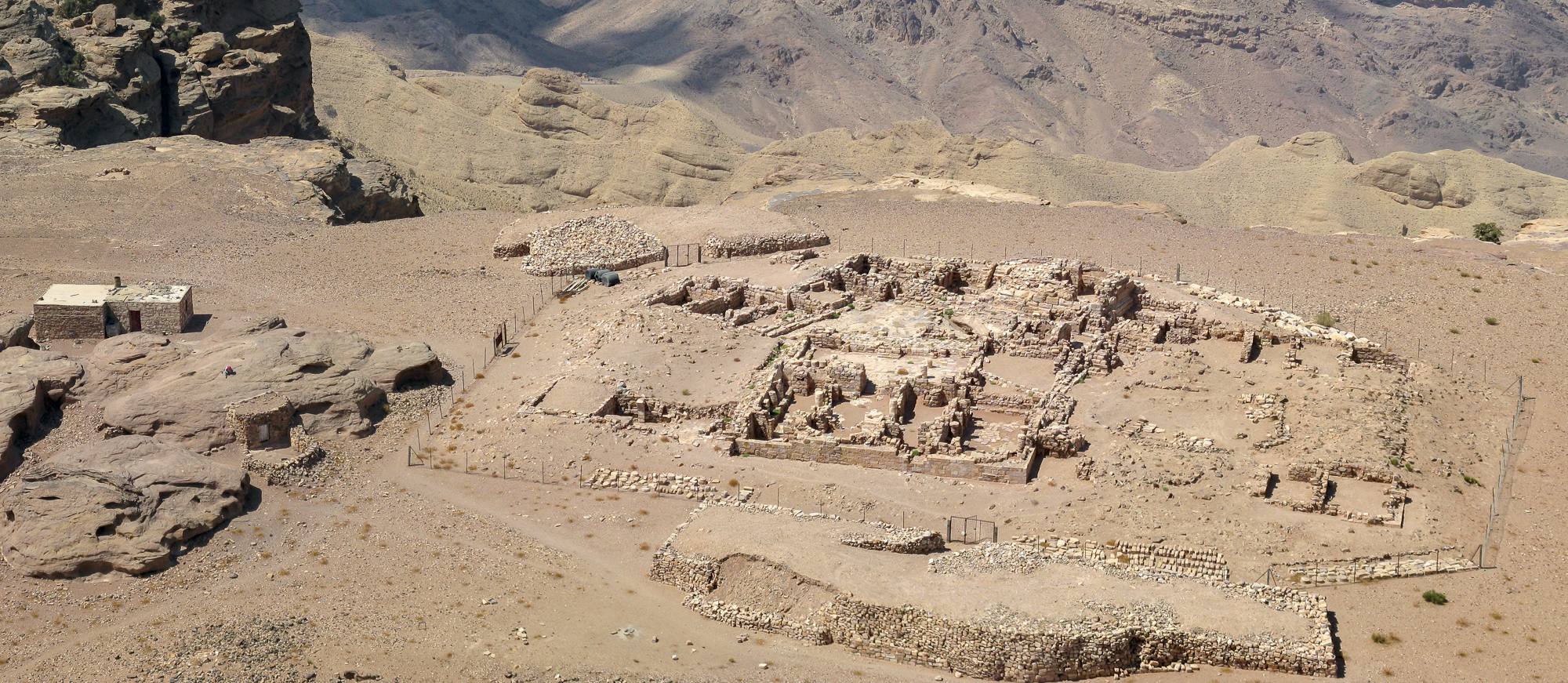
The summit has accumulated layers of devotion across centuries. During the Byzantine period, Christians built a monastery in the saddle just below the peak, creating a pilgrimage center that drew the faithful from across the region. Around 1100 CE, Baldwin I -- the Crusader king of Jerusalem -- visited the monastery with his entourage, a detour that speaks to the site's prestige even during the tumult of the Crusades. The current building was completed during the Mamluk period at the beginning of the fourteenth century. An inscription above the door records its renewal by Sultan al-Nasir Muhammad, son of Qalawun. The shrine consists of a single room measuring roughly 10 meters on each side, built of local sandstone and topped with the white dome that remains the mountain's most recognizable feature.
Living Pilgrimage
In the early twentieth century, ethnographers documented that the Bedul tribe made an annual pilgrimage to the Tomb of Aaron, while the Liyathnah tribe visited twice a year. These were not formal religious ceremonies in the institutional sense but expressions of a deeply local tradition -- part reverence, part communal gathering, part connection to the mountain itself. The shrine was adopted as sacred for Islam from the time of the Muslim conquests in the seventh century, continuing a veneration that dated from the Nabataeans and ancient Jews before them. Muslim legends regarding Aaron's tomb once formed a rich repertoire of stories, though many have faded from collective memory. The site's sanctity crosses denominational lines in ways that are rare and worth protecting.
Sacred Ground, Contested Access
Jordanian authorities classify the Tomb of Aaron as a mosque and forbid Jewish prayer services at the site. In August 2019, a group of Israeli tourists shared a video of themselves dancing with a Torah scroll on the summit. Authorities confiscated religious items from the group and temporarily closed the peak to foreign tour groups without permission from the Awqaf Ministry. Unrestricted access was restored by December of that year, and Israel maintains a regulated tourism mechanism with the Jordanian government. The incident illuminated the tensions that can arise when multiple faiths claim the same sacred geography. For the mountain itself, the controversy is nothing new -- competing traditions have orbited this summit since before anyone thought to write them down.
From the Air
Located at 30.319N, 35.407E atop Jabal Harun, the highest point near Petra at 1,350m elevation. The white dome of the mosque is visible from the air as a bright point on the dark peak. Best viewed at 5,000-7,000 feet AGL. The Byzantine monastery ruins are in the saddle just below the summit. Nearest airport is OJMF (Ma'an Airport), approximately 30 nm southeast. The peak overlooks the entire Petra basin to the northeast and the Arabah valley to the west.