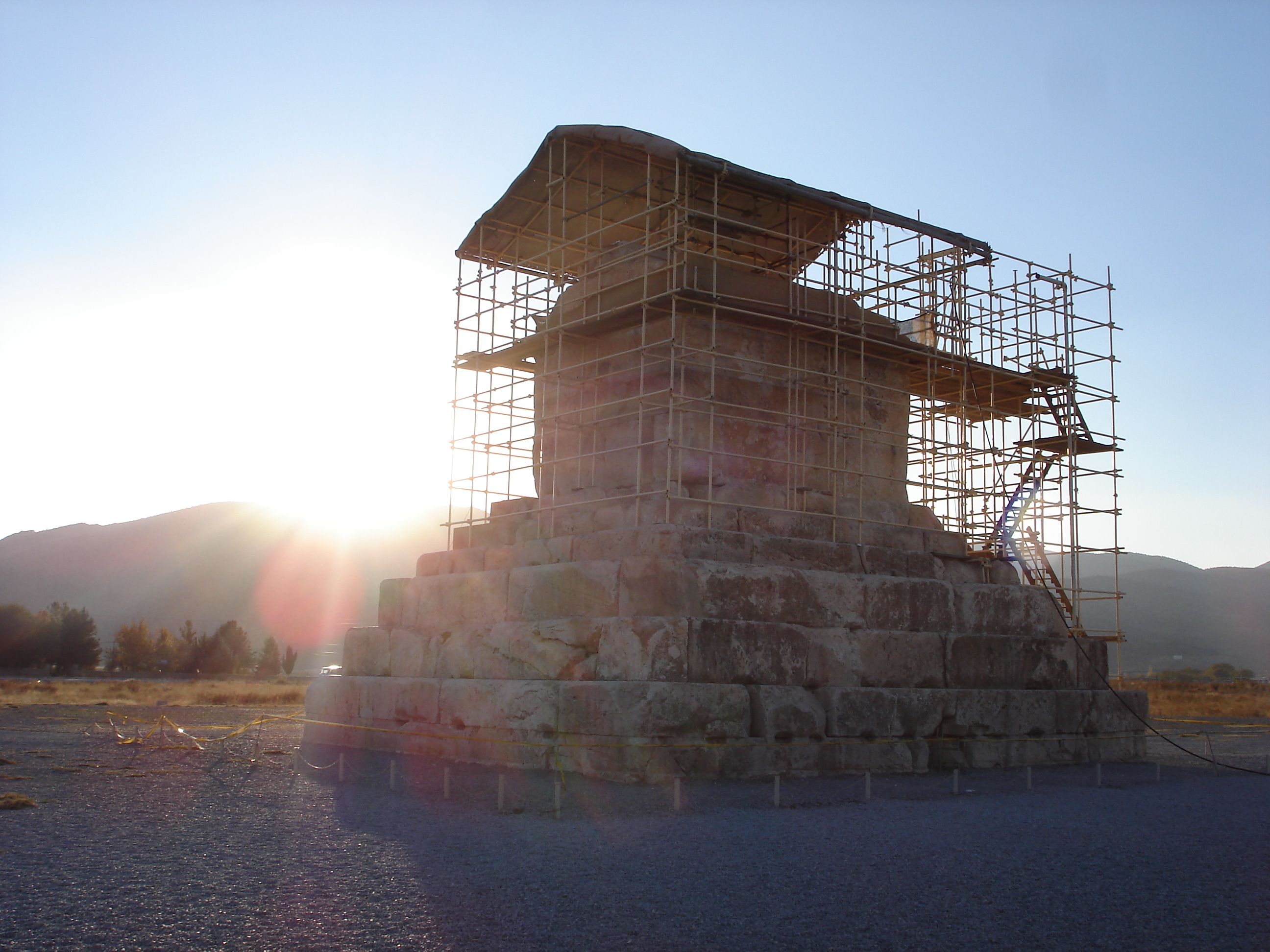
Tomb of Cyrus the Great
"O man, I am Cyrus, son of Cambyses, who founded the empire of the Persians, and was king of Asia. Do not therefore grudge me this monument." That inscription, recorded by the Greek historian Arrian from a lost account by Aristobulus, once marked the tomb of the man who built the largest empire the world had yet seen. The inscription is gone now. The golden coffin is gone. The Babylonian tapestries, the Median trousers dyed hyacinth-purple, the earrings of gold and precious stones -- all gone. What remains is the stone itself: a gabled chamber sitting atop six stepped platforms in the ruins of Pasargadae, the first capital of the Achaemenid Empire, in Iran's Fars Province. It is one of the most recognizable ancient structures in the world, and for over two thousand years, people kept forgetting whose it was.
The Tomb That Lost Its Name
After the Muslim conquest of Iran, the tomb's identity slipped away. Local tradition renamed it Mesjed Madre Suleiman -- the Tomb of the Mother of Solomon. The Venetian explorer Giosafat Barbaro, visiting in the fifteenth century, was told it held the remains of Bathsheba. Others attributed it to Wallada, mother of an Umayyad caliph. Women kept the key, and only women were permitted to enter. The surrounding area was credited with healing powers: local people directed dog-bite victims to drink from a nearby spring within thirty days of being bitten. It took a British diplomat to look past the legends. James Justinian Morier visited in 1812 and noticed that the structure bore no resemblance to any Islamic tomb he had seen across Persia, Asia Minor, or Turkey. Its architecture matched instead the descriptions left by Greek historians. Robert Ker Porter confirmed the identification in 1821. The tomb of the founder of the Persian Empire had been hiding in plain sight for a thousand years.
What Alexander Saw
When Alexander the Great reached Pasargadae after destroying Persepolis in 330 BC, he ordered Aristobulus to enter the tomb. The door was so narrow that even a slender man could barely squeeze through. Inside, Aristobulus found a golden coffin on a golden-footed couch, draped in Babylonian tapestry and purple rugs. Median coats, tunics, trousers, sabres, and collars lay arranged around a table. A grove of trees surrounded the monument, watered by a stream, and Magian priests guarded it perpetually -- a hereditary duty passed from father to son since the time of Cambyses. The king paid them with a sheep each day and a horse each month as sacrifice to Cyrus. On a later visit, Alexander found the tomb ransacked. The coffin had been broken apart, the corpse dragged away. Only the couch remained, too heavy to steal. According to Strabo, Alexander was grieved by the desecration. Even a conqueror could recognize what had been lost.
Engineering Against Earthquakes
The tomb's survival is not accidental. Modern engineers have identified it as possibly the oldest base-isolated structure in the world. The six stepped limestone platforms act as a seismic buffer, absorbing and dissipating earthquake energy before it can reach the burial chamber above. Iran sits on one of the most seismically active zones on Earth, and the tomb has stood through countless tremors over twenty-five centuries. The builders used no mortar. Instead, iron clamps connected the precisely cut stone blocks, a technique that allowed slight movement during seismic events without catastrophic failure. Most of those metal clamps were eventually pried out by treasure hunters, leaving dimpled scars across the masonry. A restoration team led by scholar Alireza Shapour Shahbazi repaired what damage they could, sourcing replacement stone from the Sivand mine. The tomb was renovated twice in modern times: once for the lavish 2,500-year celebration of the Persian Empire in 1971, and again between 2002 and 2009.
A Shape Without Precedent
Nothing quite like the Tomb of Cyrus existed before it was built. Architectural historians have debated its origins for generations, tracing threads to Mesopotamian ziggurats, Elamite traditions, and Urartian rock-cut tombs. The gabled cella atop stepped platforms has almost exactly the same dimensions as the tomb of Alyattes, father of the Lydian king Croesus -- a tantalizing connection, since Herodotus records that Cyrus spared Croesus after conquering Lydia and brought him into the Persian court. The main decorative element is a rosette carved above the door within the gable. Nineteenth-century visitors described twenty-two columns surrounding the structure on three sides, enclosed by a double wall with a gate. Robert Ker Porter counted seventeen pillars still standing in 1818, connected by a mud wall. Today no trace of these columns remains. Only the stepped platforms and the small chamber survive, stark against the treeless plain where a royal grove once grew.
A Nation's Pilgrimage
Cyrus the Great remains a defining figure of Iranian identity. Each year on October 29 -- the anniversary of Cyrus's entrance into Babylon -- Iranians celebrate Cyrus the Great Day, an unofficial holiday marked by gatherings at the tomb. During Nowruz, the Persian New Year, crowds travel from across the country to Pasargadae. The tomb appears on Iranian banknotes: the reverse of a 1938 500-rial note, the back of a 1970s 50-rial note. It is part of Pasargadae's UNESCO World Heritage designation. For Iranians, the site connects the modern nation to a founding moment -- the establishment of the Achaemenid Empire and the principles recorded on the Cyrus Cylinder, often called the first declaration of human rights. The tomb's inscription may be lost, but its message endures. Cyrus asked only not to be begrudged his monument. Twenty-five centuries later, his people still honor the request.
From the Air
Located at 30.19°N, 53.17°E in Iran's Fars Province, within the UNESCO World Heritage archaeological site of Pasargadae. The stepped tomb structure is visible from moderate altitude on an open, treeless plain. Nearest major airport is Shiraz International (OISS), approximately 130 km to the south-southwest. The site sits in a broad valley at roughly 1,900 meters elevation. Look for a small, isolated stepped structure on an otherwise flat landscape -- the tomb's geometric profile stands out clearly against the surrounding terrain.