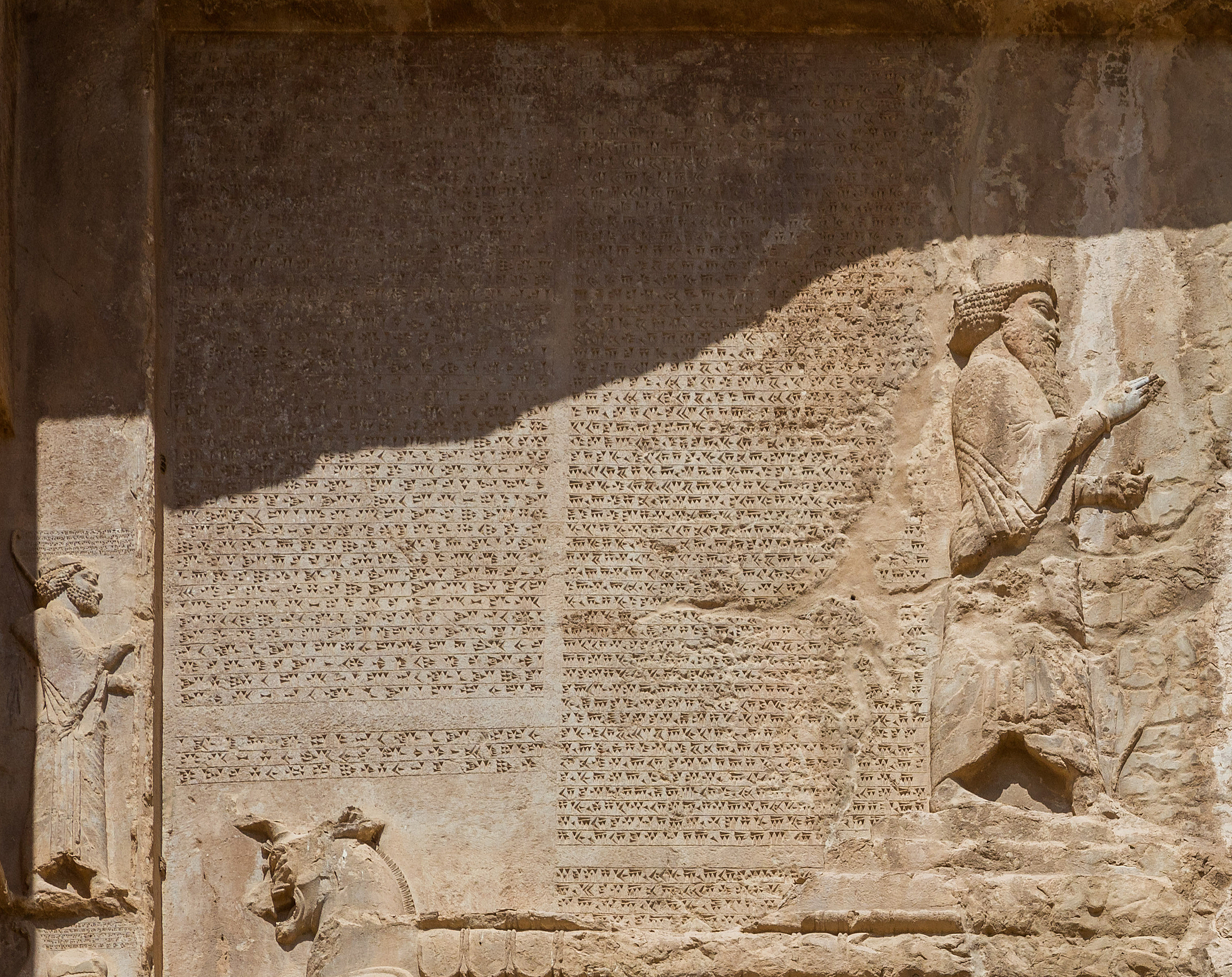
Tomb of Darius the Great
Thirty soldiers stand carved in stone, each one labeled in three languages. Persian, Elamite, Babylonian -- the trilingual inscriptions identify every ethnicity in the Achaemenid Empire, from Nubians to Macedonians, from Gandharan warriors to Scythian horsemen beyond the sea. These figures hold up the platform where Darius I stands before a sacred fire, and they have held it for over two and a half thousand years. The tomb they decorate is cut directly into the limestone cliffs at Naqsh-e Rostam, about twelve kilometers northwest of Persepolis in Iran's Fars Province. Four royal tombs occupy this cliff face, but only one carries an inscription identifying its owner. That inscription belongs to Darius the Great.
A Cliff Face of Kings
The four cruciform tombs at Naqsh-e Rostam sit high above the ground, each carved into the rock in the shape of a cross. The facades are monumental -- massive reliefs depicting the king standing on a platform supported by rows of soldiers representing the peoples of the empire. Darius chose this cliff, already sacred in earlier Iranian tradition, as his eternal resting place. The other three tombs are attributed to his successors: Xerxes I, Artaxerxes I, and Darius II. A fifth tomb, left incomplete, may belong to Artaxerxes III or the last Achaemenid king, Darius III. But Darius I's tomb is the only one that speaks for itself. His inscription, known to scholars as the DNa, announces his conquests, lists the lands he ruled, and declares his relationship to the god Ahuramazda. It was likely carved in the last decade of his reign, when the empire had reached its greatest territorial extent.
An Empire Written in Stone
The DNa inscription reads like a census of the ancient world. Darius lists the peoples under his dominion with the precision of an accountant and the pride of a conqueror. The thirty soldiers carved on the tomb's upper register each bear a trilingual label -- the DNe inscription -- identifying their nationality. Reading left to right across the relief is a journey from the Persian Gulf to the Mediterranean: Makan, Persian, Median, Elamite, Parthian, Bactrian, Sogdian, Babylonian, Assyrian, Arab, Egyptian, Armenian, Cappadocian, Lydian, Ionian, Macedonian, Libyan, Nubian, Carian. The list stretches from India to North Africa, from the steppes of Central Asia to the shores of Thrace. No other monument of the ancient world catalogues so many peoples in a single composition. Each figure is dressed in the clothing of his homeland, carrying the weapons of his tradition. Together they bear the weight of the king's platform -- a political metaphor rendered in limestone.
What Alexander Found Empty
The tomb once held the remains of Darius and his wife Atossa, daughter of Cyrus the Great. Two graves were carved inside the rock chamber. But by the time the dust of conquest settled, there was little left to find. After Alexander the Great defeated the last Achaemenid king in 330 BC and burned Persepolis, the royal tombs at Naqsh-e Rostam were systematically looted. The golden grave goods, the royal garments, the precious offerings that would have accompanied the king into death -- all were stripped away. What remained was the stone itself, the inscriptions, and the carved figures that no looter could carry off. In a way, Alexander's destruction proved the wisdom of Darius's medium. The portable treasures vanished, but the rock-cut declarations survived. The tomb endures as exactly what Darius intended it to be: not a container for wealth but a permanent statement of power.
Echoes Across the Centuries
The architectural influence of Naqsh-e Rostam extends far beyond the Achaemenid period. Artaxerxes II, ruling more than a century after Darius, copied the same soldier labels for his own tomb at Persepolis -- the A2Pa inscription -- replicating the imperial catalog even as the empire's borders shifted. The Persian poet Ferdowsi, composing the Shahnameh around 1000 AD, was eventually buried in a tomb at Tus that deliberately echoed Achaemenid design. The cruciform shape, the elevated placement, the monumental scale -- these elements became a vocabulary of Persian royal authority that outlasted the dynasty that invented them. Today, the cliff at Naqsh-e Rostam holds layers of history beyond the Achaemenid tombs. Sasanian rock reliefs carved centuries later crowd the lower cliff face, depicting later kings in combat and triumph. The site became a palimpsest of Iranian power, each dynasty writing its story onto the same stone.
Standing Before the Cliff
From ground level, the tombs appear impossibly high. The cliff face rises from the dry plain of Marvdasht, and the carved facades catch the afternoon light in sharp relief. The detail of individual soldiers -- their hats, their spears, their ethnic dress -- becomes visible only when the sun strikes at the right angle. At other times the figures merge into shadow, and the cross-shaped openings look almost abstract against the pale rock. There is no staircase, no obvious path to the tomb entrances. The height was intentional: a practical deterrent against exactly the kind of looting that eventually occurred anyway, and a symbolic elevation of the king above ordinary ground. Standing below, looking up at the thirty carved nations holding their king aloft, you see the Achaemenid vision of empire as Darius wanted it remembered -- not as conquest, but as order, not as subjugation, but as the architecture of a world held together.
From the Air
Located at 29.99°N, 52.87°E in Iran's Fars Province, approximately 12 km northwest of Persepolis. The cliff face of Naqsh-e Rostam is visible from moderate altitude against the dry Marvdasht plain. Nearest major airport is Shiraz International (OISS), about 60 km to the southeast. The site sits in an arid valley with generally clear visibility. Look for the distinctive cruciform tomb facades carved into a pale limestone cliff running roughly north-south.