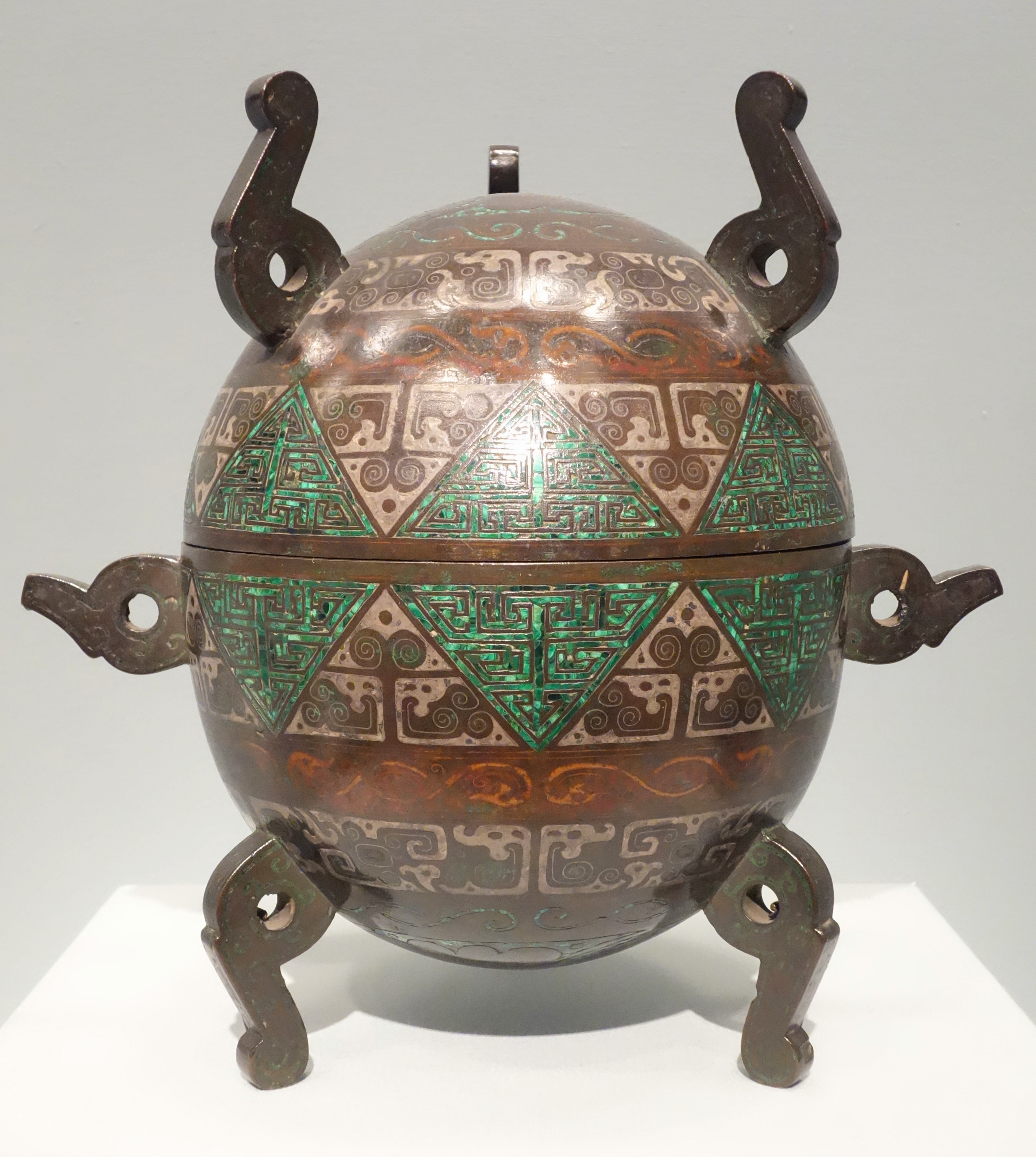
Tomb of Fu Hao
She led armies, performed ritual sacrifices, and collected antiques. When Fu Hao died sometime around 1200 BCE, she was buried with 468 bronze objects, 755 pieces of jade, 6,900 cowry shells, and enough weapons to equip a small platoon. Her tomb, discovered in 1976 at the Shang dynasty capital of Yinxu near Anyang, is the only royal burial from the Shang period found intact and unlooted, a time capsule from a civilization that existed a thousand years before the Roman Republic.
The Woman on the Oracle Bones
Fu Hao is not a figure rescued from anonymity by archaeology alone. Her name appears repeatedly in the oracle bone inscriptions found at Yinxu, the divination records of the Shang kings. The bones identify her as a consort of King Wu Ding, one of the most powerful Shang rulers, but she was far more than a royal spouse. Oracle bone inscriptions describe her leading military campaigns with armies numbering in the thousands, commanding troops against rival states and hostile peoples on the Shang frontiers. She also performed ritual divinations and led sacrificial ceremonies, roles that placed her at the intersection of military, religious, and political authority in a way that was exceptional even by the standards of the Shang court.
A Shovel and Red Lacquer
In 1976, archaeologist Zheng Zhenxiang and her team were probing the ground around Yinxu with a Luoyang shovel, a specialized tool used in Chinese archaeology to extract soil samples from depth. When the shovel brought up traces of red lacquer, they knew they had found something significant. The burial pit, officially designated tomb M5, lay just outside the main royal cemetery. It was smaller than the great royal tombs, but unlike every other Shang royal burial ever found, it had never been robbed. The wooden chamber and lacquered coffin had rotted away over three millennia, but the contents remained where they had been placed more than three thousand years earlier.
A Treasury Underground
The inventory of Fu Hao's tomb reads like a museum catalog. Among the 468 bronze objects were over 200 ritual vessels, 130 weapons, 23 bells, 27 knives, 4 mirrors, and 4 tiger statues. The 755 jade artifacts included pieces from the Longshan, Liangzhu, Hongshan, and Shijiahe cultures, objects that were already ancient when Fu Hao acquired them, suggesting she was a deliberate collector of antiques. There were 564 bone objects, including 500 hairpins and 20 arrowheads. Five ivory objects and 63 stone objects rounded out the collection, along with 6,900 cowry shells that served as currency during the Shang dynasty. The sheer volume of goods confirmed Fu Hao's exceptional status.
The Cost of Royal Death
Beneath the floor of the burial chamber, a small pit held the remains of six sacrificial dogs. Along the edges of the tomb lay the skeletons of sixteen people, identified as enslaved individuals killed to accompany their mistress into the afterlife. Human sacrifice was a systematic practice in Shang royal burials, with larger tombs containing hundreds of victims. Fu Hao's tomb, one of the smaller royal burials, contained a proportionally modest number, but the presence of those sixteen bodies is a reminder that the extraordinary artistic achievements of the Shang dynasty coexisted with practices of profound cruelty. The people buried alongside Fu Hao had lives, families, and identities that the archaeological record cannot recover but that their deaths demand we acknowledge.
From the Air
The Tomb of Fu Hao is located at approximately 36.12°N, 114.32°E within the Yinxu archaeological site on the northwest side of Anyang, Henan Province. The site is now a museum and protected area along the Huan River. From altitude, look for the museum complex and gardens in the northwest urban area of Anyang. Nearest airport is Anyang Airport (ZHAY). Zhengzhou Xinzheng International (ZHCC/CGO) is the nearest major hub, approximately 180 km south. The terrain is flat North China Plain.