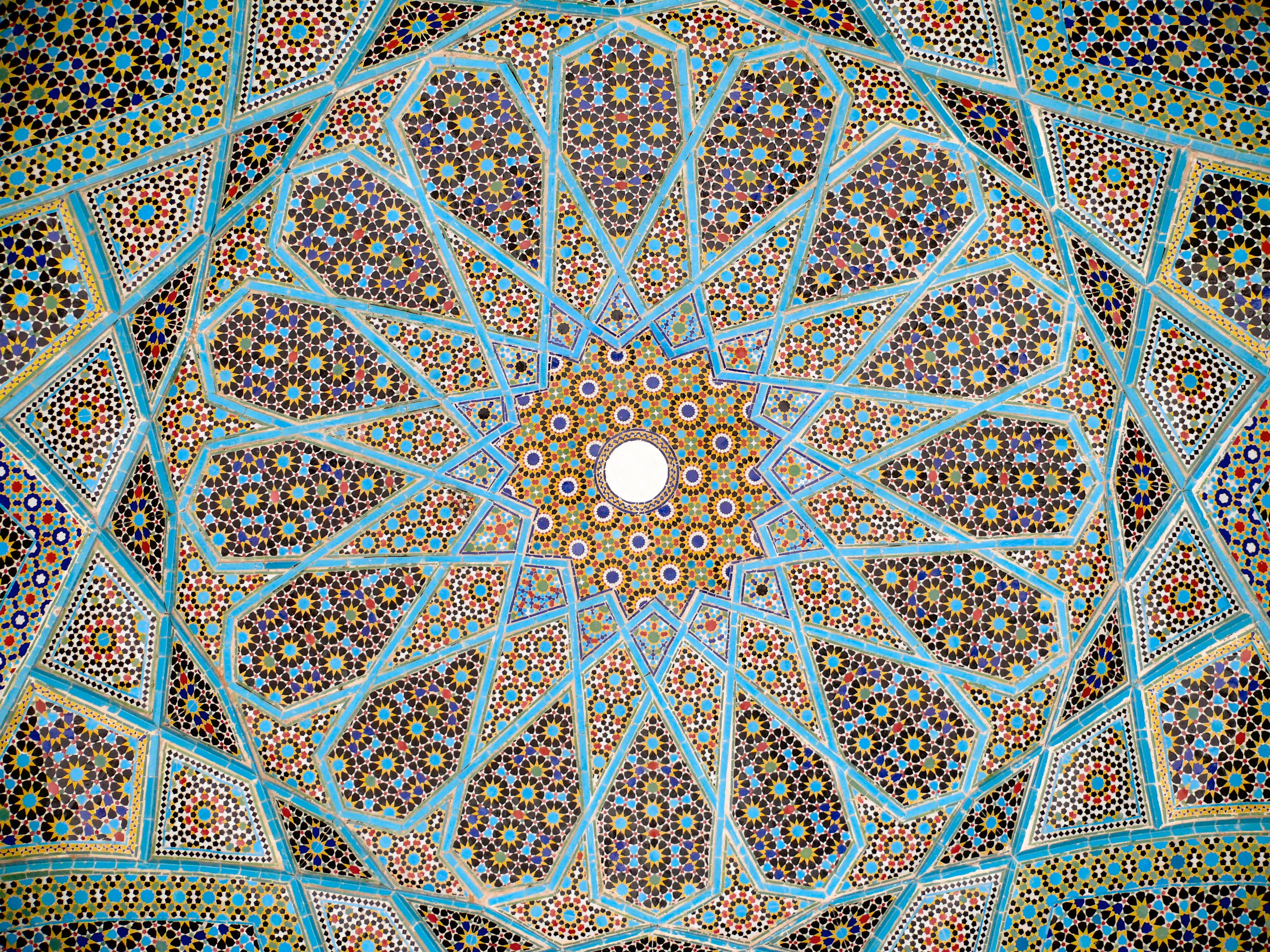
Tomb of Hafez
Every night in Shiraz, someone opens a book and asks a dead poet for advice. They hold the Divan of Hafez, close their eyes, let the pages fall open, and read whatever verse appears. This is fal-e Hafez -- divination by poetry -- and the practice has continued without interruption since the fourteenth century. The poet who inspires it lies beneath a marble slab in the Musalla Gardens on the northern edge of the city, sheltered by a copper dome shaped like the hat of a wandering dervish. The Tomb of Hafez, known to Iranians simply as Hafezieh, is not a mausoleum in the conventional sense. It is a conversation that never ends.
The Poet Who Memorized Everything
Hafez was born in Shiraz around 1315. His chosen pen name means "one who has memorized the Quran," and by most accounts he had done exactly that, mastering the sacred text while still young. He spent his entire life in the city, rising to the position of court poet and composing the ghazals -- lyric poems of love, wine, and mystical longing -- that would make him the most quoted poet in the Persian language. His collected works, the Divan, contains roughly five hundred ghazals. Goethe called him a master. Emerson tried to translate him. But the deepest measure of his influence is domestic: a copy of the Divan sits in nearly every Iranian household, consulted at weddings, during Nowruz celebrations, and on Yalda Night, the winter solstice, when families gather and let Hafez speak to whatever uncertainty they carry.
Seven Centuries of Rebuilding
Hafez died in 1390 and was buried in what was then a garden on the north bank of a seasonal river. The first formal memorial structure appeared in 1452, built by the governor of Fars. Subsequent rulers enlarged and altered the site. The best-known pre-modern tomb was constructed in 1773 during the Zand dynasty, when Karim Khan Zand -- who made Shiraz his capital -- honored the poet with a structure befitting the city's most beloved resident. By the early twentieth century, that structure had deteriorated. In 1935, the French architect and archaeologist Andre Godard was commissioned to design a replacement. Godard, who lived in Iran for roughly thirty-two years and served as technical director of the Department of Antiquities, drew on Zand-era architectural principles while creating something distinctly modern: an open pavilion that let the garden pour into the memorial space.
Eight Gates of Paradise
Godard's design carries symbolic weight in every proportion. Eight columns, each ten meters tall, support the copper dome -- and the number is deliberate. In Islamic tradition, paradise has eight gates, and the eight columns and eight openings of the pavilion map that cosmology onto architecture. The dome itself takes the form of a dervish's hat, linking Hafez to the Sufi mystical tradition that infuses his poetry. Beneath the dome, the underside reveals an arabesque mosaic in vivid color, a ceiling that rewards the upward gaze. The marble tombstone at the center sits elevated one meter above ground level, encircled by five steps. Visitors run their hands across the cool stone, murmur verses, and leave. The open design means that wind, birdsong, and the rustle of the Musalla Gardens' cypress trees are always part of the experience. Godard understood that enclosing Hafez would have contradicted everything his poetry stood for.
The Living Ritual
Hafezieh is one of the most visited sites in Iran, but the atmosphere is closer to a public park than a shrine. Families spread picnic blankets on the garden grass. Students sit on benches reading. Couples walk the pathways between orange trees and reflecting pools. At the tomb itself, the ritual is personal and unhurried. A visitor opens the Divan, reads a verse aloud or silently, and interprets its meaning for their own circumstances. There is no priest, no intermediary, no prescribed format. Hafez, who spent his life skewering religious hypocrisy and celebrating direct experience, would likely approve. During Nowruz, the Persian new year, and on the anniversary of Hafez's death, the gardens fill to capacity. But the ordinary Tuesday evening visit -- a grandmother reading to a grandchild, a student seeking courage before an exam -- captures the site's real purpose. Hafezieh exists not to memorialize Hafez but to keep him speaking.
From the Air
Located at 29.626N, 52.558E on the northern edge of Shiraz, Iran. The Hafezieh complex and Musalla Gardens are visible as a green area along the north bank of a seasonal river channel. Shiraz Shahid Dastgheib International Airport (OISS) lies approximately 10 km to the south-southwest. The site sits at roughly 1,500 meters elevation in the Zagros Mountain valley. The Tomb of Saadi, Shiraz's other great poet memorial, is located approximately 2 km to the east, providing a useful paired reference for navigation.