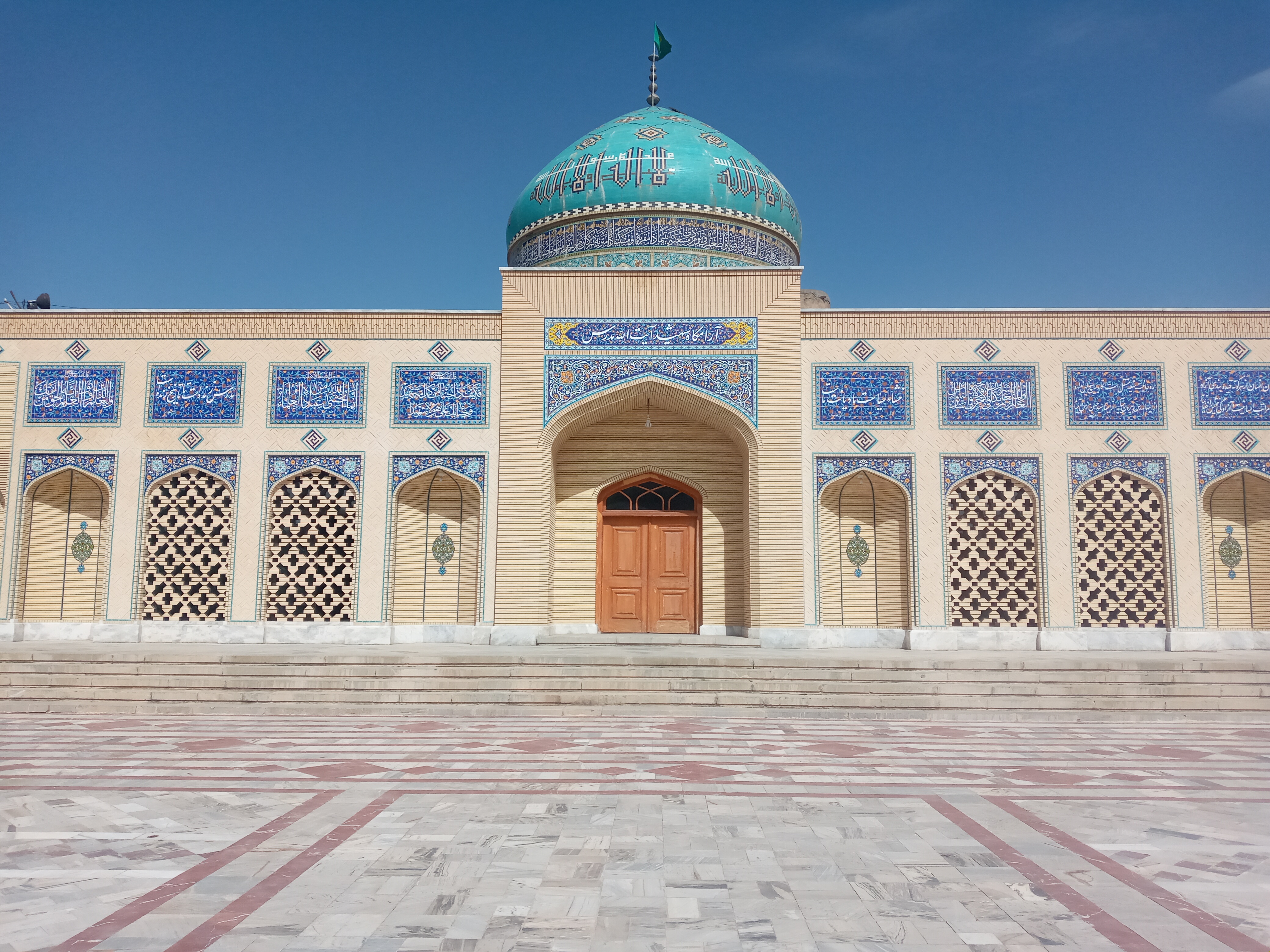
Tomb of Hassan Modarres
The man buried beneath the turquoise dome in Kashmar was killed for saying no. Sayyid Hassan Modarres, a Twelver Shi'ite cleric who served as a representative in Iran's National Consultative Assembly (Majlis), spent his political career defending constitutional government against the consolidating power of Reza Shah Pahlavi. He was exiled, survived an assassination attempt in 1926, and was banished to the remote city of Kashmar in eastern Iran. There, on December 1, 1937, agents of the Shah poisoned him and then suffocated him during prayer. He was sixty-seven years old. The mausoleum that now stands over his grave tells a story of how a dead man's cause can outlast the regime that killed him.
The Cleric Who Fought a King
Hassan Modarres entered politics not to accumulate power but to check it. Born around 1870, he rose through the ranks of Shi'ite religious scholarship before serving in Iran's parliament, where he became known as perhaps the most fervent clerical supporter of true constitutional government. While Reza Khan maneuvered to transform the republic into a monarchy -- crowning himself Reza Shah Pahlavi in 1925 -- Modarres led the parliamentary minority that opposed him. He challenged the Shah's reliance on foreign powers and his erosion of democratic institutions. This was not abstract dissent. Modarres was exposing what he called the Shah's deceptive republicanism, and he did it openly, on the record, knowing the risks. The response came swiftly: a failed assassination attempt in November 1926, followed by expulsion, first to Khaf and then to Kashmar.
Death in Exile
Kashmar sits in Iran's Razavi Khorasan Province, far enough from Tehran to silence a dissident in the days before mass media. Modarres spent his final years there under effective house arrest. On December 1, 1937, the Shah's agents came for him. They poisoned him first, then, when the poison did not finish the job quickly enough, they strangled him while he was at prayer. The murder was meant to be quiet, a problem solved in a distant province. Instead, it made Modarres a martyr. His death anniversary, the 10th of Azar in the Iranian calendar, is now observed as Majlis Day -- the Day of Parliament -- a national recognition that the ideas Modarres defended proved more durable than the dynasty that silenced him.
A Dome Built in Defiance
The mausoleum did not appear immediately. After Reza Shah was forced to abdicate in 1941 during the Anglo-Soviet invasion of Iran, the people of Kashmar erected a new tombstone over Modarres's grave in an act of quiet honor. By 1943, a building had risen over the site. Following the 1979 Iranian Revolution, Supreme Leader Ruhollah Khomeini ordered an extensive restoration, transforming the modest structure into the building that stands today. The present mausoleum is designed in the Safavid architectural style, with four iwans -- one on each side -- and a large turquoise dome that marks the site from a distance. A wooden zarih encloses the grave directly beneath the dome. Beside the mausoleum sits the library of Hassan Modarres. The complex was added to the Iran National Heritage List on March 14, 2005.
Martyr and Monument
What makes the Tomb of Hassan Modarres unusual among Iran's many mausoleums is the way it bridges religious and political memory. Modarres was both a cleric and a constitutionalist, a man who believed that Islamic scholarship and democratic governance were not in conflict but mutually necessary. His tomb draws visitors who come for different reasons -- some for religious devotion, some for political inspiration, some simply to stand in a place where principle cost a man his life. The garden that once surrounded the original small building has been absorbed by expansions and reconstructions, but the core of the site remains the same: a grave, a dome, and the memory of a man who chose opposition over survival. In the arid landscape of eastern Khorasan, where the wind carries dust from the Afghan border, that memory persists.
From the Air
Located at 35.23°N, 58.45°E in Kashmar, Razavi Khorasan Province, Iran. The turquoise dome of the mausoleum is a visible landmark within the city. The nearest airfield is Kashmar (OIMQ), a small facility. Mashhad International Airport (OIMM), the major regional hub, lies approximately 200 km to the northeast. The terrain is arid with good visibility in most conditions. Kashmar sits in a valley surrounded by low mountains, making it identifiable from moderate altitude.