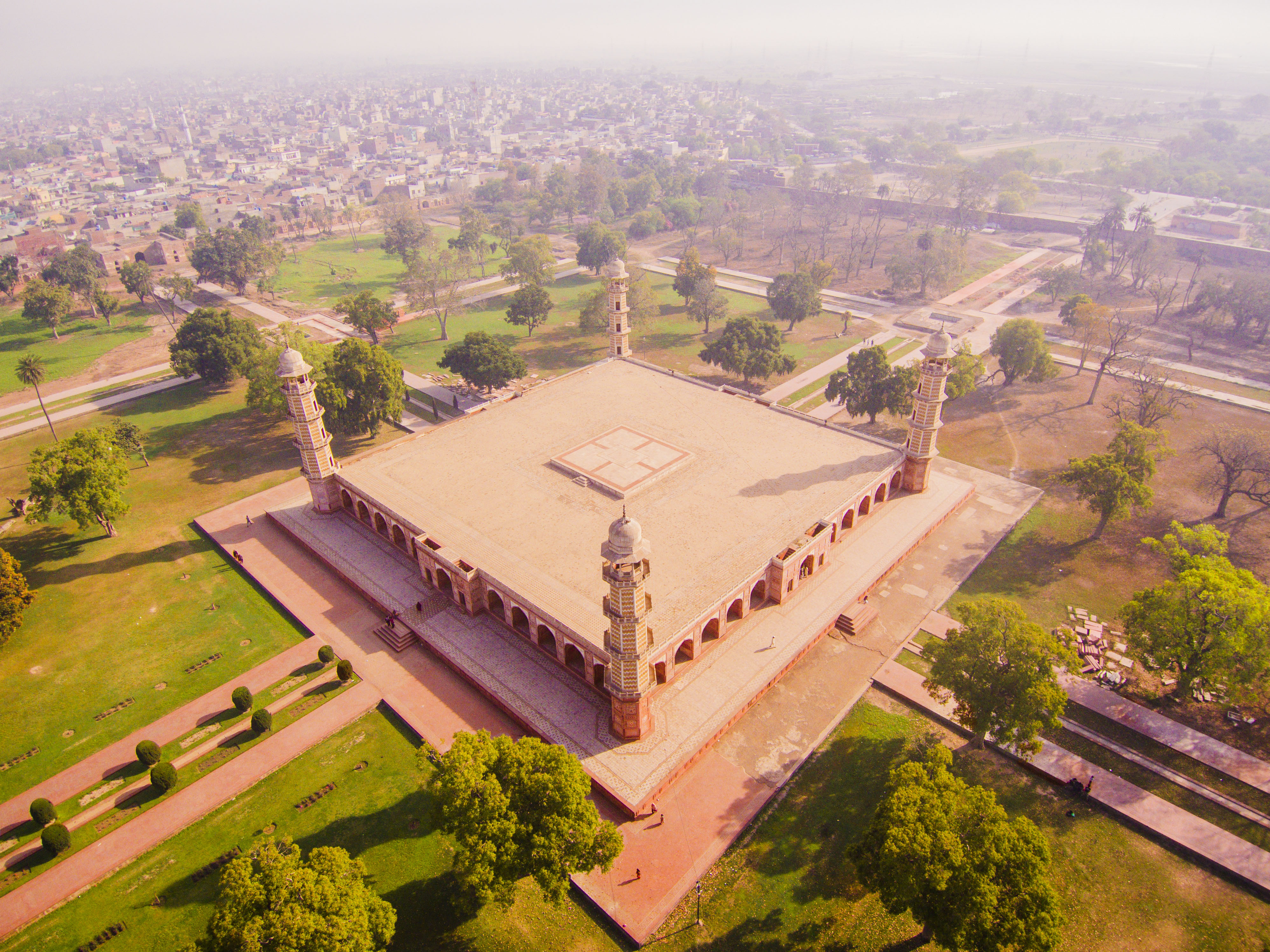
Tomb of Jahangir
Most Mughal emperors were buried under domes. Jahangir was not. Whether this was his own instruction -- he reportedly forbade the construction of a dome over his grave -- or simply the choice of his son Shah Jahan, who ordered the mausoleum built, the result is startling. Where the Taj Mahal soars, Jahangir's tomb spreads: a low, square platform with four towering minarets at its corners, the roof flat and open to the sky, decorated only with mosaic tilework. The effect is less a monument to death than a throne set upon the earth. The Mughal word for this form is takhtgah -- a mausoleum built upon a podium that serves as a takht, a throne. Completed in 1637, a decade after the emperor's death, the tomb stands in Shahdara Bagh on the western bank of the Ravi River in Lahore, surrounded by what remains of the pleasure garden Jahangir loved in life.
A Funeral Procession Across the Mountains
Jahangir ruled the Mughal Empire for 22 years, from 1605 to 1627. He died in the foothills of Kashmir near the town of Rajauri on 28 October 1627, far from his capital. A funeral procession carried his body across the mountains, arriving in Lahore on 12 November 1627 -- a two-week journey through some of the most difficult terrain in the subcontinent. He was buried in the Dilkusha Garden, a pleasure ground he had loved during his years in Lahore. The garden had been laid out decades earlier, in 1557, and Jahangir had spent many hours there. His son Shah Jahan, who had just become emperor amid the usual Mughal succession struggles, ordered that a mausoleum befitting an emperor should be built to honor his father. The construction took a decade. By 1637, the tomb and its surrounding complex -- including the Akbari Sarai caravanserai and flanked by the later Tomb of Asif Khan -- formed an ensemble oriented on an east-west axis, a miniature city of the dead on the river's far bank.
Red Sandstone and Rising Minarets
The mausoleum's design bridges two eras of Mughal architecture. Its vaulted bays reflect Timurid styles from Central Asia, the inheritance of the dynasty's origins in Samarkand and Kabul. The facade of red sandstone inlaid with white marble motifs, however, points forward to the decorative intensity Shah Jahan would perfect at the Taj Mahal. The square-shaped structure rises 22 feet as a single-story plinth, arcades lining all four sides. At each corner, a minaret climbs 100 feet into the air, divided into three sections and capped with white marble cupolas. The minarets give the tomb its vertical drama -- without a dome, they are the only elements that reach skyward, and from a distance they frame the empty roof like sentinels guarding an open courtyard. The surrounding garden follows the classic charbagh plan: four squares divided by paved walkways and bisecting water channels representing the four rivers of jannat, the Islamic paradise. Each square subdivides further into four more, creating 16 garden plots within a quadrangle measuring roughly 500 meters on each side.
Plunder and Persistence
The tomb did not survive the centuries unscathed. When the Sikh Empire conquered the Punjab, Ranjit Singh stripped precious materials from the mausoleum. Building materials were taken to decorate the Golden Temple in Amritsar -- an act of cultural appropriation that repurposed Mughal splendor for Sikh sacred architecture. The pillaged grounds became a private residence for one of Ranjit Singh's officers, a European mercenary known as Senor Oms or Musa Sahib. When Musa Sahib died of cholera in 1828, Ranjit Singh ordered him buried on the tomb's grounds, a further desecration of the imperial space. Then came the floods. The Ravi River has threatened or damaged the site at least fourteen times since 1867, with major events in 1947, 1988, and 2010. Each flood deposited silt, eroded foundations, and tested the structural integrity of a building designed for permanence but built beside an unpredictable river.
What the Interior Remembers
Step inside and the mood shifts completely. The flat, austere exterior gives way to vaulted compartments richly embellished with Mughal buon fresco -- painted plaster in deep reds, blues, and golds depicting floral arabesques and geometric patterns. Carved jali screens filter daylight into shifting geometric shapes on the floor, each screen oriented toward Mecca. At the center lies an octagonal chamber lined with carved marble. Below the cenotaph, in a crypt, rest the actual remains of the emperor. The white marble cenotaph itself is inlaid with pietra dura in vegetal patterns -- the same technique of semi-precious stone inlay that Shah Jahan would later use to devastating effect at the Taj Mahal. The tomb was important enough to appear on Pakistan's 1000-rupee banknote until 2005, and a postage stamp commemorated it as early as 1954. Today the complex, along with the adjacent Akbari Sarai and the Tomb of Asif Khan, sits on UNESCO's tentative list for World Heritage status -- recognized, but still awaiting full inscription.
From the Air
The Tomb of Jahangir (31.62N, 74.30E) is located in Shahdara Bagh on the western bank of the Ravi River, northwest of Lahore's Walled City. From altitude, the square mausoleum with its four corner minarets is distinctive against the surrounding garden quadrangle. The adjacent Akbari Sarai and Tomb of Asif Khan extend the complex to the west. The Ravi River runs immediately to the east. Nearest airport: Allama Iqbal International Airport (OPLA/LHE), approximately 16km south, with runways 36L/18R and 36R/18L. Lahore Fort and the Badshahi Mosque are roughly 5km southeast across the river. Flat terrain; monsoon season (July-September) brings flood risk to the riverside site.