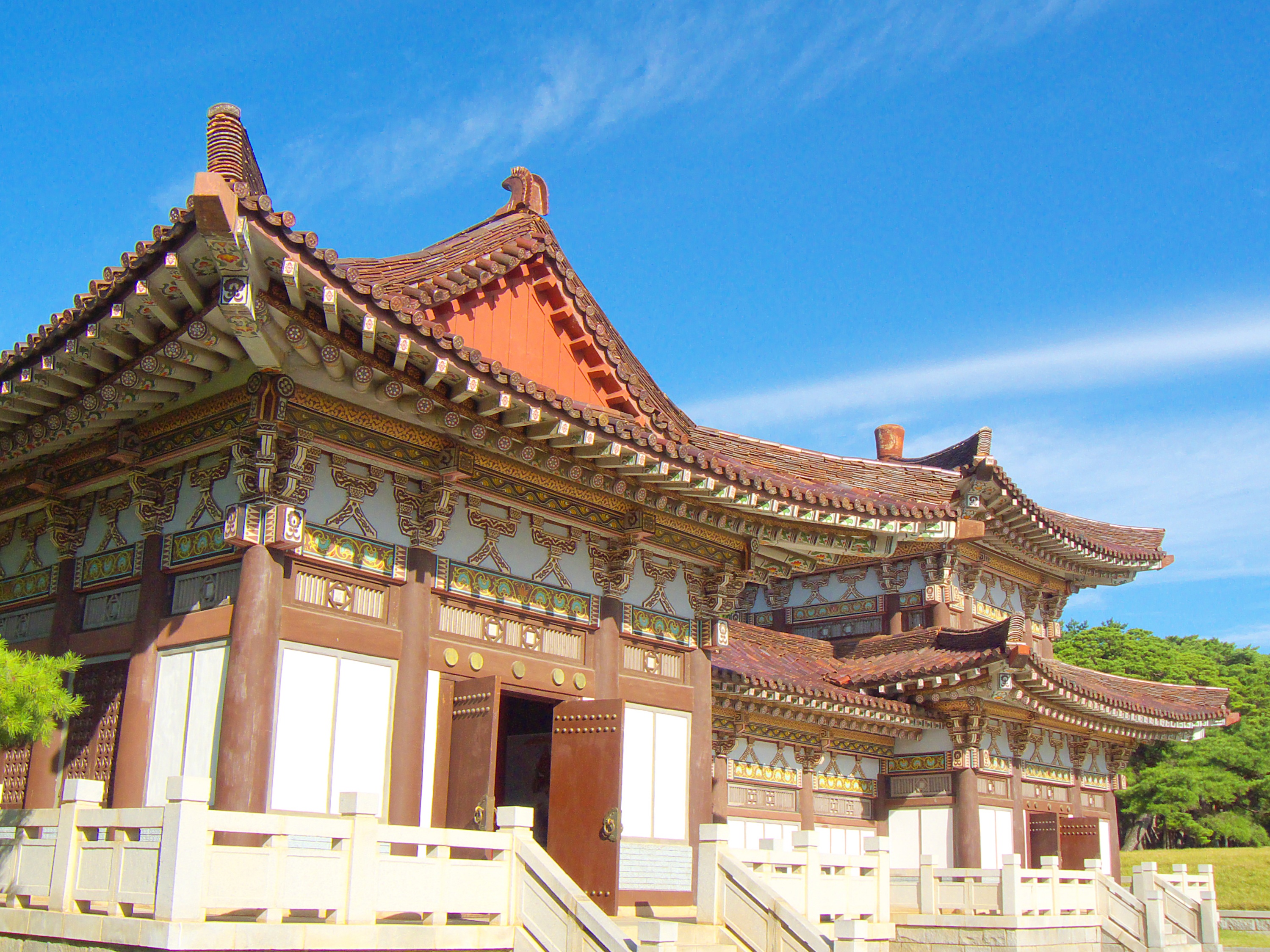
Tomb of King Tongmyong
In the early 1970s, Kim Jong Il reportedly identified "a major shortcoming of North Korean archaeology" -- the country's archaeologists had failed to locate the tomb of King Tongmyong, the legendary founder of the Goguryeo Kingdom. By 1974, they had produced one. Whether the tomb in Ryokpo-guyok, on the outskirts of Pyongyang, actually holds the remains of Jumong -- the warrior-king who founded Goguryeo around 37 BC and ruled until 19 BC -- remains an open question. What is certain is that this site, now a UNESCO World Heritage property, sits at the intersection of ancient Korean burial art and modern political mythology, a place where twenty centuries of history are filtered through the priorities of the present.
A Kingdom's Founding Myth
Goguryeo was the northernmost of the Three Kingdoms of Korea, a domain that stretched across much of Manchuria and the northern Korean peninsula from 37 BC to 668 AD. Its founder, Jumong, was given the posthumous name Dongmyeong -- King of the Eastern Light. When King Jangsu transferred the Goguryeo capital from the Hwando Mountain Fortress to Pyongyang in 427 AD, the royal burial grounds followed. The complex that grew around Dongmyeong's tomb eventually encompassed 63 individual tombs across five zones, their construction spanning the 5th and 6th centuries. Fifteen of the surrounding tombs are believed to belong to vassal lords, creating a necropolis that mirrors in death the hierarchies of the living court.
Lotuses in the Dark
What makes these tombs extraordinary are the paintings inside them. Where Chinese tombs of the same era typically feature the four celestial animals representing the constellations, the Goguryeo murals depict blossoming lotuses and Buddhist themes -- evidence of a faith that had traveled from India through China and taken distinctive root in Korea. The frescoes render daily life in vivid, almost three-dimensional form: women dancing, warriors in training, dragons coiling through cloud-filled skies, fish swimming in painted rivers. The richness of color has survived centuries underground. These are not merely decorative. Inscriptions at the site confirm that the tomb complex served as a sacred space for festival rites, combining the worship of the earth -- a South Asian tradition -- with shamanistic livestock ceremonies drawn from the steppes. Buddhism, shamanism, and ancestor veneration layered on top of one another in a single burial chamber.
Resurrection in White Marble
The tomb that visitors see today bears little resemblance to what archaeologists first documented. Originally catalogued as "Jinpari Tomb No. 10," it was one of many authentic Goguryeo burial sites in the area, but no evidence beyond state assertion connects it to Dongmyeong specifically. The 1980s "restoration" was thorough to the point of replacement: all original buildings, structures, and monuments were removed to make way for a new complex of white marble. Kim Il Sung personally attended the opening ceremony on May 14, 1993, and wrote the calligraphy on the stele erected at the entrance. The 11.5-meter-high tumulus, bordered at its base with stone blocks and measuring 34 meters on each side, contains a 22-square-meter pyramidal inner chamber, a front chamber, and a stone gallery. In 2002, the tomb appeared on commemorative 10-won coins -- small pieces of metal carrying a very large claim about national origins.
Temple and Legacy
Adjacent to the tomb stands the rebuilt Chongrungsa Buddhist temple, where funeral services were historically conducted for the deceased monarch. Its foundations, excavated in 1974, were reconstructed to mark what North Korea calculates as the 2,300th anniversary of Tongmyong's birth. A nearby monastery, discovered in 1978 about 120 meters from the tomb, preserves inscriptions naming King Changsu as chief monk -- a ruler who was also the spiritual custodian of his ancestor's grave. The monastery's three halls surrounding a central pagoda bear a striking resemblance to Japanese temple architecture of later centuries, suggesting that Goguryeo's Buddhist culture radiated outward across the sea. UNESCO inscribed the Complex of Goguryeo Tombs as a World Heritage Site in 2004, recognizing 233 hectares of burial grounds and a 1,701-hectare buffer zone. The designation acknowledges the artistic and architectural achievement of the original tombs, even as the modern reconstruction surrounding Dongmyeong's alleged resting place remains a monument to a different kind of ambition entirely.
From the Air
Located at 38.90N, 125.92E in Ryokpo-guyok district, on the outskirts of Pyongyang, North Korea. The white marble tomb complex is visible from moderate altitude against the surrounding green landscape. Nearest airport is Pyongyang Sunan International Airport (ZKPY), approximately 25 km to the northwest. The Chongrungsa Buddhist temple adjacent to the tomb provides an additional visual reference point. Recommended viewing altitude: 2,000-4,000 feet.