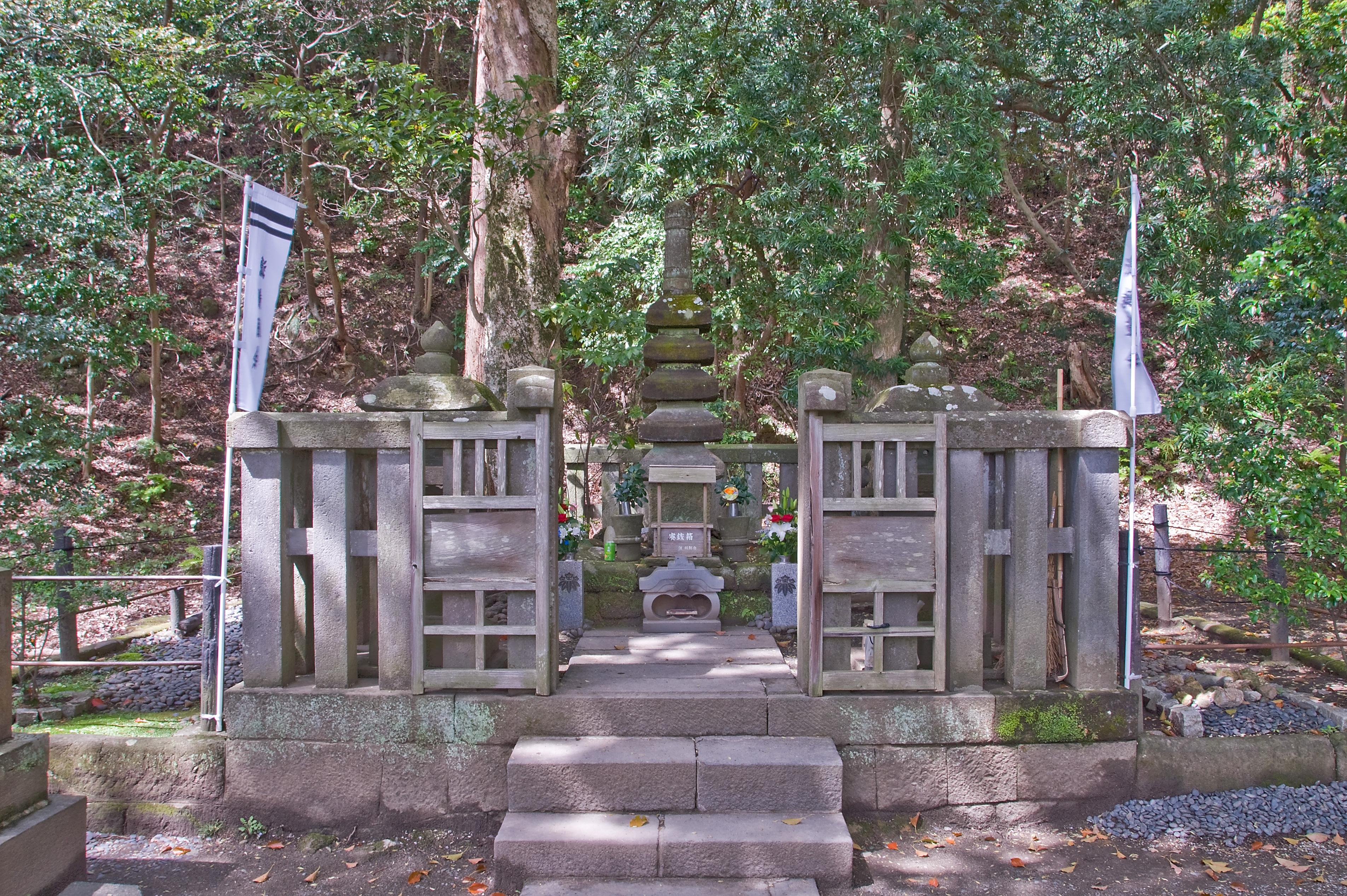
Tomb of Minamoto no Yoritomo: The Shogun's Uncertain Rest
Nobody knows where Minamoto no Yoritomo's bones actually lie. The man who founded Japan's first military government, who chose Kamakura as his capital because its hills formed a natural fortress, who reshaped Japanese politics for seven centuries to come -- he fell from his horse on February 8, 1199, and died. His followers buried him in a Buddhist temple called the Hokke-do, on a hillside just north of the Okura Bakufu, the palace from which he had governed all of Japan. The stone monument that marks his grave today is a 186-centimeter gorintou -- a five-ringed Buddhist stupa -- surrounded by a stone tamagaki fence. It was built during the Edo period, somewhere between 1603 and 1868, more than four hundred years after the shogun's death. There is no evidence that his remains rest beneath it. Yet every April 13, during the Kamakura Matsuri, mourners gather before this cenotaph to honor the man who made this city the center of the world.
The Rise and Fall of a Warlord
Yoritomo's path to power began in exile and ended in a saddle. After his Minamoto clan was defeated by the Taira in the Heiji Rebellion of 1160, the teenage Yoritomo was banished to Izu Province. He spent twenty years in political obscurity before rallying forces in 1180 to launch the Genpei War against the Taira. By 1185, his armies had destroyed the Taira completely. He established the Kamakura shogunate -- Japan's first military government -- choosing this coastal valley for its defensive geography: hills on three sides, the sea on the fourth, and only seven narrow mountain passes for entry. The shogunate he built would last until 1333, and the system of military government he pioneered would define Japan until the Meiji Restoration in 1868. Then, on a winter day in 1199, while riding near the Sagami River, his horse stumbled. He never recovered.
Blood in the Funerary Hall
The Hokke-do where Yoritomo was buried quickly became a stage for the violence that defined Kamakura politics. In June 1217, when the warlord Wada Yoshimori rebelled against the Hojo regents and set the Okura Bakufu on fire, Shogun Minamoto no Sanetomo -- Yoritomo's own son -- fled to the Hokke-do for refuge. Three decades later, in August 1247, the site witnessed something far worse. Miura Yasumura, besieged by Hojo forces, barricaded himself inside the funerary hall. When defeat became certain, he gathered 500 members of his clan and led them in mass suicide. Contemporary accounts describe the ground dyed red and black with their blood. The funerary hall where a shogun was meant to rest in peace had become a place of desperate last stands and clan annihilation. The spot where the Hokke-do once stood is now marked by a stele and designated a national Historic Site.
Carved Into the Hillside
A steep stairway cut into the rock a few meters from Yoritomo's monument leads upward to three more graves, each carved into the limestone hillside. Here lie Shimazu Tadahisa, Oe no Hiromoto, and Mori Suemitsu -- men whose lives were bound to the shogunate Yoritomo created. Oe no Hiromoto served as the shogunate's chief vassal, a court noble who helped build and consolidate the military government's administrative machinery. Shimazu Tadahisa, reportedly Yoritomo's illegitimate son, was appointed governor of Satsuma province in Kyushu and founded the Shimazu clan -- a family that would control Satsuma until the Meiji Restoration in the 19th century. His tomb was erected here in 1779 by his descendant Shigehide. These graves, side by side on the hillside, are still regularly tended. Even Mori Suemitsu's descendants, the powerful Mori clan of western Japan, maintained this connection across centuries.
The Caves of the Dead
Below the stairway to these hilltop graves, barely visible at the base of the twin flights of steps, sits a small yagura -- a cave carved into the soft limestone that characterizes the hills around Kamakura. During the Kamakura period, for reasons that remain unclear to historians, warriors, priests, and sometimes even commoners were buried in these cave tombs. Some yagura contain gorintou, the same five-ringed stupas found at Yoritomo's monument, and served as cenotaphs -- memorials for souls rather than containers for remains. This particular yagura enshrines the spirits of the Miura clan members who perished in the mass suicide at the neighboring Hokke-do in 1247. Food offerings and small wooden sotoba still appear at its entrance. Someone tends it. Seven hundred and seventy years after 500 warriors chose death over surrender, their memorial cave still receives visitors, still holds offerings, still keeps faith with the dead in a practice unique to this place.
From the Air
Located at 35.33°N, 139.56°E in the Nikaidou area of Kamakura, on a forested hillside north of where the Okura Bakufu palace once stood. The tomb site is not individually visible from altitude but sits within the broader temple and residential district east of Tsurugaoka Hachimangu shrine. Best viewed at 2,000-3,000 feet AGL as part of Kamakura's historic core. Tokyo Haneda Airport (RJTT) lies approximately 25 nautical miles northeast. Naval Air Facility Atsugi (RJTA) is roughly 15 nautical miles northwest. Sagami Bay is visible to the south.