Tomb of Saadi: Where Poetry Became Prayer
"Human beings are members of a whole, in creation of one essence and soul." These words, written in 13th-century Shiraz by the poet Saadi, now hang on a carpet in the United Nations headquarters in New York. The man who wrote them lies beneath an azure dome in a garden on the eastern edge of the city where he was born, traveled from for thirty years, and returned to die. The Tomb of Saadi -- known locally as Saadieh -- is not simply a monument to a poet. It is a place where Iranians come to touch the marble that covers a man whose verses they can still recite from memory, eight centuries after he wrote them.
The Wanderer Returns
Saadi was born Abu Mohammad Moshrefoldin in Shiraz around 1210. He lost his father young and studied in Baghdad at the renowned Nezamiyeh College before the Mongol invasions sent him wandering through Syria, Egypt, Anatolia, and Iraq for nearly three decades. He returned to Shiraz around 1257 as a man who had seen the world's cruelty and beauty in equal measure. In quick succession he produced his two masterworks: the Bustan (The Orchard) in 1257 and the Gulistan (The Rose Garden) in 1258. These books blended poetry, moral tales, and sharp observation of human nature into a form that would influence Persian literature for centuries. The Gulistan has been ranked among the hundred greatest books ever written. Saadi died around 1291, and was buried at a khanqah -- a Sufi lodge -- on the spot where his tomb stands today.
Seven Centuries of Shelter
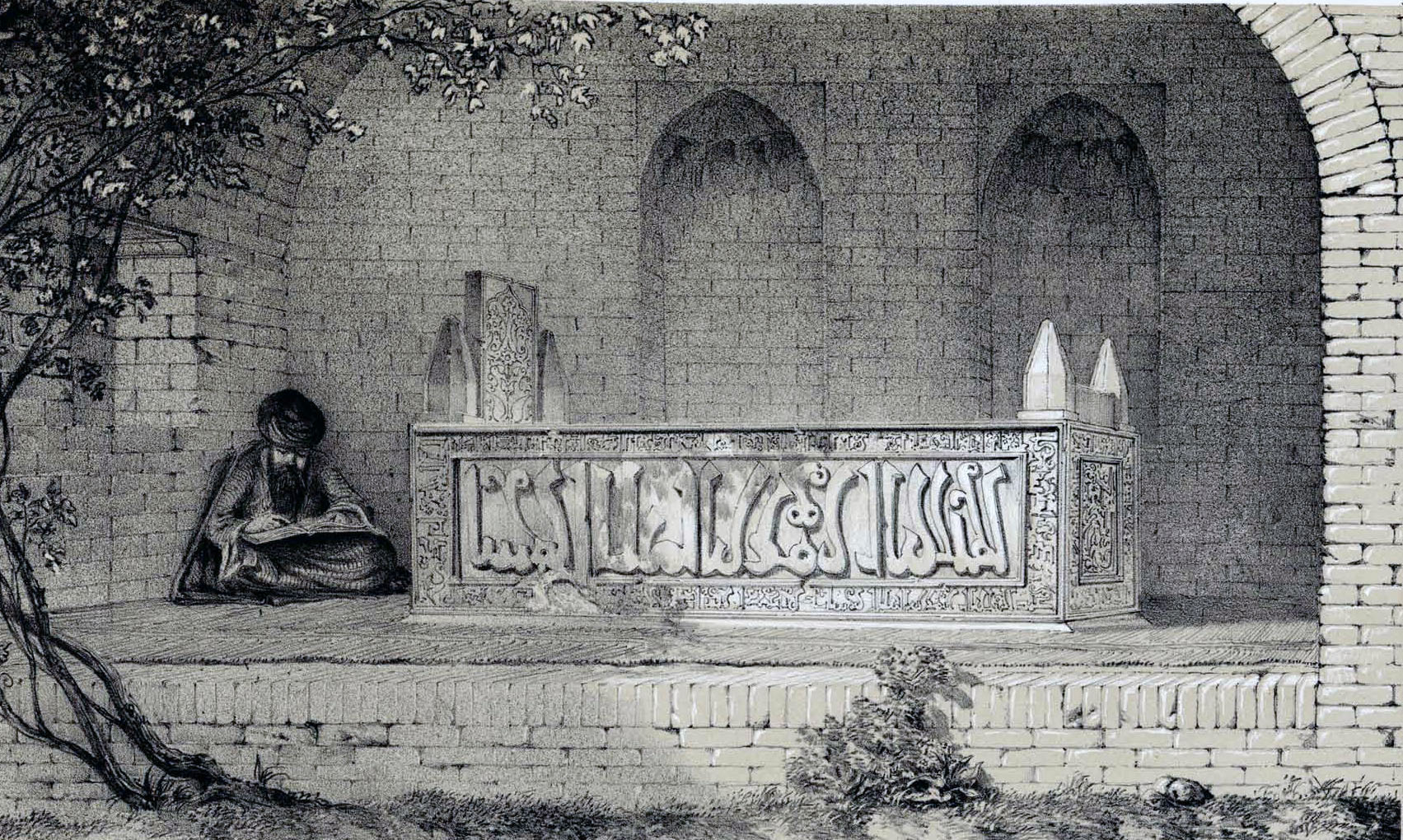
The tomb Saadi's admirers built did not last. In the 13th century, Shams al-Din Juvayni, the vizier of the Mongol ruler Abaqa Khan, constructed the first formal tomb over the burial site. By the 17th century, that structure had been destroyed. Karim Khan Zand, the ruler who made Shiraz his capital, built a replacement: a two-story mausoleum of brick and plaster flanked by two chambers. That too gave way. The building visitors see today was completed between 1950 and 1952, designed by the architect Mohsen Foroughi. He drew inspiration from the Chehel Sotoun palace in Isfahan, fusing classical Persian architecture with modern materials. Eight brown stone pillars frame the entrance. Inside, the cubic exterior opens into an octagonal chamber lined with marble, crowned by a dome of turquoise tiles. Seven of Saadi's verses adorn the walls.
Stone, Water, and Light
The building itself is a study in contrasts. Black stone forms the foundations. Red granite columns rise from them. Travertine sheathes the facade, and marble lines the interior. The effect is deliberate -- heavy earth below, luminous refinement above, the dome overhead seeming to float in its own blue atmosphere. An octagonal fish pond sits to the left of the tomb, its surface reflecting the turquoise arch above. At the front terrace, visitors toss coins into a second pool, continuing a tradition whose origins no one can pin down precisely. Roughly ten meters below the tomb, an ancient aqueduct runs through the earth, its water carrying traces of sulfur and quicksilver -- a subterranean presence that lends the site an almost alchemical quality, as though the ground itself were something more than ordinary dirt.
A Poet's Reach
Saadi's fame rests on the clarity of his moral vision. His most celebrated poem, Bani Adam, declares that all human beings are limbs of one body, created from a single essence, and that when one limb suffers, the others cannot remain at ease. The poem was suggested as a motto for the League of Nations in 1928. In 2005, it was woven into a large handmade carpet and installed in the United Nations building in New York. For Iranians, Saadi is not a historical curiosity but a living voice. Schoolchildren memorize his couplets. Families visit the tomb on holidays. The garden surrounding the Saadieh is a place for quiet walks, shared tea, and the particular pleasure of sitting where a great writer once sat and looking at the same mountains he watched while composing lines the world has never stopped reading.
From the Air
Located at 29.62°N, 52.58°E on the eastern edge of Shiraz, in the Fars province of Iran. The azure dome of the Saadieh is set within gardens visible from moderate altitude against the brown terrain of the Zagros foothills. Shiraz Shahid Dastgheib International Airport (OISS) lies approximately 10 km to the southeast. From altitude, the tomb complex appears as a green garden enclave amid the dense urban fabric of Shiraz's eastern districts. The city of Shiraz itself fills a broad valley between mountain ranges, its grid of streets and garden complexes distinguishing it from the arid terrain beyond.