Tomb of Safdar Jang
An inscription in Persian greets visitors at the gate: "When the hero of plain bravery departs from the transitory, may he become a resident of god's paradise." It is a generous epitaph for a man whose career ended in exile. Safdar Jang, born Mirza Muqim Abul Mansur Khan, was the second Nawab of Awadh and the prime minister of an empire that existed mostly on paper. By the time he held office in the 1750s, Mughal authority had shriveled to parts of northern India, and the man with the title Wazir ul-Mamlak-i-Hindustan -- Prime Minister of All India -- wielded more real power than the emperor he nominally served. His tomb, completed in 1754, was the last grand Mughal garden burial complex ever built. It marks an ending as clearly as a period at the close of a long sentence.
A Son's Petition
Safdar Jang's path to this tomb ran through political catastrophe. As Wazir under Emperor Ahmad Shah Bahadur, he had reduced the emperor to a figurehead. But his authoritarian style earned him powerful enemies. Rival nobles Imad-ul-Mulk and Najib-ud-Daulah organized a faction against him, and after a series of battles, Safdar Jang was forced out of Delhi in 1753. He retreated to Awadh, where he died the following year. His son, Nawab Shuja-ud-Daula, then made an unusual request: permission from the very Mughal emperor his father had diminished to build a tomb for his father in the imperial capital. Permission was granted. The tomb was designed by an Abyssinian architect named Bilal Muhammad Khan at a cost of approximately three lakh rupees. It was the first time someone outside the immediate Mughal imperial family had built themselves such a garden tomb complex -- a measure of how thoroughly the old hierarchies had dissolved.
Echoes of the Taj, Fading at the Edges
The tomb follows the template of Mughal masterpieces -- Humayun's Tomb, the Taj Mahal -- but with unmistakable signs of decline. At its center stands a mausoleum of red and buff sandstone measuring 28 meters square, topped by a central dome and surrounded by four polygonal towers with faded marble panels. The floor plan uses the classic hasht bihisht layout: eight rooms radiating around a central domed chamber, an arrangement meant to represent the eight paradises of Islamic tradition. A Char Bagh garden divides the grounds into four quadrants. But art historians have noted that the facade lacks the symmetry of its predecessors -- the vertical axis dominates at the expense of balance, producing what critics describe as an unbalanced appearance. Slabs recycled from the tomb of Abdul Rahim Khankhana were used in construction, a practical decision that carries melancholy overtones. The Mughals were building their last monument partly from the materials of earlier ones.
Hidden Chambers and Rococo Plaster
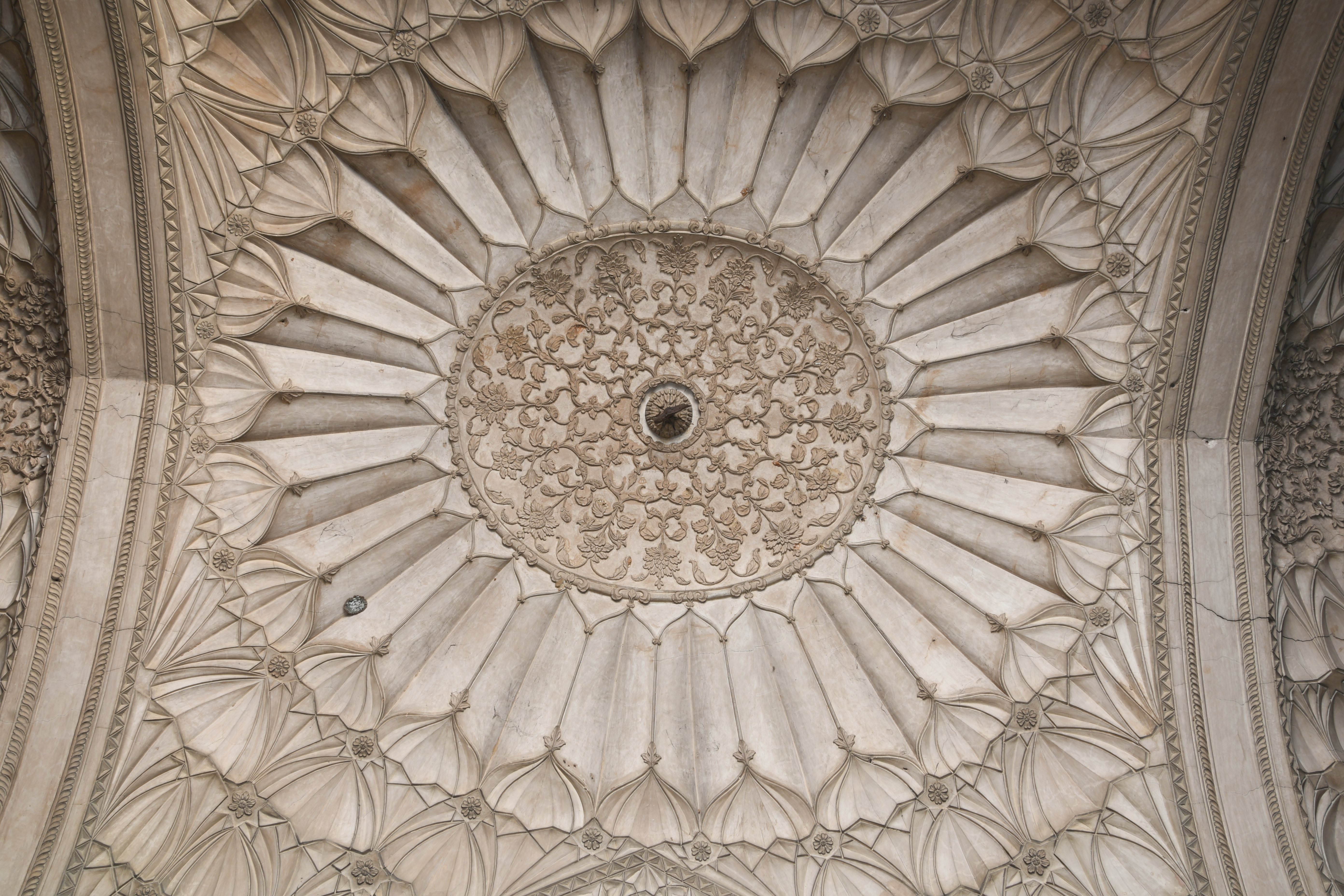
Step inside and the tomb reveals layers invisible from the garden. The central chamber houses a cenotaph, with rectangular and octagonal partitions creating an intricate geometric interior. The walls and ceiling are covered in rococo plasterwork -- an unexpected European influence decorating a Mughal tomb, evidence of the cosmopolitan cross-pollination that Delhi attracted even in its declining years. Below the main floor, an underground chamber holds the actual graves of Safdar Jang and his wife, accessible through a separate passage that remains mostly closed to visitors. The main gate is two-storied, with elaborate ornamentation over plastered surfaces in ornate purple. To the right stands a three-domed mosque marked with stripes. Four fountains once played on each side of the tomb; in 2013, the Archaeological Survey of India unearthed an original drainage system during excavation and announced plans to make at least one fountain functional again -- a small resurrection for a place built to honor the dead.
Between an Airport and an Intersection
The tomb stands at the T-junction of Lodi Road and Aurobindo Marg, near the former Safdarjung Airport -- a location that places the last Mughal garden tomb squarely in the traffic patterns of modern Delhi. The ground itself holds older violence: to the south lies the site where Timur defeated Sultan Mahmud Shah Tughluq in 1398, nearly four centuries before Safdar Jang's mausoleum rose here. In 2013, the Hollywood film Jobs used the tomb as a filming location, adding yet another layer to a place that keeps accumulating incongruous histories. In 2014, the ASI shifted its offices out of the monument and installed new visitor boards to promote what officials called 'the lesser known but striking monuments' of Delhi. The tomb of a man who commanded an empire for a few turbulent years, built in the style of the Taj Mahal but falling just short of its grace, remains one of those monuments -- lesser known, still striking, and quietly marking the end of an era.
From the Air
The Tomb of Safdar Jang is located at 28.5893N, 77.2106E in south-central New Delhi, at the prominent T-junction of Lodi Road and Aurobindo Marg. The domed sandstone mausoleum set within a green Char Bagh garden is a visible landmark from the air, especially given the adjacent Safdarjung Airport (VIDD) -- the old airfield immediately to the west is itself a recognizable feature. Lodi Gardens lie just to the northeast, and Humayun's Tomb is approximately 3.5 km to the east-southeast. Indira Gandhi International Airport (VIDP) is about 12 km to the southwest. Best viewed at 2,000-4,000 feet AGL; the dome, garden quadrants, and proximity to the airstrip make it easy to identify in clear conditions.