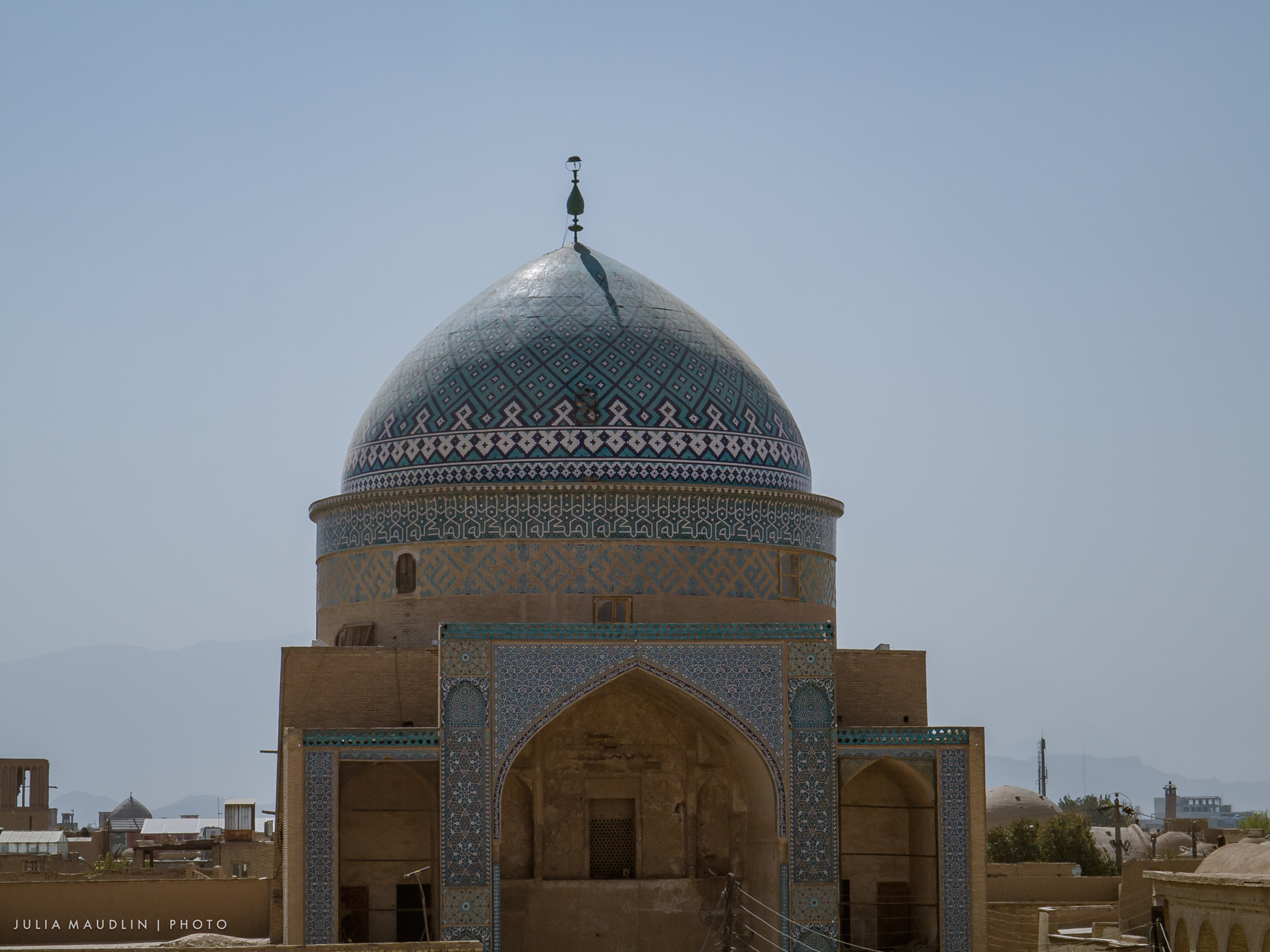
Tomb of Sayyed Rukn ad-Din
He called it the Muasasa Vaqt u Sa'at, the Institute of Time and the Hour. In 1325, the scholar and chief judge Sayyed Rukn ad-Din Mohammad Qazi Hosseini Yazdi completed a sprawling campus in the desert city of Yazd that included a mosque, a library, a madrasa, an observatory, and even a mill. Seven centuries later, only his tomb remains. But what a tomb it is: a square chamber crowned by a shamrock-shaped dome, its interior sheathed in white plaster carved with such intricate stucco work that the walls seem to breathe with geometric life. Outside, azure and turquoise mosaic tiles catch the desert light. Inside, alternating bands of Naskhi and Kufic calligraphy radiate from a sunburst at the dome's apex, a design so precise it suggests that the man who built an Institute of Time understood something about eternity.
A Scholar in Chains
Rukn ad-Din's story is not one of quiet contemplation. He was a cleric and scholar who rose to become the chief Qadi of Yazd, the highest judicial authority in the city. But Yazd in the early 14th century was a place of fierce sectarian rivalries, and Rukn ad-Din's involvement in these conflicts drew the wrath of the local ruler, Atabeg Yusof Shah, who had him arrested and imprisoned in the remote fortress of Khormiz. The scholar's career appeared finished. His son, Shams ad-Din, refused to accept the verdict. He traveled hundreds of kilometers northwest to Tabriz, the seat of Ilkhanid power, where he leveraged a connection to Rashid al-Din Hamadani, the powerful vizier and polymath. Through this intervention, Shams ad-Din secured a decree from the Ilkhan ruler Abu Sa'id Bahadur Khan himself, ordering Rukn ad-Din's release. The father returned to Yazd a free man, and devoted his remaining years to teaching in the very madrasa he had founded.
The Dome That Survived
Of the entire complex Rukn ad-Din envisioned, only the mausoleum endures. Its architects achieved something remarkable with its dome: they transformed the square base into an octagon, then added further corners to create a sixteen-sided transition before the dome rises in its distinctive shamrock profile. The exterior is dressed in mosaic tilework in shades of white, azure, and turquoise, made from clay and stone. Step inside, and the effect shifts dramatically. Every surface is coated in white plaster, elaborately decorated with painted designs, stenciled patterns, and low-relief stucco carving. The dome's interior features a central sunburst motif from which radial foliage spirals outward, punctuated by large escutcheons bearing calligraphic inscriptions in both Naskhi and Kufic scripts. It is a space designed not just for burial but for contemplation, where the interplay of light through the dome transforms the chamber throughout the day.
Yazd's Layered Heritage
The mausoleum sits within Yazd's historic core, surrounded by the mud-brick fabric of a city that has been continuously inhabited for millennia. Yazd itself was designated a UNESCO World Heritage Site in 2017, recognized for its extraordinary adaptation to desert life through windcatchers, qanats, and adobe construction. Rukn ad-Din's tomb belongs to a constellation of monuments that trace the city's layered identity: the Jameh Mosque with its towering 15th-century minarets, the Zoroastrian fire temple where a flame has burned since roughly 470 AD, and the labyrinthine covered bazaars that once connected Yazd to the Silk Road. The mausoleum was registered as Iranian National Heritage site number 246 on December 17, 1935, one of the earliest monuments in the country to receive formal protection.
Between Repair and Memory
Today the mausoleum stands surrounded by scaffolding, undergoing conservation work that reflects both the fragility and the significance of what remains. The complex that once housed an observatory and a library is gone, absorbed back into the city's clay-colored streetscape. But the mausoleum's survival speaks to something stubborn in Yazd's character: a city built of mud brick in one of the world's driest places, where summer temperatures regularly exceed 40 degrees Celsius, yet whose buildings have endured for centuries through continuous care. Rukn ad-Din chose to spend his final years teaching in the institution he built, and to be buried there. His tomb outlasted the institution, the dynasty that freed him, and the dynasty that imprisoned him. What endures is the craftsmanship of the dome, the precision of the calligraphy, and the ambition of a man who named his school after time itself.
From the Air
Located at 31.901N, 54.370E in the historic center of Yazd, Iran. The mausoleum's tiled dome is visible among the mud-brick rooftops of the old city. Yazd Shahid Sadooghi Airport (OIYY/AZD) lies approximately 10 km to the south. Isfahan International Airport (OIFM) is 255 km to the northwest. Best viewed at 2,000-3,000 feet AGL for context within the UNESCO-listed old city. The surrounding terrain is flat desert plateau at roughly 1,200 meters elevation.