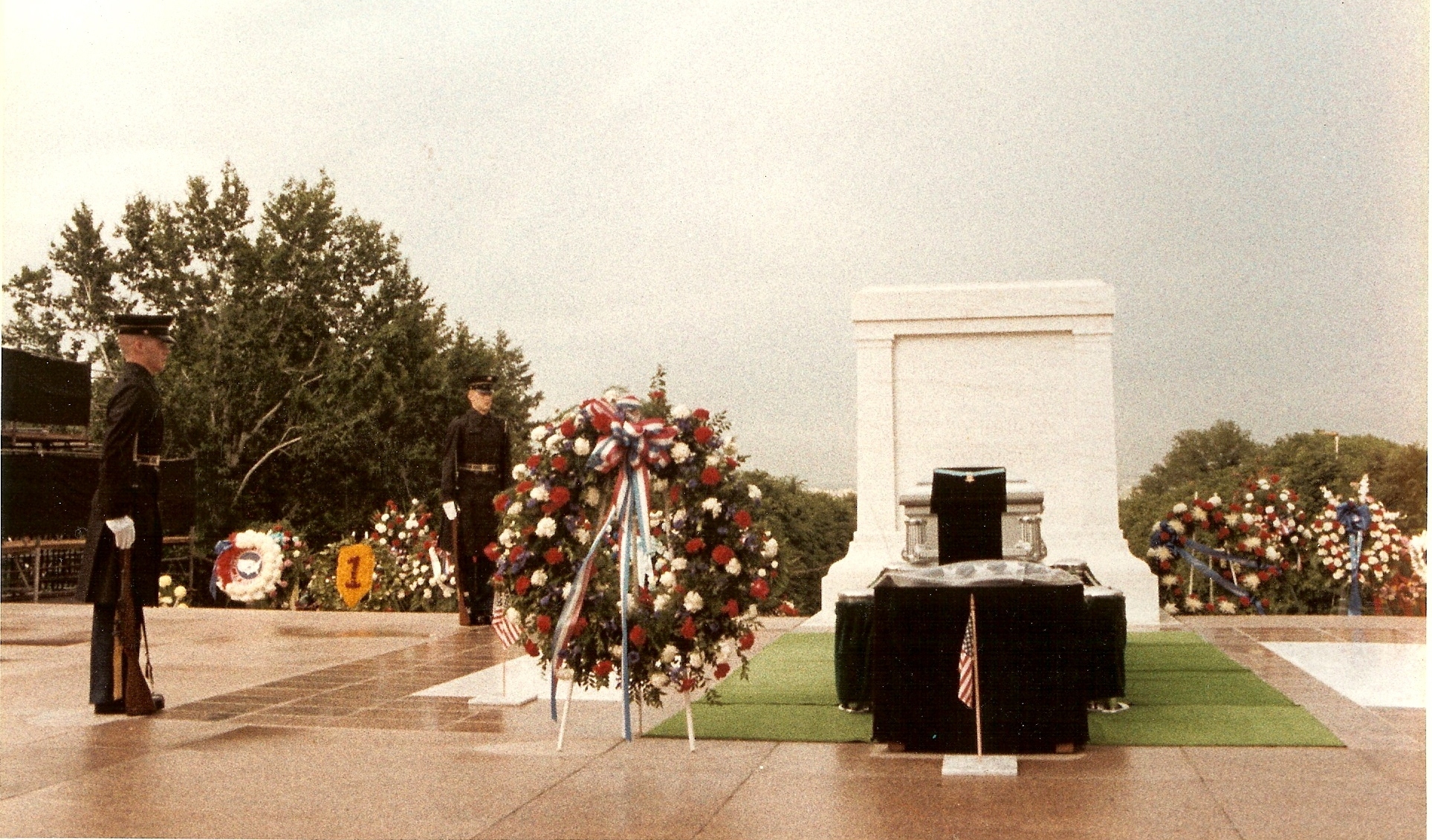
Tomb of the Unknown Soldier
Twenty-one steps south. Pause. Face east for twenty-one seconds. Turn. Twenty-one steps north. The rhythm has not stopped since midnight on July 2, 1937. Through hurricanes, blizzards, the September 11 attacks, and the quiet hours when no one is watching, a lone sentinel from the U.S. Army's 3rd Infantry Regiment walks a precise, unbroken vigil before a block of white Yule marble at Arlington National Cemetery. The Tomb of the Unknown Soldier is not simply a monument. It is a promise, renewed with every measured step, that the unnamed dead will never be forgotten.
A Soldier Comes Home from France
On March 4, 1921, Congress approved the burial of an unidentified American serviceman from World War I in the plaza of the new Memorial Amphitheater at Arlington. On November 11, 1921, Armistice Day, President Warren G. Harding officiated at the interment. The unknown soldier, brought back from France, was lowered into the earth below a three-level marble tomb. During the ceremony, Admiral of the Fleet Lord Beatty, on behalf of King George V, presented the Victoria Cross. France bestowed the Legion of Honour, the Medaille Militaire, and the Croix de Guerre. Italy, Poland, Czechoslovakia, and Romania each sent their highest military decorations. This single unidentified soldier became the most decorated American serviceman of the First World War, bearing the honors of grateful nations for all who could not be named.
Fifty-Six Tons of Colorado Marble
The intent was always to place a grand monument above the grave, but it took a decade to realize. In 1926, Congress authorized $50,000 for the work. Architect Lorimer Rich and sculptor Thomas Hudson Jones won the design competition. The marble came from a quarry 3.9 miles south of Marble, Colorado. Quarrying the massive die block was a year-long ordeal beginning in 1930, requiring 75 men and three attempts. When first separated from the mountain, the block weighed 124 tons; a wire saw trimmed it to 56 before a four-day journey to the mill. From Colorado the block traveled to Vermont, where it was sawed to final size in West Rutland and finished by craftsmen in Proctor. The Piccirilli Brothers, the same sculptors who carved the Lincoln statue for the Lincoln Memorial, handled the carvings. Assembly at Arlington began in September 1931 and was completed by December. The Tomb was finished without formal ceremony on April 9, 1932. Today, cracks that first appeared in the marble die block by 1963 are carefully monitored and repaired, a testament to the passage of time that even stone cannot escape.
The Sentinels
A civilian guard first stood watch at the Tomb on November 17, 1925, posted partly to prevent families from picnicking on the flat marble slab with its views of the city. Military guards took over on March 25, 1926, and the first continuous 24-hour watch began on July 2, 1937. It has never ceased. Tomb Guards are volunteer soldiers from the 3rd Infantry Regiment, known as 'The Old Guard,' stationed at Joint Base Myer-Henderson Hall. Fewer than 20 percent of volunteers are accepted for training, and only a fraction earn the Tomb Guard Identification Badge, the third least-awarded qualification badge in the U.S. Army. As of December 2023, just 868 badges have been issued. Guards spend an average of six hours preparing their heavy wool uniforms for each shift. They memorize 35 pages of information about Arlington, including the locations of nearly 300 graves. When walking the mat, sentinels wear no rank insignia so as not to outrank the Unknowns, and metal plates in their shoes produce the signature click of each precise heel turn.
Names Reclaimed, Promises Kept
In 1958, Unknowns from World War II and the Korean War were interred beside the original tomb. A Vietnam Unknown followed in 1984. But science caught up with sacrifice. In 1998, mitochondrial DNA testing identified the Vietnam Unknown as First Lieutenant Michael Blassie of the U.S. Air Force. His remains were returned to his family in St. Louis and reinterred at Jefferson Barracks National Cemetery. The crypt was rededicated with a new inscription: 'Honoring and Keeping Faith with America's Missing Servicemen, 1958-1975.' It remains empty, a deliberate void that speaks to the military's commitment to identify every fallen service member. On November 9-10, 2021, for the centennial commemoration, the public was allowed to walk the plaza and lay flowers at the Tomb for the first time since 1925. On October 4, 2021, the first all-female changing of the guard honored Sergeant of the Guard Chelsea Porterfield, the first woman to hold that position.
From the Air
Located at 38.8764°N, 77.0722°W within Arlington National Cemetery, on the Virginia side of the Potomac River directly across from the National Mall. The white marble tomb and Memorial Amphitheater are visible from the air as a bright focal point among the rows of white headstones. Best viewed at 1,500-3,000 ft AGL. Nearest airports: KDCA (Ronald Reagan Washington National, 2 nm east), KIAD (Washington Dulles International, 23 nm west). Note: Arlington airspace is within the Washington DC SFRA/FRZ restricted zone.