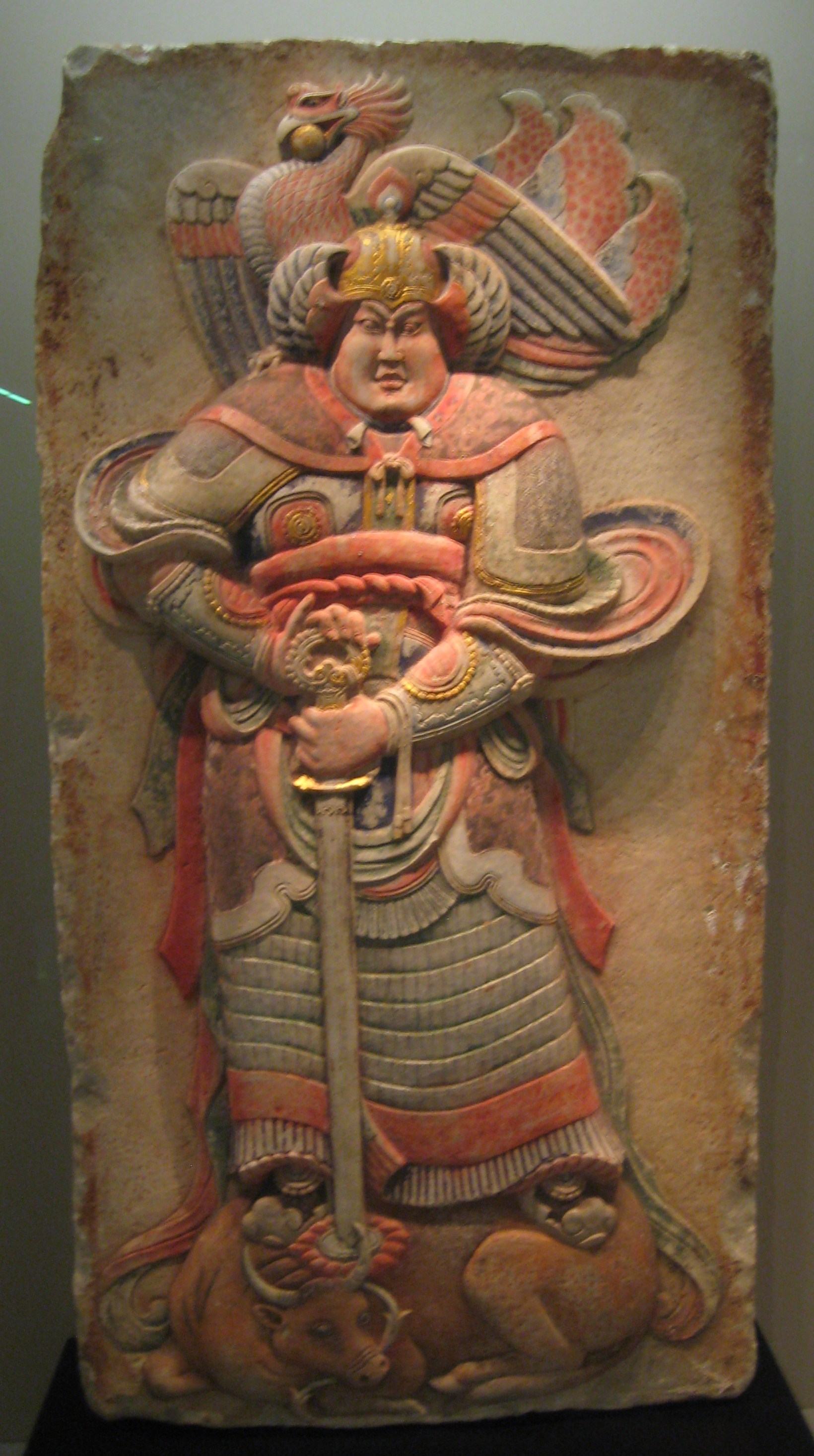
Tomb of Wang Chuzhi
In the year 2000, a painted marble relief panel appeared in a Christie's auction catalogue in New York, listed among 'Fine Chinese Ceramics, Paintings, and Works of Art.' It depicted a scene of extraordinary delicacy -- court musicians frozen in stone, their instruments identifiable, their costumes detailed. What the catalogue did not say was that the panel had been blasted from a tomb with dynamite six years earlier by thieves who knew exactly what they were stealing. The tomb belonged to Wang Chuzhi, a warlord who died in 923 after being overthrown by his own adopted son, and whose burial site in Quyang County, Hebei, contained some of the finest funerary art of medieval China.
A Prince Betrayed
Wang Chuzhi was the Prince of Beiping and military governor of Yiwu during one of Chinese history's most turbulent transitions -- the collapse of the Tang dynasty into the chaotic Five Dynasties and Ten Kingdoms era. From his base in Baoding, Hebei, he wielded significant and sometimes independent power, navigating between shifting allegiances and rival warlords. In 921, his adopted son Wang Du overthrew him. Wang Chuzhi died two years later, on 6 February 923, and was buried in a tomb near Lingshan in Quyang County -- a burial that reflected the wealth and cultural sophistication of a man who had ruled like a king even without the title.
A Fifteen-Member Ladies' Orchestra
The tomb's most remarkable feature is a set of painted marble reliefs depicting court musicians and servants. On the western wall, twelve women form an orchestra. The front row shows five musicians playing the konghou (bow harp), the guzheng (a plucked zither with moveable bridges), the pipa (lute), paiban (bamboo clapper), and a bass drum called dagu. Behind them, seven more women play the sheng (mouth organ), fangxiang (a Chinese metallophone), a West Asian cylindrical drum called dalagu, two oboes known as bili, and two bamboo transverse flutes. At the far right stands a female conductor dressed in men's clothing, with two child dancers performing before her. Together, the reliefs provide an extraordinarily detailed portrait of elite musical culture during the late Tang period -- the instruments, the ensemble structure, the crossing of gender expectations in performance.
Dynamite, Christie's, and Diplomacy
The tomb was rediscovered in 1980 in Xiyanchuan Village. For fourteen years it sat largely undisturbed. Then in July 1994, thieves armed with dynamite blasted their way in and removed several painted marble relief panels, recognizing their extraordinary artistic value. The tomb was officially excavated in 1995 after the damage, revealing what the thieves had left behind -- and confirming what they had taken. The story took an international turn when one of the stolen panels surfaced in Christie's New York auction catalogue in 2000. The Chinese government contacted US Customs, which seized the panel before it could be sold. It was returned to China in 2001 and is now displayed at the National Museum of China in Beijing. The episode became a landmark case in the international effort to repatriate looted cultural artifacts, demonstrating both the vulnerability of China's vast archaeological heritage and the channels through which stolen art reaches the legitimate market.
Music Across a Millennium
What makes the tomb's reliefs irreplaceable is not just their beauty but their documentary precision. Each instrument is rendered with enough detail for musicologists to identify the tuning systems and playing techniques of the era. The konghou, a harp-like instrument that later disappeared from Chinese musical practice, is shown with its strings clearly visible. The combination of Chinese and West Asian instruments in a single ensemble reveals the cosmopolitan musical culture of 10th-century northern China, where Silk Road influences persisted even as dynasties collapsed and reformed. The female conductor in male dress suggests that court entertainment operated with its own conventions, distinct from the rigid gender hierarchies of everyday life. Wang Chuzhi chose to take this orchestra with him into the afterlife, a final luxury more revealing than any amount of gold.
From the Air
The Tomb of Wang Chuzhi is located at 38.81°N, 114.57°E near Lingshan in Quyang County, Baoding, Hebei Province. The site is in the foothills transitioning from the North China Plain to the Taihang Mountains. Nearest major airport is Shijiazhuang Zhengding International Airport (ICAO: ZBSJ), approximately 90 km to the south. The tomb site itself is not visible from altitude but the terrain transition from plains to hills is notable at 5,000-8,000 feet AGL.