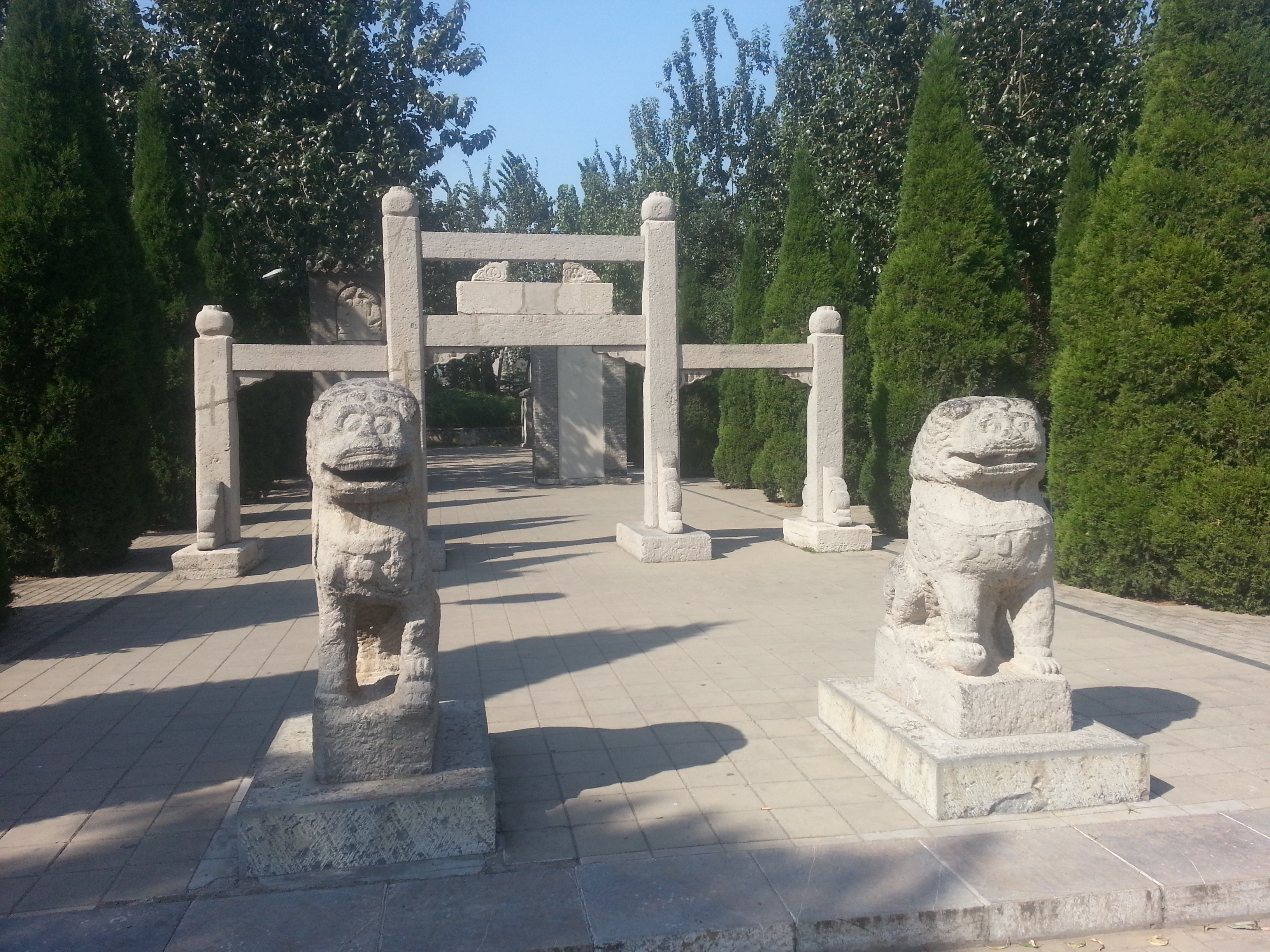
Tomb of Zhang Yanghao
"When the land prospers, the people suffer. When the land falls, the people suffer." Zhang Yanghao wrote those lines in his most celebrated sanqu poem, "Tongguan Nostalgia," while passing through the ancient mountain pass at Tongguan. He was a poet of the Yuan dynasty, the era of Mongol rule over China, and his verse cut through the usual imperial rhetoric to state a blunt truth: ordinary people bore the cost of every regime, triumphant or collapsing. His tomb sits in a small public park in Liu Yun Village, within the Tianqiao District of Jinan, Shandong -- a quiet memorial to a man whose words still resonate.
A Poet Among Pines
The park surrounding the tomb covers about 2,000 square meters, planted with pines and willows that give it the character of a scholar's retreat rather than a grand imperial monument. Zhang Yanghao's tomb itself is modest: an earth mound 1.9 meters tall, enclosed by masonry walls. In front of the mound stand a stone altar and an incense set. A spirit way -- the ceremonial approach road traditional in Chinese memorial architecture -- leads visitors through stone gates flanked by stone lions and tortoise figures. The tombs of four of Zhang's relatives share the park, making it a family burial ground as much as a literary memorial. It was inscribed on the list of protected cultural sites in Shandong Province in June 1992.
The Voice of the Sanqu
Zhang Yanghao (1270-1329) was a master of the sanqu, a form of Chinese lyric poetry that flourished during the Yuan dynasty. Unlike the more formal ci and shi poetic traditions, sanqu borrowed rhythms and vocabulary from popular music and spoken language, giving it an immediacy and emotional directness that the older forms sometimes lacked. Zhang held government office during his career, serving as a regional administrator, but it is his poetry that survived him. His work is characterized by a clear-eyed sympathy for the people caught between the machinery of empires -- a perspective that was both politically daring and deeply humane for its time.
Quiet Ground in a Growing City
Tianqiao District sits in the northern part of Jinan, a zone that has urbanized rapidly around the older villages it once contained. Liu Yun Village, where the tomb stands, is now fully absorbed into the city's fabric. The park that shelters the tomb feels like a remnant of a different pace of life -- two thousand square meters of green in a dense urban grid, its pines offering shade and its stone figures offering silence. Visitors who come here are not drawn by spectacle. There are no grand halls, no towering monuments. What draws them is the chance to stand at the grave of a man who, seven hundred years ago, looked at the sweep of Chinese history and saw not glory but the human cost of it. The altar still receives incense.
From the Air
Located at 36.705°N, 117.043°E in the Tianqiao District of Jinan, north of the city center. The park is small and embedded within urban development. Nearest airport is Jinan Yaoqiang International Airport (ZSJN), approximately 28 km northeast. From the air, look for the Yellow River to the north; the tomb site is between the river and the old city core. Elevation approximately 25 meters above sea level.