Tombstone: 30 Seconds That Built a Legend
The gunfight at the O.K. Corral lasted about 30 seconds. On October 26, 1881, three Earp brothers and Doc Holliday faced the Clanton and McLaury brothers in a vacant lot near Tombstone's O.K. Corral. When the smoke cleared, three men were dead, three wounded. The actual shootout - confused, brutal, possibly illegal - has been argued about ever since: were the Earps lawmen doing their duty or murderers hiding behind badges? The answer depends on which historian you believe, which movie you watched, which version of the West you want to exist. Tombstone itself nearly died when the silver mines flooded in the 1880s, but the town that was 'too tough to die' survived on its legend. The gunfight lasted 30 seconds. The argument continues.
The Context
Tombstone boomed after silver was discovered in 1877, growing to 10,000 residents by 1881 - larger than San Francisco at the time. The boom attracted miners, merchants, gamblers, and outlaws. The Cowboys - a loose confederation of cattle rustlers and bandits - clashed with the Earps, who represented town business interests. Wyatt Earp dealt faro; his brothers Virgil and Morgan held law enforcement positions. Doc Holliday, a tubercular dentist turned gambler, was Wyatt's friend. The Clantons and McLaurys ran cattle, sometimes rustled, associated with the Cowboys. The tensions were political as much as personal: Republicans versus Democrats, town versus range, capital versus rustlers. The gunfight resolved nothing but created immortal legend.
The Fight
The confrontation happened in a vacant lot near Fremont Street, not actually inside the O.K. Corral. Virgil Earp, serving as town marshal, led his brothers and Holliday to disarm the Cowboys, who'd been seen carrying weapons in violation of town ordinance. What happened next is disputed: who drew first, who surrendered, who shot whom. In 30 seconds, Billy Clanton and both McLaury brothers were dead or dying; Virgil and Morgan Earp were wounded; Holliday grazed. The survivors gave conflicting testimony. The Earps were charged with murder, then acquitted. Wyatt killed additional Cowboys in subsequent months. The violence scattered the participants across the West.
The Legend
The gunfight became legend almost immediately, but the legend changed. Contemporary accounts saw the Earps as reckless or murderous; later retellings made them heroic lawmen taming the frontier. Wyatt Earp lived until 1929, long enough to consult on Hollywood Westerns and shape his own myth. Stuart Lake's 1931 biography, 'Wyatt Earp: Frontier Marshal,' created the definitive legend: noble Earps versus villainous Cowboys. Countless films followed - 'My Darling Clementine,' 'Gunfight at the O.K. Corral,' 'Tombstone,' 'Wyatt Earp' - each version reflecting its era's anxieties about law, violence, and justice. The 30-second gunfight became a screen for American self-mythology.
The Town
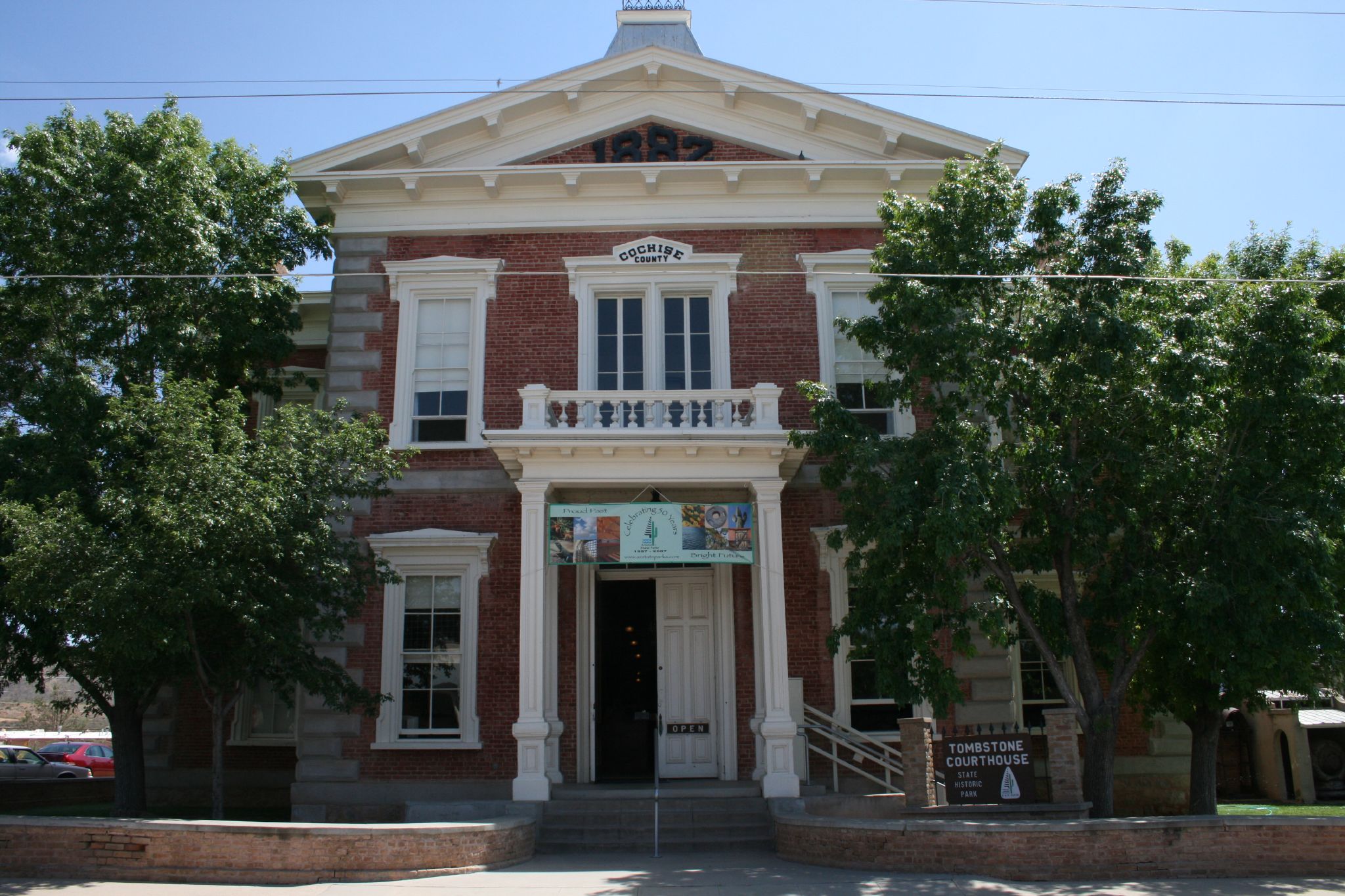
Tombstone should have died when the silver mines flooded in 1881 and fires devastated the business district. The population collapsed; the boom ended. But the county seat remained, providing enough economic activity to sustain a remnant population. When Western tourism emerged in the mid-20th century, Tombstone was ready. The town preserved its historic buildings, staged daily gunfight reenactments, and marketed itself as 'The Town Too Tough to Die.' The tourism economy succeeded where mining failed. Boothill Cemetery, the Bird Cage Theatre, Big Nose Kate's Saloon - the attractions celebrate violence and vice, the mythology the town created from its chaotic boom years.
Visiting Tombstone
Tombstone is located in southeastern Arizona, roughly 70 miles southeast of Tucson via I-10 and AZ-80. Allen Street, the main historic thoroughfare, is closed to vehicles; boardwalks line the storefronts as they did in 1881. The O.K. Corral offers historical exhibits and reenactments of the famous gunfight. Boothill Graveyard contains graves from the town's violent era, including the McLaurys. The Bird Cage Theatre preserves a remarkably intact 1880s saloon and theater. Wyatt Earp's name appears everywhere. The town is small; a few hours covers the attractions. Bisbee, a more authentically preserved mining town, lies 25 miles south. The Arizona desert provides the backdrop the legend requires.
From the Air
Located at 31.71°N, 110.07°W in the high desert of southeastern Arizona. From altitude, Tombstone appears as a small grid of streets in the San Pedro Valley, surrounded by desert grassland and distant mountain ranges. The town is tiny - the boom that created 10,000 residents left a settlement of under 2,000. The mining landscape that justified the town's existence has largely vanished; the legend remains. The Dragoon Mountains rise to the east; the Huachuca Mountains to the west. The Mexican border lies 30 miles south. The desert emptiness emphasizes what the town always was: a temporary camp that extracted silver, created legend, and somehow survived.