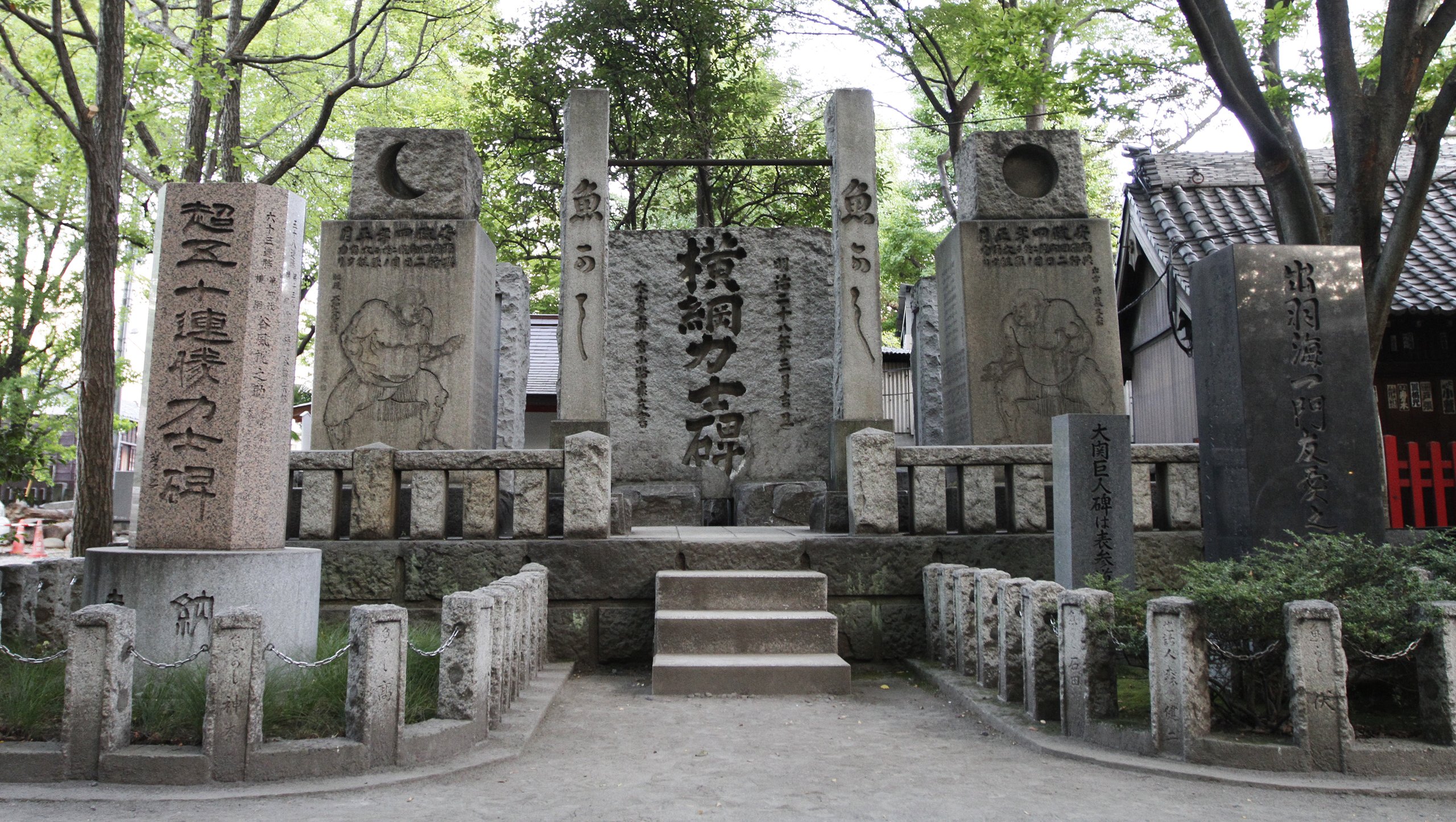
Tomioka Hachiman Shrine
In 1684, the first organized sumo tournaments began in the grounds of a Shinto shrine built on a drained shoal in Fukagawa. The wrestlers performed under the gaze of Hachiman, the god of war, while spectators packed the precincts twice a year -- spring and autumn -- under permits granted by the Tokugawa shogunate. Three and a half centuries later, every wrestler who reaches sumo's highest rank still returns to this same shrine to perform the dohyo-iri, the sacred ring-entering ceremony, before a stone monument inscribed with the names of all 73 yokozuna. Tomioka Hachiman Shrine is the largest Hachiman shrine in Tokyo, but its significance has never been about size. It is the place where Japan's most ancient sport became professional.
Reclaimed from the Tides
The shrine was established in 1627 in Fukagawa, on land reclaimed from a tidal shoal along the eastern edge of Edo. It was dedicated to Hachiman, the Shinto deity of war and protector of warriors, who also served as the patron kami of the Minamoto clan. This connection to the Minamoto bloodline -- from which the Tokugawa shoguns claimed descent -- earned the shrine cordial protection from the ruling government throughout the Edo period. But Tomioka Hachiman was never solely a shrine of the powerful. The people of shitamachi, the low-lying merchant and artisan neighborhoods of old Edo, embraced it as their own, calling it simply 'Hachiman of Fukagawa.' Its festivals, particularly the Fukagawa Matsuri, became among the liveliest in the city, drenching participants and spectators alike in buckets of water thrown from the crowds.
Where Sumo Became a Sport
Professional sumo traces its origins to 1684, when organized tournaments began at Tomioka Hachiman Shrine under the shogunate's official permission. Two annual basho -- spring and autumn -- were held in the shrine precincts, and during this period the foundational systems of the sport took shape, including the banzuke, the ranking charts that still govern the hierarchy of wrestlers today. For roughly 80 years, the shrine was sumo's primary venue in Edo. Eventually, tournaments spread to other locations across the city, and by 1833 the temple Ekoin had taken over as the regular host. But the shrine's claim as the birthplace remained undisputed. In 1900, the 12th yokozuna, Jinmaku Kyugoro, erected a stone monument honoring every grand champion. That monument now bears the ring names of all yokozuna through Terunofuji Haruo, the 73rd, along with the legendary Raiden Tameemon, recognized as an 'unrivaled rikishi' despite never holding the title.
Fire, War, and the Emperor's Visit
The Meiji Restoration of 1868 stripped the shrine of its Tokugawa-era patronage, though the new government designated it a shrine of significance. The loss of feudal protectors proved less devastating than what came next. During the firebombing of Tokyo in March 1945, the shrine burned to the ground. On March 18, 1945, Emperor Showa toured the devastated area and stopped at the ruins of Tomioka Hachiman. Returning to the Imperial Palace, he described the destruction to his Grand Chamberlain Hisanori Fujita, comparing it to the aftermath of the Great Kanto earthquake of 1923, which he had witnessed as Crown Prince. Two stone monuments now stand in the shrine precincts commemorating that somber imperial visit. The shrine was rebuilt after the war and continued its centuries-old traditions.
A Sacred Trust Broken
In June 2017, Tomioka Hachiman Shrine made the unusual decision to withdraw from the Association of Shinto Shrines, the governing body overseeing most of Japan's Shinto institutions. The reasons pointed to long-simmering internal tensions. Those tensions erupted into horror on December 7, 2017, when the shrine's chief priestess, Nagako Tomioka, was stabbed to death near the shrine grounds. The attacker was her brother, Shigenaga Tomioka, accompanied by his wife. The priestess's driver was also injured. Shigenaga then killed his wife before taking his own life. Police found a bloodied sword and knives at the scene. The murder of a chief priestess by her own brother sent shockwaves through Japan's religious community and cast a shadow over an institution that had endured earthquakes, firebombings, and political upheaval for nearly four centuries.
From the Air
Located at 35.672N, 139.800E in the Fukagawa area of Koto ward, eastern Tokyo. The shrine sits near the Sumida River's eastern bank, identifiable from the air by its traditional roofline and surrounding tree cover amid dense urban blocks. Nearest airports: Tokyo Haneda (RJTT) approximately 8 nm south-southwest, Narita International (RJAA) approximately 35 nm east. Best viewed at 1,500-3,000 feet AGL. The Sumida River and the network of canals in Fukagawa serve as visual navigation aids.