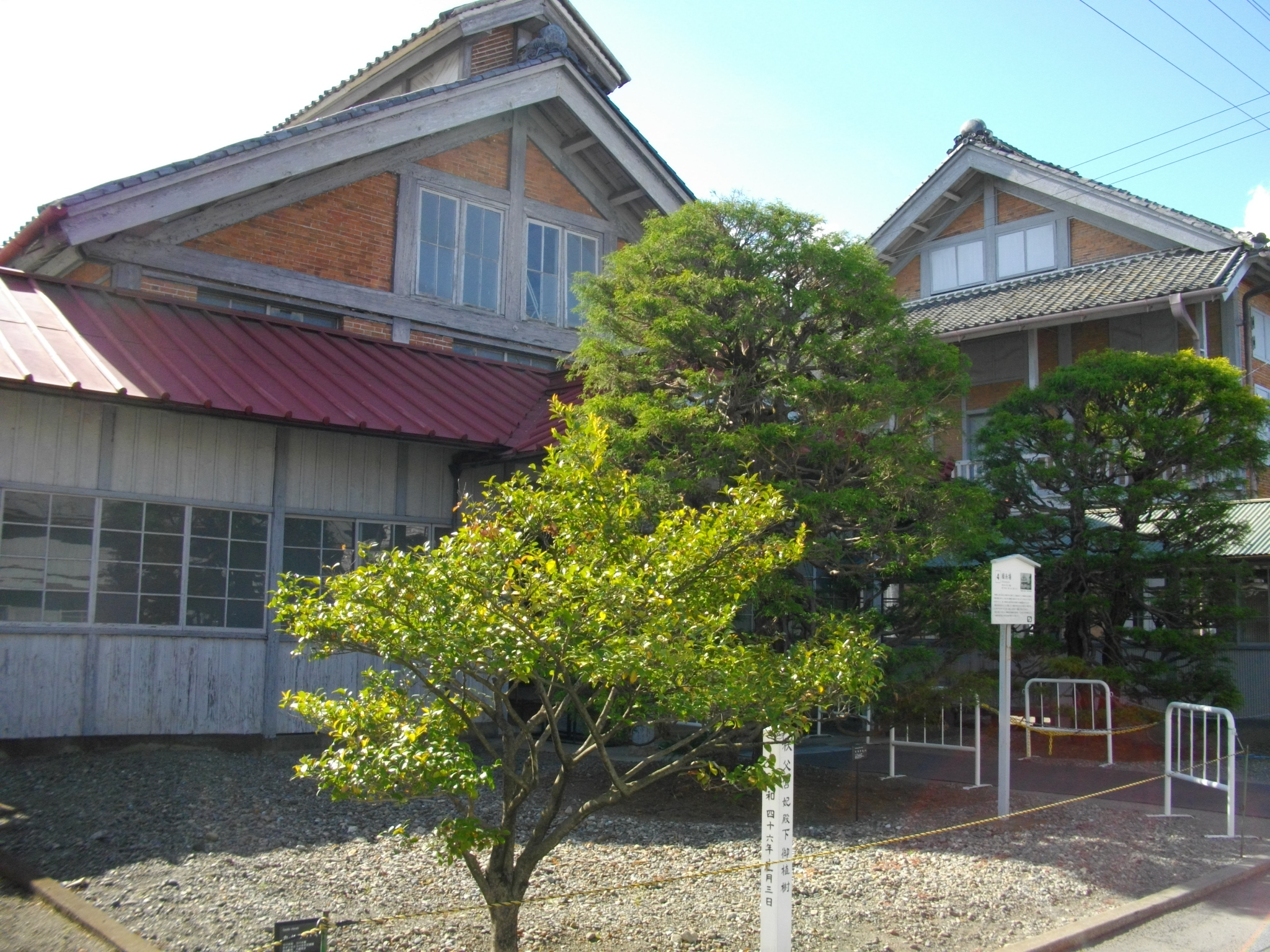
Tomioka Silk Mill: The Factory That Frightened Its Workers
When the French engineers at the Tomioka Silk Mill were seen drinking red wine, a rumor swept through the countryside: the foreigners were living off blood drained from the Japanese workers. Recruitment collapsed. Factory director Odaka Atsutada, desperate to fill his 300 reeling machines, sent his own daughter to work the production line, proving by her survival that the French were merely fond of Bordeaux. The episode captures something essential about this place -- the collision of two worlds, playing out inside a massive brick building in the mountains of Gunma Prefecture, 100 kilometers northwest of Tokyo.
Silk as National Strategy
The Tomioka Silk Mill was not built to make money. It was built to save a country. Following the Meiji Restoration, Japan's new government needed exports to finance the industrialization that would prevent the nation from becoming a Western colony. In 1862, raw silk and silkworm cocoons had accounted for 86% of Japan's exports, driven by demand from a Europe ravaged by the silkworm disease pebrine and a China torn apart by the Taiping Rebellion. But overproduction and the recovery of European silk farms soon crashed prices. The government needed to move up the value chain -- from raw cocoons to finished thread. Japan had the silkworms but lacked the technology. In 1870, leaders including Okuma Shigenobu, Ito Hirobumi, and Shibusawa Eiichi approached the French embassy and were introduced to Paul Brunat, an engineer working as a silk inspector in Yokohama. Brunat was hired to build the largest silk mill in the world.
Three Hundred Reels and a Brick Kiln
Brunat hired architect Edmond Auguste Bastan to design the mill, and Bastan completed the blueprints by December 1870, drawing on his experience designing the Yokosuka ironworks. Construction began in March 1871, but brick was not yet common in Japan, so a kiln had to be built first in nearby Kanra, where suitable clay was found. The completed mill was a timber-framed brick building 140.4 meters long, lit by large glass windows imported from France, housing 300 reeling machines -- twice the capacity of the largest plants in France or Italy. The complex included east and west cocoon warehouses, each 104.4 meters long, arranged in a U-shape around the reeling hall. A steam plant powered the machinery, and an iron water reservoir with a 400-ton capacity supplied the operation. Even the drainage system was noteworthy -- a brick culvert running 186 meters east to west, then bending south to the Kabura River, incorporating Western architectural styles rarely seen outside the treaty ports.
Samurai Daughters and Eight-Hour Days
The mill opened on November 4, 1872, with about 210 workers operating half the machines. After the blood-drinking rumors subsided, the workforce grew to 404 by January 1873 and 556 by April -- mainly daughters of former samurai, whose families saw factory work as a form of national service. Brunat introduced working conditions that were progressive for the era: eight-hour days, Sunday holidays, and ten-day breaks at midyear and year-end. Workers received uniforms and access to an elementary school. They were ranked across eight skill levels introduced in 1873. The silk they produced won second place at the 1873 Vienna World's Fair, and the name Tomioka became a brand. But social pressure against women working in factories, combined with class friction among workers from different backgrounds, kept turnover high. One worker, Wada Ei, recorded daily life in a diary that became a valuable historical document.
Four Owners and a Century of Silk
When Brunat and the French engineers departed in 1875, the mill continued under Japanese management. Mitsui and Company purchased it from the government in 1893 for 121,460 yen, exporting all production to the United States but extending working hours to twelve in summer. Silk merchant Hara Tomitaro bought the mill in 1902 for 135,000 yen and distributed silkworm eggs to farmers nationwide to improve cocoon quality. By 1936, production reached 147,000 kilograms. But nylon's invention and the Pacific War devastated the industry. Katakura Spinning took over management in 1938, and production shifted to military materials during the war. Postwar recovery brought automation and record output of 373,401 kilograms in 1974, but synthetic fibers, declining kimono use, and cheap Chinese silk imports finally ended production on February 26, 1987.
From Factory Floor to National Treasure
After the last reel stopped turning, Katakura maintained the buildings at considerable expense for eighteen years. In 2005, the company sold the site to Tomioka city for a nominal sum, and the designation as a National Historic Site followed immediately. The oldest buildings became Important Cultural Properties in 2006, and three -- the silk-reeling mill and the east and west cocoon warehouses -- were elevated to National Treasure status in 2014. That same year, the site was inscribed on the UNESCO World Heritage List, formally recognized as a monument to Japan's industrial transformation. The Brunat Mansion still stands, its exterior largely unchanged from 1873. The inspector's house, the French women's dormitory, the steam plant, and the iron water reservoir all survive. Walking through the complex today, the scale of Brunat's ambition is still palpable -- 140 meters of brick and glass, designed to turn a nation of silk farmers into an industrial power.
From the Air
Located at 36.26°N, 138.89°E in the city of Tomioka, Gunma Prefecture, in the Kabura River valley approximately 100 km northwest of Tokyo. From the air, the mill complex is identifiable as a cluster of long brick buildings with distinctive rooflines arranged in a U-shape, surrounded by the modern city. The Kabura River runs nearby to the south. Best viewed at 2,000-3,000 feet AGL to appreciate the scale of the factory complex against the surrounding mountain landscape. Nearest airports include RJAH (Ibaraki Airport) approximately 120 km east and RJTT (Tokyo Haneda) approximately 130 km south-southeast. The Joshu mountains rise to the north and west.