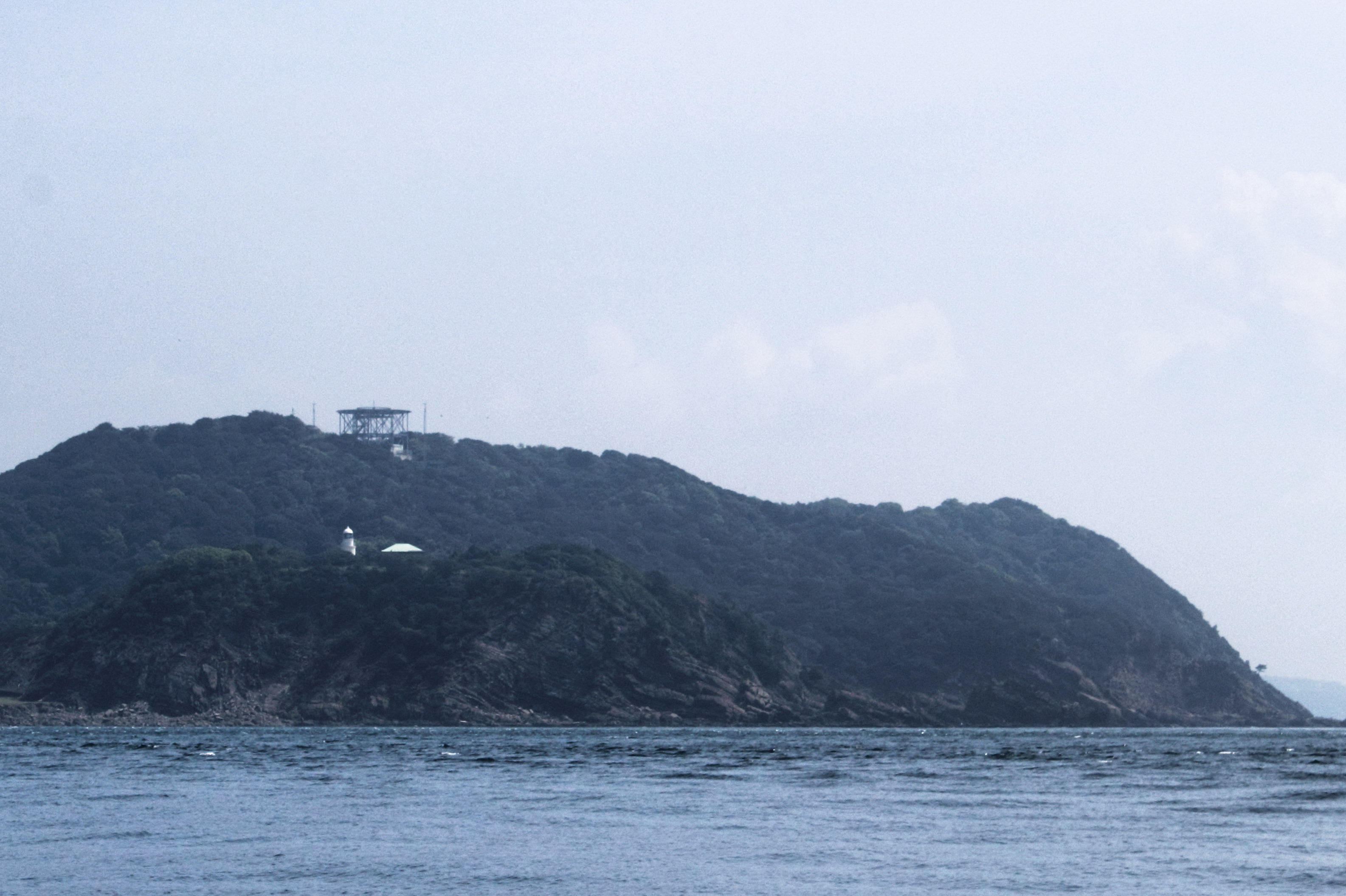
Tomogashima
The red-brick walls are still standing, but the jungle is winning. Vines thread through empty gun slits, tree roots pry apart mortar joints, and ferns colonize the powder magazines where Imperial Japanese Army soldiers once stacked artillery shells. On Tomogashima, a cluster of four uninhabited islands guarding the southern entrance to Osaka Bay, nature has spent eight decades reclaiming a military fortress that was once so secret it was erased from civilian maps. Visitors who make the twenty-minute ferry crossing from Kada Port in Wakayama City step into an atmosphere so hauntingly overgrown that it has drawn comparisons to Laputa, the floating castle in Hayao Miyazaki's 1986 film Castle in the Sky.
Monks on the Cliffs
Long before the gun batteries arrived, Tomogashima belonged to ascetic monks. Folklore holds that Ennogyoja, the founder of Shugendo -- a rigorous blend of mountain Buddhism, Shinto, and Taoist practice -- trained on the steep sea cliffs of the islands during the seventh and eighth centuries. The experience was punishing enough that Tomogashima earned the nickname "Island of Shugendo." The first station of the Katsuragi 28 Shuku pilgrimage route begins on Torajima, the smallest and most dramatic of the four islands, whose cliffs rise sheer from the Kitan Strait. Torajima means "Tiger Island," and from the water its jagged profile does suggest a predator crouching at the edge of the sea.
Fortress at the Strait's Mouth
Geography made Tomogashima irresistible to military planners. The Kitan Strait, the narrow passage between the southern tip of Awaji Island and the Wakayama coast, is the gateway to Osaka Bay. In 1888, the Japanese government designated the islands a military zone and began constructing coastal artillery positions under the Shusei Kokubo -- "Static Defence" -- policy of the 1870s and 1880s, which prioritized fortified coastlines against foreign warships. Brick forts, gun batteries, underground ammunition stores, and support buildings rose across Okinoshima, the largest of the four islands. A granite lighthouse, designed by Richard Henry Brunton -- the Scottish engineer known as the "Father of Japanese Lighthouses" -- had already been lit on August 1, 1872, making it Japan's eighth western-style lighthouse. Public access was strictly prohibited. For the better part of sixty years, civilians could not set foot on Tomogashima.
The Jungle Takes Over
After Japan's surrender in 1945, the weapons were stripped and the soldiers left. The islands were absorbed into Setonaikai National Park, but no one bothered to demolish the fortifications. Subtropical humidity and salt air did what no invading fleet ever attempted. Moisture crept into the brick arches, roots forced their way through foundations, and the canopy closed over roofless magazines. The Third Battery, with its open gun emplacements and network of underground rooms, is the most atmospheric site -- corridors recede into green-filtered darkness, and the silence is broken only by birdsong and the distant wash of the strait. Today the islands are uninhabited, reachable only by seasonal ferry, and visited primarily by hikers, photographers, and anime fans tracing the real-world setting of the manga and anime series Summer Time Rendering, which reimagined Tomogashima as the fictional Hitogashima Island.
Painted by Masters, Forgotten by Time
Tomogashima's strange beauty caught the attention of artists centuries before the first tourists arrived. In 1661, the celebrated Edo-period painter Kano Tan'yu produced a scroll depicting the islands, now held at the Shogo-in temple in Kyoto. An anonymous handscroll from 1798 resides in the British Museum's Asian collection. These works captured a Tomogashima that existed before fortification -- wild, sacred, and remote. That older character has, in a sense, returned. With the military infrastructure crumbling and the forest reasserting itself, the islands look more like the places those painters saw than the garrison they became. The lighthouse still operates, its white tower visible from the Wakayama coastline, a lone functional artifact amid the beautiful decay.
From the Air
Located at 34.28N, 135.01E in the Kitan Strait at the southern entrance to Osaka Bay, between Wakayama and Awaji Island. The four islands -- Okinoshima (largest), Jinoshima, Torajima, and Kamijima -- are clearly visible as distinct landmasses from moderate altitude. The white Tomogashima Lighthouse on Okinoshima's western shore is a useful visual reference. Nearest major airport: Kansai International Airport (RJBB), approximately 20nm northeast. The strait is a busy shipping lane connecting Osaka Bay to the Pacific. Expect maritime haze common to the Inland Sea region, with best visibility in autumn and winter months.