Tomonoura
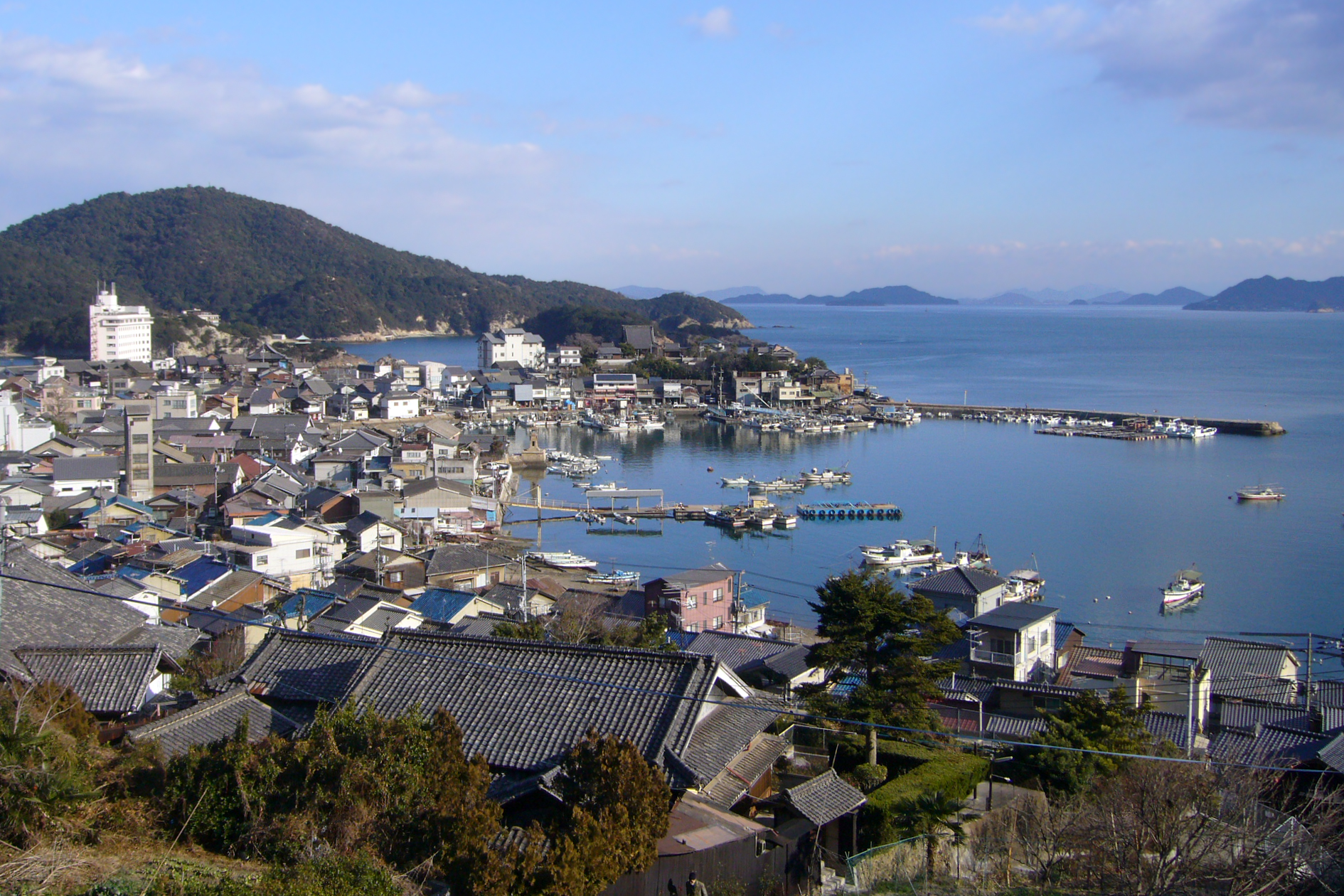
Hayao Miyazaki spent two months in Tomonoura in 2005, living quietly in this tiny port town on the Seto Inland Sea. What he found there -- the intimate harbor, the layered hillside of temples and merchant houses, the constant presence of the water -- became the visual foundation for Ponyo, his 2008 film about a goldfish who wants to become human. Miyazaki was not the first artist to fall under Tomonoura's spell. Poets have written about this harbor since the 8th century, when eight verses praising it were collected in the Man'yoshu, Japan's oldest poetry anthology. The town's old nickname tells you why they came: Shio machi minato, the port of waiting for tides.
Where the Currents Meet
Tomonoura sits at the southern tip of the Numakuma Peninsula, 14 kilometers south of Fukuyama Station in Hiroshima Prefecture. Its location was determined by physics: the tidal currents of the Seto Inland Sea converge here, and in the age of sail, ships traveling in either direction had to wait at Tomonoura for favorable tides before continuing. This made the port a natural gathering place, a bottleneck where travelers, merchants, and sailors idled together while the sea decided when they could leave. The town's circular harbor, unique among Japanese ports, was preserved even after modern facilities arrived. With a population of about 3,500, Tomonoura remains remarkably intact -- a living settlement rather than a museum piece, its narrow streets still lined with the merchant houses and sake warehouses that served the waiting sailors.
Layers Upon Layers
Tomonoura's history reads like a compressed timeline of Japan itself. Temples established during the Heian period by the Buddhist founders Saicho and Kukai still stand. The Nunakuma Shrine is recorded in the Engishiki, the 10th-century compendium of imperial procedures, as the origin of Kyoto's famous Yasaka Shrine. After the Battle of Tatarahama in 1336, Emperor Kogon visited the town during the wars between the Northern and Southern Courts. The Mori clan built Tomo Castle during the Sengoku period, and when the last Ashikaga shogun, Yoshiaki, was banished from Kyoto by Oda Nobunaga, he established a rival government here -- the Tomo Bakufu. In the late Edo period, Tomonoura witnessed the sinking of the Iroha Maru, a ship belonging to the legendary samurai-turned-revolutionary Sakamoto Ryoma.
Saving the Harbor
In the early 2000s, Tomonoura faced a crisis familiar to historic communities worldwide: a plan to build a bridge across the scenic harbor for a bypass road. The conflict between development and preservation grew fierce enough to attract international attention. The World Monuments Fund placed the town on its Watch List in 2002 and 2004, and the Hiroshima District Court eventually overturned the bridge plan. The WMF, with financial support from American Express, helped restore Uoya-Manzo, a 19th-century merchant residence that now serves as an information center and guesthouse. In 2007, the port was recognized as one of Japan's top 100 scenic municipalities, and the harbor was named one of the country's top 100 historical natural features. The Setonaikai National Park, which includes Tomonoura, was established in 1934, making it part of Japan's first generation of protected landscapes.
A Town That Inspires
Beyond Miyazaki's Ponyo, Tomonoura has drawn a remarkable range of creative attention. The composer Michio Miyagi wrote Haru no Umi, one of the most famous pieces of koto music, inspired by the sea here in 1929. Wim Wenders photographed the nearby coast for his 2006 exhibition A Journey to Onomichi. Hugh Jackman filmed scenes for The Wolverine in the town's narrow streets in 2013. Woodblock artist Tsuchiya Koitsu captured a sunset scene of ships in the harbor in 1940, and the port appeared on a Japanese postage stamp in 1939. For a town of 3,500 people, Tomonoura punches far above its weight in the cultural imagination -- perhaps because, in a country that has modernized with extraordinary speed, it preserves something that most places have lost.
From the Air
Located at 34.381N, 133.380E on the southern tip of the Numakuma Peninsula in Hiroshima Prefecture, overlooking the Seto Inland Sea. The circular harbor and dense cluster of traditional buildings are visible from low altitude. Nearest airport is Hiroshima Airport (RJOA) approximately 80 km west, or Okayama Airport (RJOB) approximately 70 km east. Fukuyama Station (Shinkansen) is 14 km north. The peninsula and surrounding islands of the Inland Sea create a distinctive landscape when viewed from 3,000-5,000 feet.