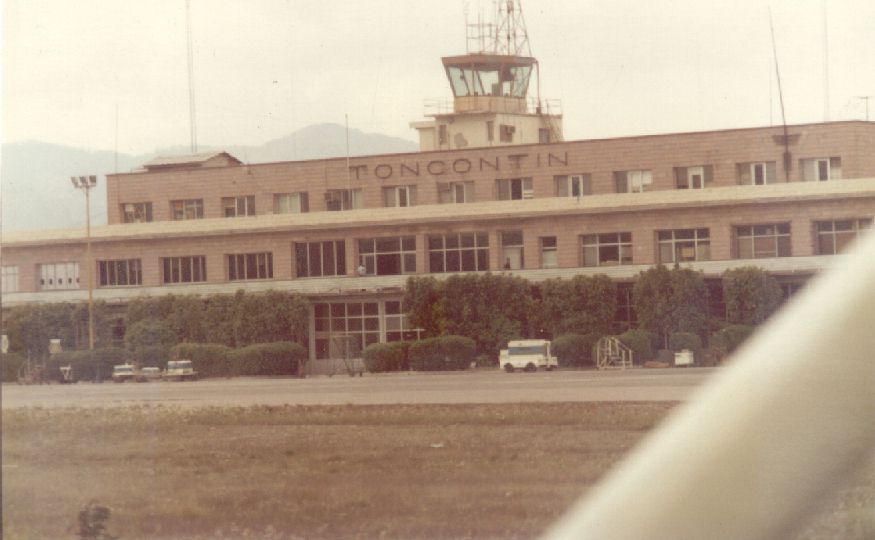
Toncontin International Airport
The approach to Runway 02 at Toncontin was not something pilots forgot. Hemmed in by mountains on nearly every side, Tegucigalpa's airport did not allow a standard straight-in landing. Instead, aircraft flew an RNAV approach that resembled a circle-to-land procedure, threading through the shallower terrain south of the city before following the Anillo Periferico ring road to a highway cloverleaf interchange. At the cloverleaf, the pilot banked hard left to line up with the runway. Until the hillside at the threshold was partially demolished, planes cleared the ground by an uncomfortably thin margin. The runway stretched just 1,830 meters -- short for the Boeing 757s and 737s that used it -- and departures off Runway 02 required an immediate climb to 9,000 feet to clear the mountains to the north. The History Channel ranked Toncontin the second most extreme airport in the world. Passengers who flew in tended to agree.
Champagne on the Propeller
The story of Toncontin begins with a farm field. Since the 19th century, the plains south of Tegucigalpa were known as Potrero Los Llanos, part of a hacienda near the southern edge of Comayaguela. The first airplane landing came in 1921 when a Bristol single-engine plane touched down with Captain Dean Ivan Lamb at the controls. President Rafael Lopez Gutierrez greeted him by breaking a bottle of champagne on the propeller. The name Toncontin may derive from the Nahuatl word Tocoltin, referring to an ancient ceremonial dance from the Yucatan. Early aviators -- Luigi Venditti, Jose Villa, Enrique Massi, and Clarence H. Brown among them -- used the natural floodplain as a runway. In 1933, President Tiburcio Carias Andino formally acquired the land, and the airport was inaugurated on January 5, 1934, with the landing of a Pan American World Airways Douglas DC-3. TACA soon opened Hotel Toncontin for transit passengers, and Pan Am built a hangar.
War, Weather, and the Approach
During the Football War of 1969, Toncontin became a military target. The Salvadoran Air Force bombed the airport on several occasions, grounding Honduran aircraft until repairs could be made within days. The Hondurans counterattacked and regained the initiative, but the vulnerability of an airport pinched between mountains was made brutally clear. Decades later, the same geography that made the airport a difficult military target made it a legendary challenge for commercial aviation. Pilots approaching Runway 02 had to contend with terrain that left almost no room for error. Late go-arounds were particularly dangerous because the short runway and the airport's elevation demanded enormous power to climb clear of the mountains to the north. The approach became the kind of thing airline crews talked about -- a test of skill that most airports in the world would never require.
TACA 390 and the Reckoning
On May 30, 2008, TACA Flight 390, an Airbus A320, overran the runway at Toncontin, crashed through a perimeter fence, crossed a road, and struck several vehicles. Five people were killed. The accident forced a reckoning that years of nervous landings had not. President Manuel Zelaya announced that all large aircraft operations would move to Soto Cano Air Base, and the International Civil Aviation Organization conducted a safety review. Businessmen protested that Soto Cano was too far from Tegucigalpa. Zelaya reopened Toncontin under pressure but promised a replacement airport at Palmerola in Comayagua. Then the 2009 Honduran coup removed Zelaya from office, and the airport plan stalled. Toncontin's own runway became a stage for the political crisis: on July 5, 2009, the military blocked the single runway with vehicles and troops to prevent Zelaya's private jet from landing. The plane diverted to Managua.
The Last Departure
International flights continued at Toncontin for another twelve years after the TACA crash, sustained by inertia, politics, and the simple fact that no alternative was ready. A runway extension on the south end added some length for northbound takeoffs, though its value for the standard southbound approach was debatable given the mountains. During 2018 the airport handled over 625,000 passengers. Finally, in December 2021, the long-promised replacement became reality: the new Comayagua International Airport opened at the Palmerola military air base, 70 kilometers from Tegucigalpa. American Airlines, United, Copa, and Avianca moved their operations there. Toncontin, the airport that terrified and thrilled for nearly nine decades, was reduced to domestic flights and a single cargo carrier. The mountains still ring the runway. The cloverleaf interchange is still there. But the Boeing 757s that once threaded through the valley no longer come.
From the Air
Toncontin International Airport (ICAO: MHTG) is located at 14.06N, 87.22W, 6 km south of downtown Tegucigalpa at approximately 1,005 meters (3,297 feet) elevation. The airport sits in a valley surrounded by mountains on nearly all sides. Runway 02/20 is 1,830 meters long. The famous circling approach to Runway 02 follows the Anillo Periferico highway to a cloverleaf interchange before a sharp left turn to final. Departures from Runway 02 require an immediate climb to 9,000 feet. International flights now operate from Comayagua International Airport (MHPR) at Palmerola, 70 km to the northwest. Terrain awareness is critical in this area.