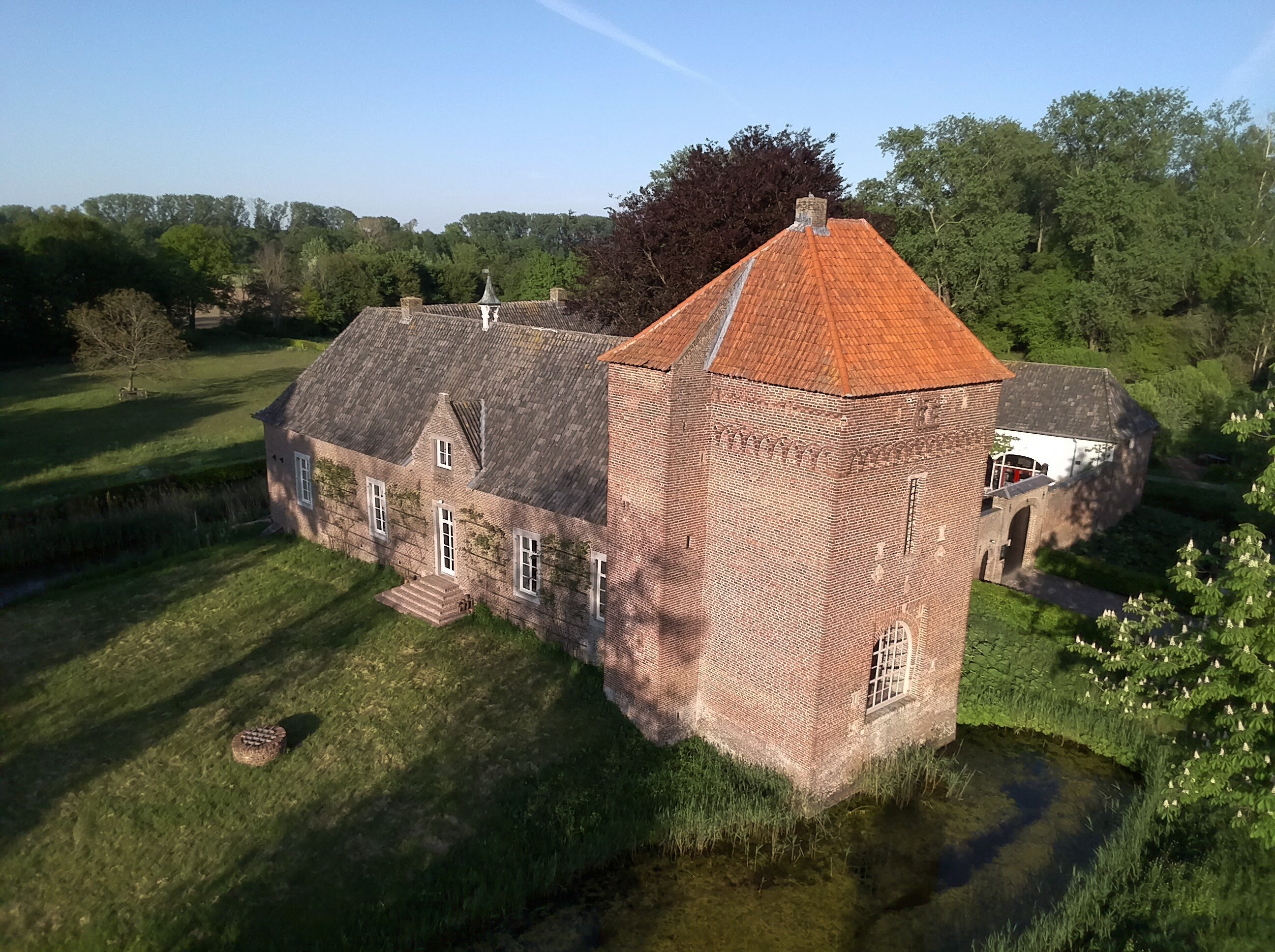
Tongelaar Castle
The tower at Tongelaar still shows you how the drawbridge worked. Look up at the brickwork on the eastern side and you can see the slots where the chains ran, the hinges of the long-gone doors, the notch where the bridge once pivoted against the wall. It is a piece of fourteenth-century mechanical engineering, frozen in masonry, set in a moated castle between the villages of Mill and Gassel in North Brabant. The lord who once held it from this tower also helped plot the murder of a count of Holland - and got away with it long enough to die in his bed.
A Gatehouse Built to Be Lived In
The big tower at Tongelaar is, properly speaking, a leftover. It was the gatehouse of a vanished outer bailey, dated to the late fourteenth century, and when the old keep was demolished sometime before 1752 the gatehouse stayed. What makes it unusual is what archaeologists found inside. Most bailey gatehouses in the Netherlands were pure defensive works - cold, narrow, military. Tongelaar's had toilets that drained into the moat, a fireplace mantel on the first floor, and a stair-tower cellar with embrasures shaped for arquebuses. Someone meant to live here from the start. The walls are more than 1.5 metres thick, the floor plan almost perfectly square at 7.72 by 7.86 metres, and the gate is still there, with the brickwork hardware of the drawbridge fossilised around it.
The Murder of Floris V
In 1282 Jan I of Cuijk - then the most famous of the Lords of Cuijk and the holder of Tongelaar - did something diplomatic and shrewd. He dedicated the castle to Floris V, Count of Holland, and received it back as a fief. The Latin deed called it 'munitionem et castrum nostrum' - our fortification and our castle. The arrangement protected Jan's assets in Holland. It lasted fourteen years. On 5 May 1296, Jan formally ended his allegiance to Floris. Seven weeks later, on 27 June, Floris V was murdered near Utrecht. Jan's nephew Gijsbrecht IV of Amstel and Herman VI van Woerden carried out the abduction. Gerard van Velsen did the killing. Jan I of Cuijk is regarded by historians as the chief conspirator. The plot is one of the most famous political crimes in medieval Dutch history, taught in schools, dramatised in literature, and it was hatched by the lord of this quiet moated castle in the Brabant fields.
A Six-Century Procession of Families
After the Cuijks the castle passed through a tangled list of heiresses and marriages: Van Merwijk by 1445, Van Bocholtz from 1513, Van Berchem from the late sixteenth century. The Van Berchems were Antwerp grandees - one of them, Floris, was mayor of Antwerp while also Lord of Tongelaar. His son Henri Antoine embraced Jansenism, wrote religious books, and died in Utrecht in 1729. After the Van Berchems came the De Hinnisdaels, then the counts of Thiennes de Lombize, then the Boessiere-Thiennes marquesses. In 1840 the estate amounted to 305 hectares spread across six municipalities. The names change every generation - countesses, marquesses, ambtmen of Grave - but the castle stays. Three leopards carved on a grave slab in nearby Escharen, found during a 2001 excavation, identified one of these families across more than five hundred years.
The Twentieth Century Quietly Takes Over
In July 1917 a widow named Louisa van Nispen bought Tongelaar Castle and its farms for 314,517.50 guilders. Within a year she had sold most of it on to three Van Wagenberg brothers from Vlijmen. In 1976 the castle changed hands again, briefly. Then in 1978 it passed to Het Brabants Landschap, the regional conservation trust that still owns it. The shift was quietly final: after six centuries of being a private seat passed between aristocratic families, Tongelaar became a public landscape. The castle today hosts weddings, business meetings, and summer concerts. The tower is an information centre for the surrounding nature reserve.
Four Hundred and Ninety Hectares for the Badgers
The Landgoed Tongelaar - the manor's grounds - covers 490 hectares of woodland, meadow, and old farm tracks. About fifty European badgers live there, and the reserve is managed largely around their habits and habitat: setts, foraging routes, hedge corridors. The land is freely open to walkers and cyclists. In summer the castle itself opens on Wednesdays and Sundays. The drawbridge is gone, the moat fills with weather, and on a still afternoon you can hear nothing but woodpeckers and the cattle in the next field. Six hundred years of Dukes of Brabant, mayors of Antwerp, and murder plots have settled into something quieter and arguably better.
From the Air
Tongelaar Castle sits at 51.71 N, 5.78 E, about 4 km southwest of the small town of Mill in North Brabant. The site is set in woodland between the Meuse and the wider Peel region; the moat and square inner court are visible from low altitude. Nearest airport is Eindhoven (EHEH) about 35 km south; Volkel military airfield (EHVK) is 10 km west.