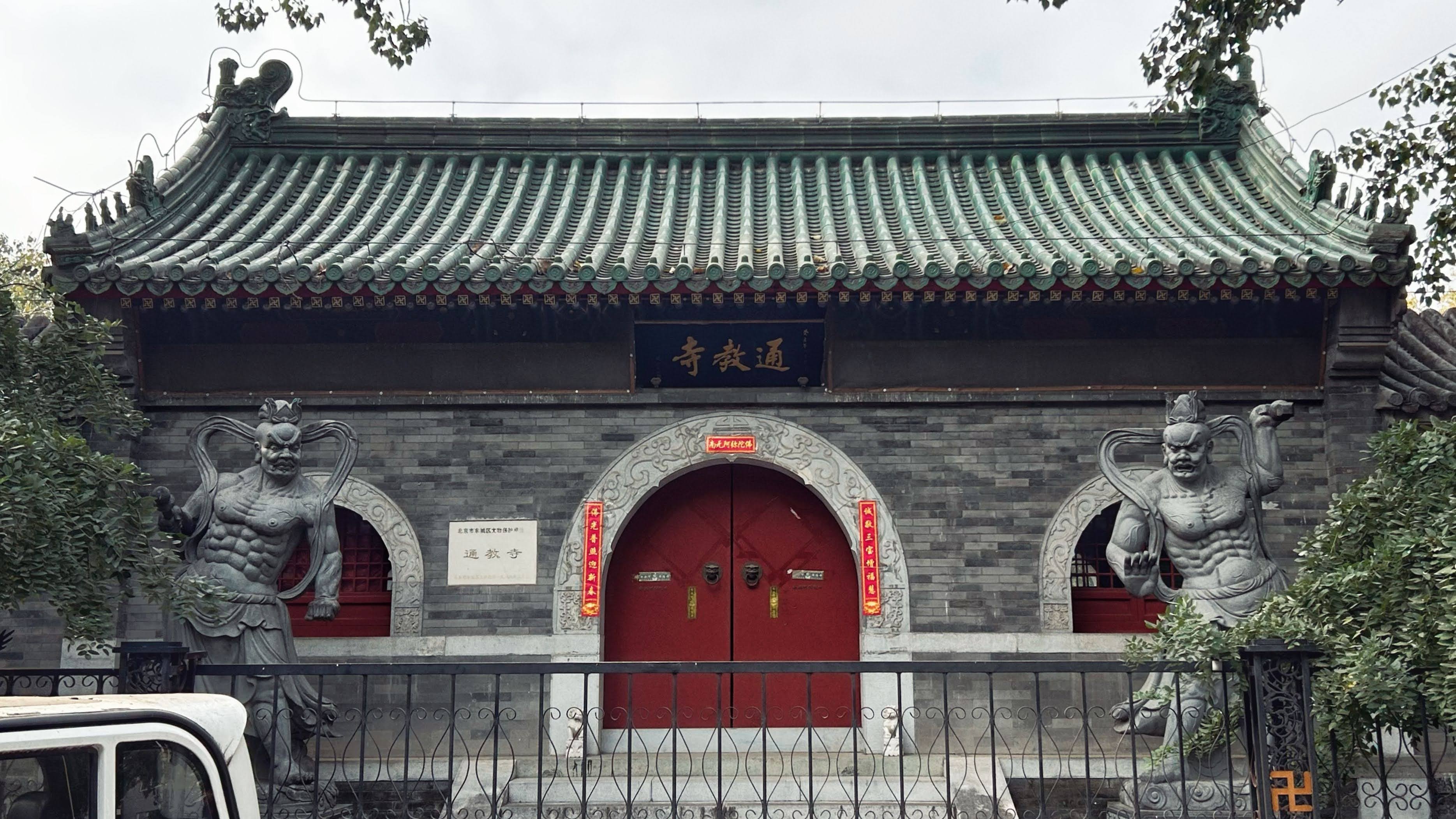
Tongjiao Temple
In 1941, only one nun remained. Her name was Yinhe, and she was the sole occupant of a crumbling Buddhist temple in Beijing's Dongcheng District -- a place that had been neglected so thoroughly during the early Republic of China that it was barely a functioning institution. The following year, three disciples of an eminent bhikkhuni named Cizhou arrived to rebuild. Kaihui, Tongyuan, and Shengyu added new halls, renamed the complex Tongjiao Temple, and founded Bajing Xueyuan, a Buddhist school that quickly earned a reputation across the capital. For a brief window, the temple flourished. Then history intervened, as it repeatedly has for this small, stubborn sanctuary.
A Eunuch's Foundation, a Nunnery's Mission
Tongjiao Temple was first established by a court eunuch during the Ming dynasty, sometime between 1368 and 1644. In the Qing dynasty, the complex was refounded as Tongjiao Chanlin and dedicated as a practice center for bhikkhuni -- fully ordained Buddhist nuns. This made it a rarity in Beijing, where monasteries far outnumbered nunneries. Covering just 700 square meters, the temple was modest by any standard, but its purpose was distinctive. Today, it remains the only bhikkhuni temple in Beijing, a status that gives it significance disproportionate to its physical size.
Flight to the Mountains
The political upheavals of the mid-twentieth century made Beijing increasingly inhospitable for religious institutions. In 1956, as socialist campaigns intensified, Kaihui and Tongyuan -- the nuns who had rebuilt the temple just fourteen years earlier -- left for the remote Buddhist sanctuaries of Mount Wutai, one of China's four sacred Buddhist mountains. Kaihui died there in the mid-1960s, never returning to the temple she had revived. Their departure marked the beginning of a period that would prove far worse: during the Cultural Revolution, Red Guards attacked Tongjiao Temple, destroying Buddhist statues and scriptures. The remaining bhikkhuni were forced to abandon their robes and return to secular life.
A Second Resurrection
After the Third Plenary Session of the Eleventh Central Committee in 1978 ushered in a new era of religious tolerance, Tongjiao Temple was reopened and rebuilt. In 1983, the State Council of China designated it among the first group of National Key Buddhist Temples in Han Chinese Areas -- an official recognition that offered both protection and prestige. The following year, Beijing's municipal government classified it as a key cultural heritage site. The temple's more than ten buildings now include a Shanmen gate, a Mahavira Hall, a Hall of Sangharama Palace, and various residential and administrative structures, all compressed into an area smaller than many Beijing apartment complexes.
Persistence in Miniature
Tongjiao Temple sits tucked into the urban fabric of Dongcheng District, surrounded by the dense residential blocks that characterize central Beijing. Its modest scale is part of its character. Where the great monasteries of Beijing command attention through size and grandeur, Tongjiao makes its case through survival. Founded by a eunuch, rebuilt by determined nuns, destroyed by ideologues, and restored by shifting political winds, the temple carries the compressed history of Chinese Buddhism in the twentieth century within its compact walls. That it continues to function as a place of active worship and practice -- still Beijing's sole bhikkhuni temple -- speaks to a resilience that no amount of political pressure has managed to extinguish permanently.
From the Air
Located at 39.94°N, 116.42°E in Beijing's Dongcheng District. The temple is too small to be individually visible from altitude but sits within the dense urban core northeast of the Forbidden City. Beijing Capital International Airport (ZBAA/PEK) lies 22 km to the northeast. Best appreciated in the context of the surrounding historic district at 2,000-4,000 feet.