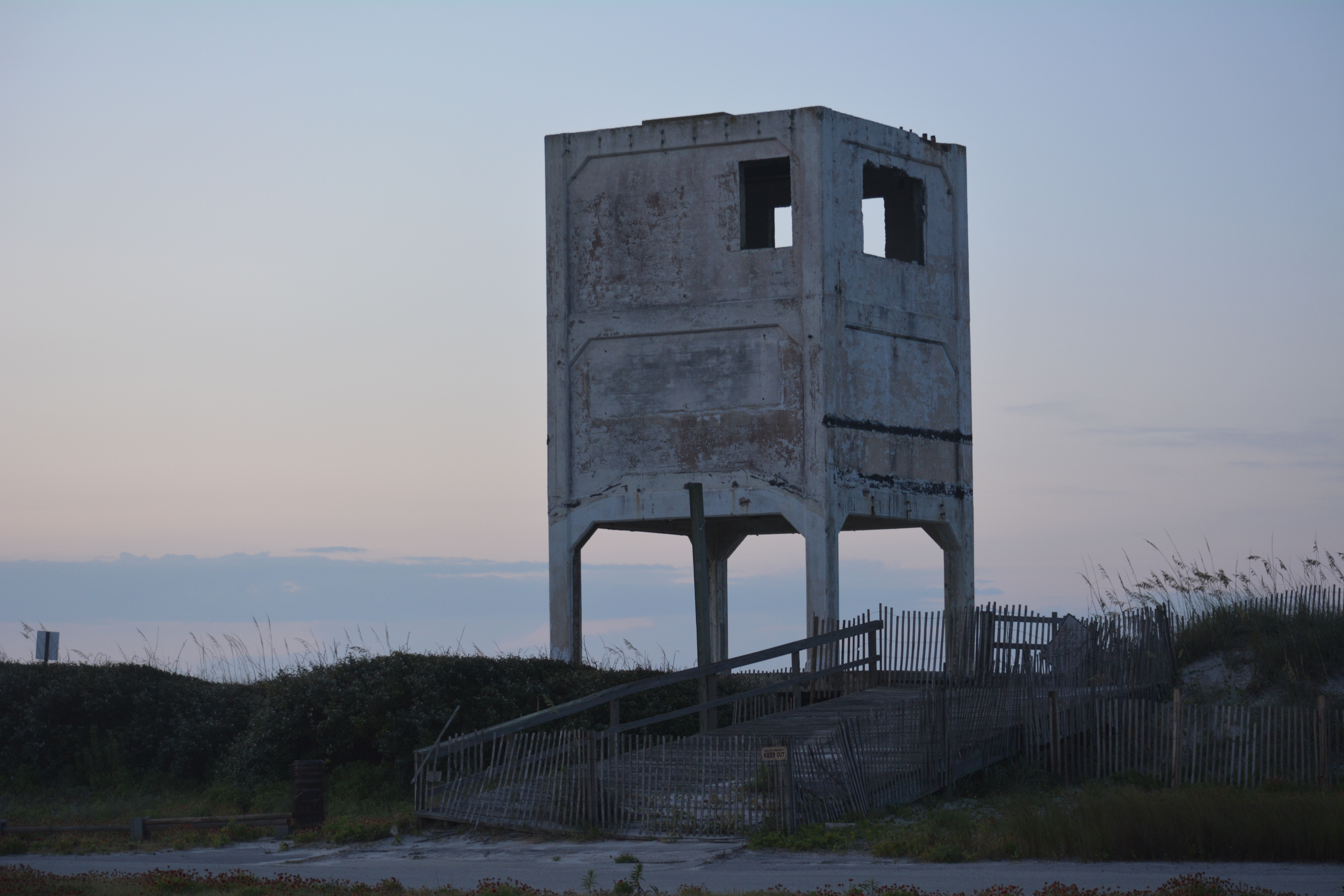
Topsail Island
The concrete launch pad where the Navy once fired experimental rockets at the edge of space is now a patio at the Jolly Roger Motel. That single detail captures Topsail Island better than any brochure could -- a 26-mile sliver of sand off the North Carolina coast where centuries of wildly improbable history have piled up like driftwood. Pirates lurked in its channels. The Army built an anti-aircraft training base here during World War II. Then the Navy arrived with Johns Hopkins University to conduct top-secret missile tests. When the military finally left, the roads and bridges they had built opened the island to vacationers, and the beach resort era began. Through it all, loggerhead sea turtles kept crawling ashore to lay their eggs in the dunes, as they had for hundreds of years before anyone gave the island a name.
The Pirate's Giveaway
Topsail Island -- pronounced TOP-sill, never top-SAIL -- takes its name from the age of piracy. According to local tradition, pirates hid in the channels between the island and the mainland, lying in ambush for merchant ships passing along the coast. Word eventually spread among mariners: watch for a topsail peeking above the island's low tree line, because that flutter of canvas was the only warning of an attack. Whether Blackbeard himself used this tactic is a matter of legend, but treasure hunters scoured the island's thick maritime forests for his buried gold well into the 20th century. Before World War II, Topsail Island was accessible only by boat. A handful of fishing shacks dotted the sound side, and local farmers forded the shallow waterways at low tide to graze their livestock on the wild beach grass.
Operation Bumblebee
The island's most extraordinary chapter began in 1946, when the U.S. Navy established a top-secret testing facility for Operation Bumblebee, a joint venture with Johns Hopkins University to develop ramjet-powered guided missiles. The name was deliberately playful -- possibly inspired by the myth that a bumblebee is aerodynamically incapable of flight yet flies anyway. Over 18 months, some 200 experimental rockets, measuring six inches in diameter and up to 13 feet long, were assembled in a masonry building on the sound side and launched along a northeasterly trajectory over the Atlantic. Eight concrete observation towers tracked the missiles along the island's length. The program proved the viability of ramjet propulsion and directly led to the development of the Talos, Terrier, Tartar, and Sea Sparrow missiles that armed Navy warships for decades. Topsail Island was the first permanent missile testing ground in the United States. When the Navy departed in 1948, the towers remained. Today, four have been converted into houses, one became a restaurant, and Observation Tower No. 2 stands unaltered -- the last intact example of the structures where America's missile age took its first steps.
Hurricanes and Hard Lessons
The military left behind something else of lasting value: roads, a bridge across the Intracoastal Waterway, and running water. Development as a beach resort began in the 1950s, and in 1952, a developer built a brick model home at the corner of Scott Avenue and Anderson Boulevard in Topsail Beach. Two years later, Hurricane Hazel's storm surge flooded the entire island and washed away most structures. The brick model home survived with minor damage, but its design was abandoned in favor of houses elevated on pilings -- a lesson that the Atlantic teaches barrier islands on a regular schedule. Hurricane Fran struck in 1996, destroying the addition on Observation Tower No. 3 and demolishing the fishing pier attached to Tower No. 6. The island's three communities -- North Topsail Beach, Surf City, and Topsail Beach -- have rebuilt each time, connected to the mainland by only two high-rise bridges.
Guardians of the Nest
While humans have been arriving and departing Topsail Island for centuries, the sea turtles have been constant. Four species -- loggerhead, green, leatherback, and Ridley -- nest along the island's 26 miles of beach. The loggerhead is the most prominent, and protecting its nesting sites became the mission of the Karen Beasley Sea Turtle Rescue and Rehabilitation Center. Founded by Karen Beasley, the effort began with a few volunteers walking the beaches at night to stake out nesting sites and watch over hatching eggs. After Karen's death in 1991, her mother Jean took over the organization and continued leading it for decades. The center cares for sick and injured turtles and oversees the entire length of the island's coastline during nesting season. The work is a race against both human encroachment and the hurricanes that erode nesting dunes and drown unhatched eggs. All five sea turtle species found in U.S. waters are listed as endangered under the Endangered Species Act.
From the Air
Located at 34.47N, 77.47W. Topsail Island is a narrow 26-mile barrier island running roughly northeast-to-southwest along the North Carolina coast, clearly visible as a thin strip of sand between the Atlantic Ocean and the Intracoastal Waterway. Best viewed at 2,000-3,000 ft AGL for the full length of the island. Surf City and its high-rise bridge mark the approximate center. The island lies south of Marine Corps Base Camp Lejeune and the New River Inlet. Nearest airports: Albert Ellis Airport (KOAJ) in Jacksonville, NC, approximately 15 nm north; Wilmington International (KILM) approximately 30 nm southwest.