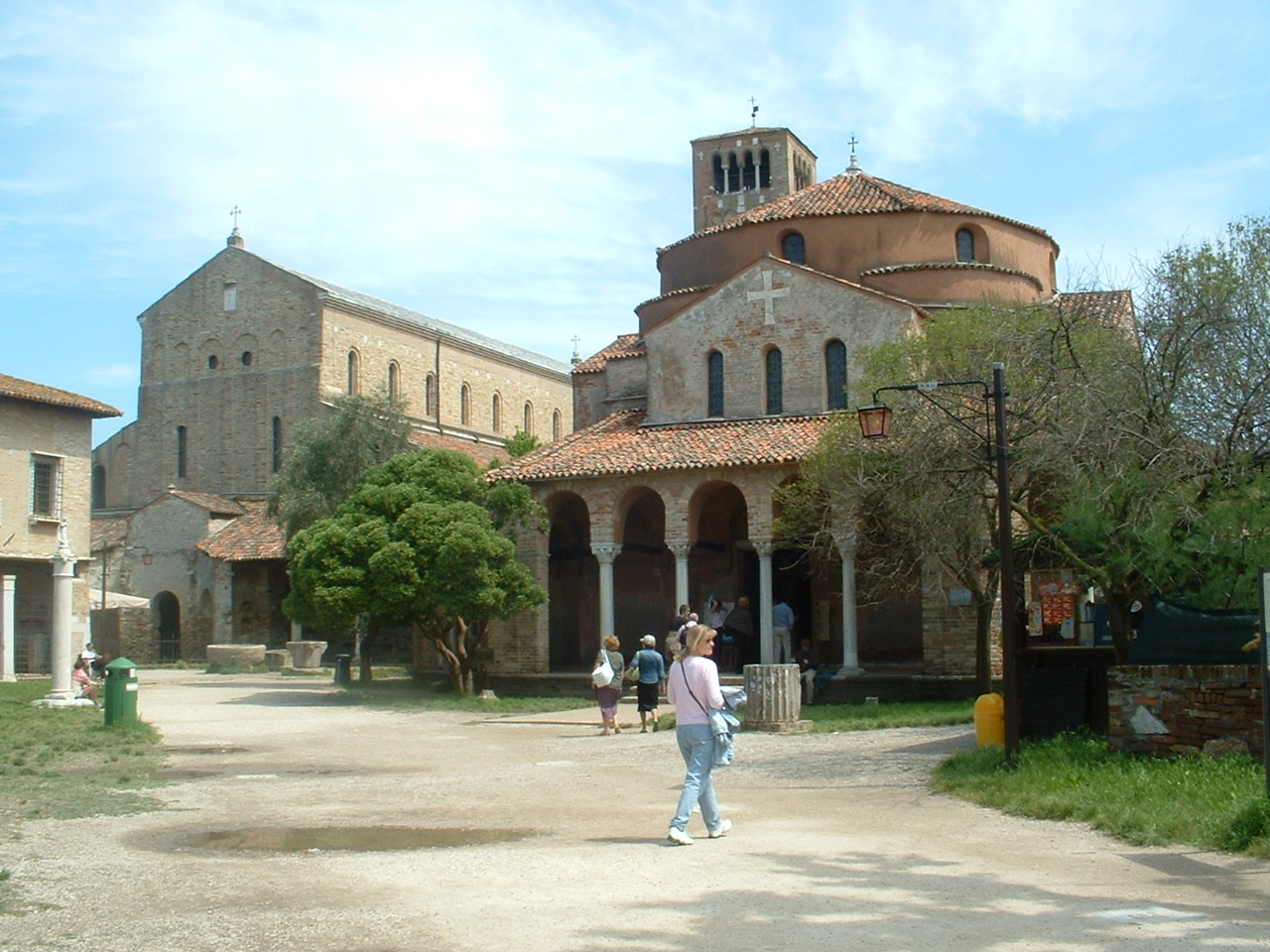
Torcello Cathedral
The oldest mosaics in the Venetian lagoon are not in St. Mark's Basilica. They are on Torcello, a near-deserted island at the lagoon's northern edge, inside a cathedral that was already ancient when the first stones of St. Mark's were laid. The Cathedral of Santa Maria Assunta was founded in 639, according to an inscription attributing its establishment to Isaac, Exarch of Ravenna. At that time, Torcello was a genuine rival to the young settlement at Venice -- a prosperous trading island with its own bishop, its own civic government, its own ambitions. The cathedral the islanders built reflected that ambition. Nearly fourteen centuries later, the city around it has vanished -- its palaces dismantled, its population reduced to single digits -- but the cathedral endures, its mosaics still glowing against their gold backgrounds, a monument to a civilization that otherwise left almost no trace.
Three Churches in One
What stands today is the product of three distinct building campaigns layered over four centuries. The original 7th century church had a simple plan: a nave with one aisle on each side and a single apse. Very little of that structure survives physically -- only the central apse wall and fragments of the baptistery that became part of the current facade. In 864, Bishop Adeodatus II directed a major renovation that added the two flanking apses, created the synthronon -- the semicircular stone seating that fills the central apse -- and placed a crypt beneath it. The church began to take recognizable shape, but it was the final renovation, consecrated in 1008 under Bishop Orso Orseolo, that produced essentially what visitors see today. Orseolo, whose father Pietro Orseolo II was the Doge of Venice, raised the nave, added clerestory windows, and built the arcades that separate the nave from its aisles. The connection to Venice's ruling family was not incidental: even as Torcello declined, its cathedral retained enough prestige to attract the doge's own son as its bishop.
Gold and Judgement
The mosaics are why anyone comes to Torcello, and they reward the journey. In the main apse, an 11th century Virgin Hodegetria stands alone against an immense field of gold, holding the Christ Child, her figure elongated and solemn in the Byzantine manner. Below her, a register of saints stands in a row, their faces individuated despite the formality of the style. A team of Byzantine mosaicists created these works in the late 11th century, though the main figure of the Virgin was reworked after an earthquake about a century later. The saints below remain from the original campaign, their tessera still sharp after a millennium.
The western wall delivers something altogether different. Above the door, occupying the entire surface from gable to floor, spreads a Last Judgement in four registers. At the top, a Crucifixion. Below it, a vigorous Harrowing of Hell shows Christ breaking open the gates and pulling the righteous free. The lowest registers sort the saved from the damned with an energy that borders on ferocity. This is not decorative art. It is theology made visceral, designed to be the last image worshippers saw as they left the church.
Bones and Stone
Beyond the mosaics, the cathedral accumulates relics of a kind that smaller churches could never claim. The interior holds the marble throne of the bishops of Altino -- the mainland city whose destruction sent refugees to Torcello in 452 -- and the sepulchre of Saint Heliodorus, Altino's first bishop, whose relics the refugees carried with them to consecrate their new home. The skull of Saint Cecilia, patron saint of music, is also kept here. The building's narthex, originally 11th century, was enlarged in the 13th century and once connected to a 7th century baptistery of which only traces remain. Adjacent to the cathedral is the martyrion dedicated to Santa Fosca, and behind it the bell tower that dates from the 11th century. The facade, with its twelve semi-columns connected by arches, faces a grassy square that feels less like a piazza and more like a meadow -- the open space left behind when a city disappeared around the church that survived.
Architecture of Survival
The cathedral belongs to the tradition of Late Paleochristian architecture -- a style that bridges the late Roman and early Byzantine worlds. Its basilica plan, with nave, two aisles, and eastern apses, follows patterns established in the earliest Christian churches. The marble portal at the center of the narthex dates to approximately the year 1000. The frontal portico was enlarged in the 14th century, around the time that Torcello itself was collapsing as a viable settlement, a detail that suggests the cathedral retained importance even as the town emptied. The building has none of the decorative excess of later Venetian churches; its beauty is structural, a matter of proportion and light, the stone warm and unadorned where mosaics do not cover it. Standing inside, you can trace the archaeology of the building: the 7th century apse wall behind the 11th century mosaics, the 9th century synthronon below the altar, the 11th century arcades rising to clerestory windows that Orseolo cut into walls already four centuries old. The layers are the history.
From the Air
Torcello Cathedral (45.50N, 12.42E) sits on the island of Torcello in the northern Venetian Lagoon. The cathedral's bell tower is the tallest structure on the island and serves as the primary visual identifier from the air. The island itself is small and largely green, surrounded by marsh and shallow water channels. Burano, with its distinctive colorful buildings, lies immediately to the southwest. Venice Marco Polo Airport (LIPZ/VCE) is approximately 8km northwest. Best viewed at 1,500-2,500 feet to spot the bell tower and the cathedral complex amid the flat marshland.