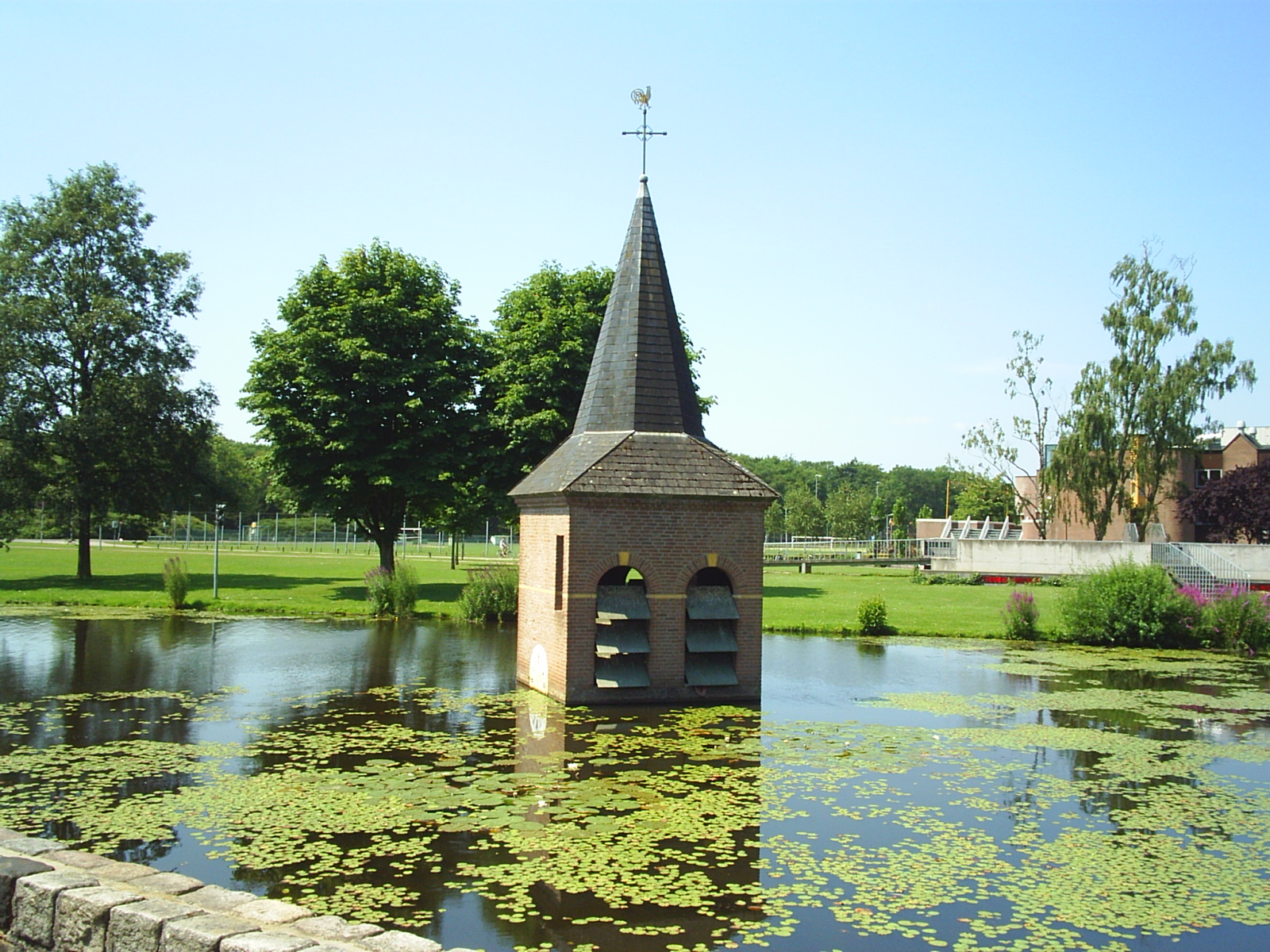
Torentje van Drienerlo
On a pond at the University of Twente in Enschede, the top of a church spire breaks the water. Just the spire - the tip of a steeple and the cross at its summit. It looks for all the world as if a small church has finished sinking, leaving its highest point as the only evidence it was ever there. There is no church beneath it. There never was. The artist who put the spire on the pond in 1979, Wim T. Schippers, intended exactly that mystery, and he intended it on a college campus because he thought a campus was the kind of place that needed it.
The Man Who Buttered the Floor
By the time Schippers built the Torentje, he had already left the visual-art world he had grown up in. In the 1960s he was associated with Fluxus, the international movement of artists who treated absurdity as a serious medium. His most notorious early piece was the Pindakaasvloer - the peanut-butter floor - a gallery installation first realized in 1969, though the concept dates from 1962, that consisted essentially of a floor entirely covered in peanut butter. He worked on short films with Wim van der Linden and others, but his relationship with the gallery world was difficult, and by the early 1970s he had moved almost entirely into television, writing and producing programs for the Dutch broadcaster VPRO. Schippers later called television 'the greatest gallery in the world.' The Torentje is one of the few permanent objects he made for a physical location after that shift.
An Idea That Floats
The work has no plaque explaining itself. It is just there, in a pond at the edge of a wooded campus, looking as though a church has gone under and only the steeple still stands. Schippers wanted that exact ambiguity. The reading is up to you - a swallowed village, a slow flood, a quiet apocalypse, a deadpan joke about Dutch land and water - and the work refuses to settle into any single one of them. That openness is what has let the Torentje become more than a sculpture on a campus. Generations of students have made up their own stories about it, defended their own readings, and used the pond around it for things its creator could not possibly have planned for.
What a Campus Does With a Steeple
The University of Twente has an extensive outdoor art collection, but the Torentje is the best-known piece, and it has become the unofficial center of campus ritual life. In winter, the pond is the venue for short-track skating events, and it serves as the finish line for the Elfvijvertocht - the campus's homemade answer to the historic Frisian Elfstedentocht, except that skaters circuit eleven ponds on the grounds instead of eleven cities across a province. The race has run since 1987. During international soccer tournaments, Dutch and German students take turns occupying the spire to hang their national flags from it. During rush week, fraternity and sorority pledges swim out to it. In March. The water is cold.
A Sister Tower in a Different Pond
On the occasion of Schippers' seventieth birthday, admirers built a replica of the Torentje and placed it in the Kortrickvijver, near the Willy Dobbeplantsoen in the town of Olst, west of the Sallandse Heuvelrug. The replica - like the Plantsoen itself - was the work of De Nuts Neut, a small Olst society describing itself as a gentlemen's club. The new tower did not stay in its first home for long. In February 2013, it was relocated to a low-lying area between the summer and winter dikes of the IJssel river - and the area promptly flooded. The replica was suddenly far more convincing than the original. A church spire poking out of a real river surrounded by real floodwater is not a thing you can plan.
Why It Lasts
Most public art on most campuses is invisible by the second semester - people walk past it on the way to lectures and stop seeing it. The Torentje van Drienerlo somehow does not do this. Part of the reason is the framing: a single object alone on water reads differently from one bolted to a plaza, and a fragment that suggests something hidden invites looking in a way that a complete sculpture does not. Part of it is the seasonal use - skating in winter, swimming in March, flag occupations in the summer of every major football year. Part of it is the campus pride in something a famous national absurdist actually built for them. And part of it, almost certainly, is that the joke still works. Wim T. Schippers spent his career arguing that art that takes itself entirely seriously is missing the point. A church spire pretending to drown in a small Dutch pond, with no church beneath it, is exactly the kind of point he meant.
From the Air
The Torentje sits in a pond on the University of Twente campus, in the northwestern outskirts of Enschede, at 52.243 N, 6.853 E. Nearest airports: Twente Airport (EHTW) just north of the city, Münster-Osnabrück (EDDG) about 45 km east in Germany, Groningen Eelde (EHGG) about 100 km north. From low altitude, the campus is identifiable as a green island of woods and small ponds wedged between Enschede's western edge and the village of Hengelo, with a cluster of modern academic buildings on its eastern half. The Torentje is small enough not to be visible from cruising height; it is best appreciated from ground level on the campus itself.