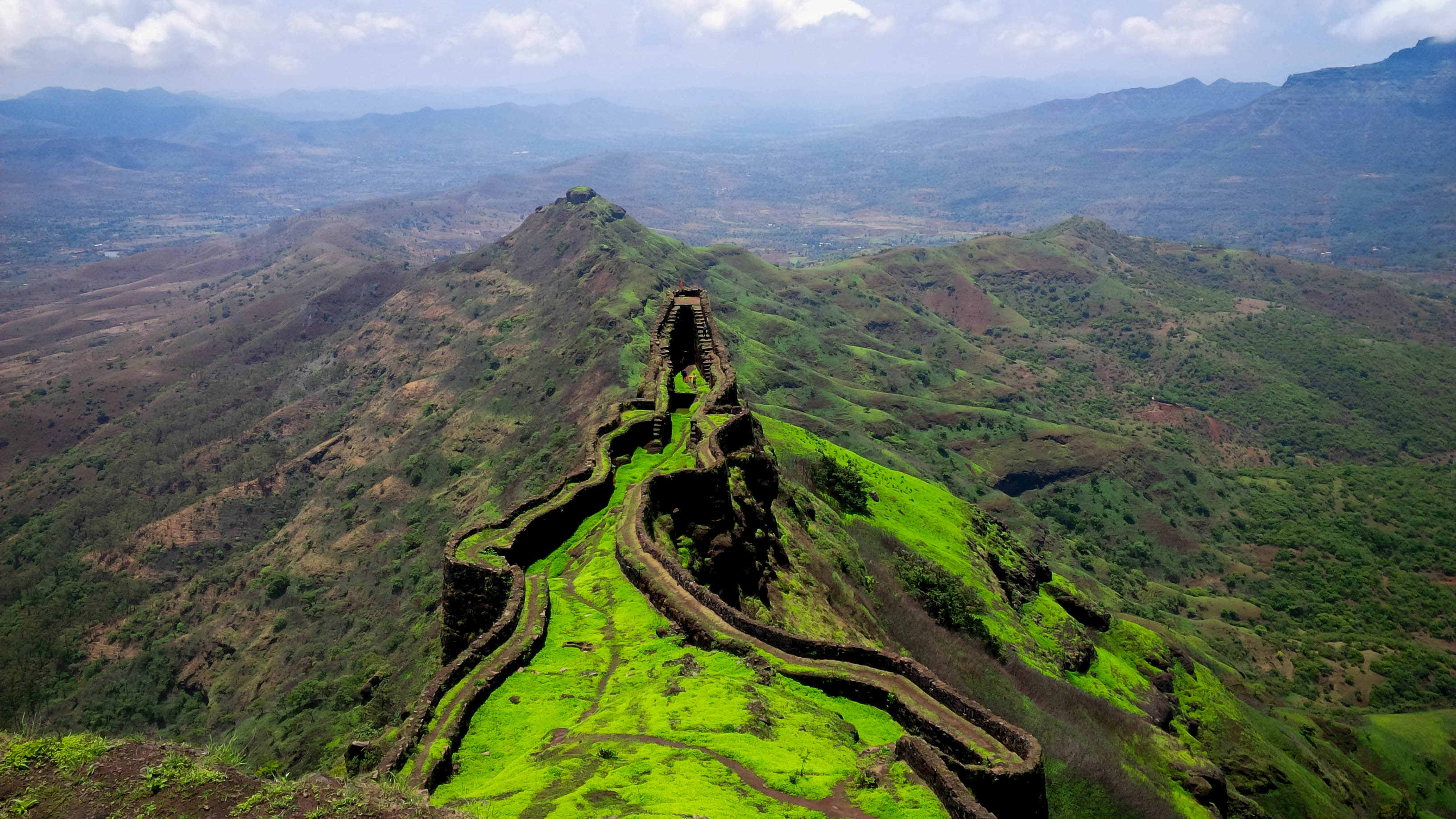
Torna Fort
A sixteen-year-old boy captured a mountain fortress, and an empire began. In 1646, Shivaji seized Torna Fort from forces loyal to the Bijapur Sultanate, and what he found inside changed history. While repairing the fort and excavating its ruins, his men unearthed large quantities of gold -- treasure buried at some unknown time by unknown hands. Shivaji used that gold to build Rajgad Fort, which became the first capital of the Maratha Empire. The conquest of Torna was not merely a bold military act by a teenager. It was the foundation stone of a kingdom that would eventually challenge the Mughal Empire itself.
Prachandagad: The Massive Fort
Torna Fort stands at 1,403 meters above sea level, making it the highest hill fort in Pune district. Its name tells you what you need to know about its character: Prachanda means "huge" or "massive" in Marathi, and gad means "fort." Shivaji renamed it Prachandagad after capturing it, though the older name Torna persisted in common use. The fort is believed to have been constructed by followers of the Shaiva tradition in the thirteenth century. A temple to the goddess Menghai Devi, also called the Tornaji temple, still stands near its entrance. The walls and fortifications spread across a vast hilltop area, with two distinct elevated sections -- the Budhla Machi and the Zungar Machi -- connected by fortified ridgelines that follow the mountain's natural contours.
The Prize That Launched a Kingdom
Shivaji's capture of Torna in 1646 was the first in a chain of fortifications that would define the Maratha military strategy for generations. Hill forts were the backbone of Maratha power -- they controlled mountain passes, sheltered armies during monsoons, and were nearly impossible to take by siege. After Torna, Shivaji captured fort after fort across the Western Ghats, building a network of strongholds that stretched from the Konkan coast to the Deccan Plateau. The buried gold at Torna was the seed money, but the real treasure was strategic position. From the summit, the view encompasses a constellation of Maratha forts: Raigad, Lingana, Rajgad, Purandar, and Sinhagad are all visible, each one a node in the defensive web Shivaji wove across the Sahyadris.
Emperors and Renaming
Torna did not remain in Maratha hands without interruption. After the assassination of Shivaji's son Sambhaji, the Mughal emperor Aurangzeb launched a prolonged campaign to dismantle the Maratha kingdom. When the Mughals finally took Torna, Aurangzeb renamed it Futulgaib, acknowledging the ferocious defense his forces had to overcome. The name was a grudging compliment -- even in conquest, the Mughals recognized the fort's formidable nature. Eventually, the Treaty of Purandar restored the fort to the Maratha Confederacy, and it returned to its original custodians. The succession of names -- Torna, Prachandagad, Futulgaib, and back again -- traces the political tides that washed over these mountains across centuries.
Trekking Where Shivaji Climbed
Today, Torna is one of the most popular trekking destinations near Pune, especially in the months after the southwest monsoon, from September to December, when the hillsides are green and the air is washed clean. The fort lies about 50 kilometers southwest of Pune via the Pabe Ghat, with the base village of Velhe serving as the starting point for the ascent. The trek is demanding enough that the district collector has prohibited overnight stays; everyone must leave the fort by five in the evening. Along the route, trekkers pass through the Kothi Darwaja and Konkan Darwaja gateways, past the Menghai goddess temple, and across the broad machis where Maratha soldiers once drilled. On a clear day, the panorama from the summit is a geography lesson in Maratha power -- fort after fort studding the ridgeline, each one visible from the next, a chain of stone sentinels watching over the Western Ghats.
From the Air
Torna Fort is located at approximately 18.276N, 73.623E in the Western Ghats, about 50 km southwest of Pune. At 1,403 meters elevation, it is the highest fort in Pune district and visible as a prominent peak with fortification ruins on the summit. The fort's two machis (elevated fortified sections) create a distinctive profile. From altitude, several other Maratha forts are visible in a chain across the Sahyadri range: Rajgad, Raigad, Sinhagad, and Purandar. Nearest airport is Pune International (VAPO, approximately 50 km northeast). Best viewed at 5,000-8,000 feet AGL. Terrain is rugged and mountainous with no nearby landing areas.