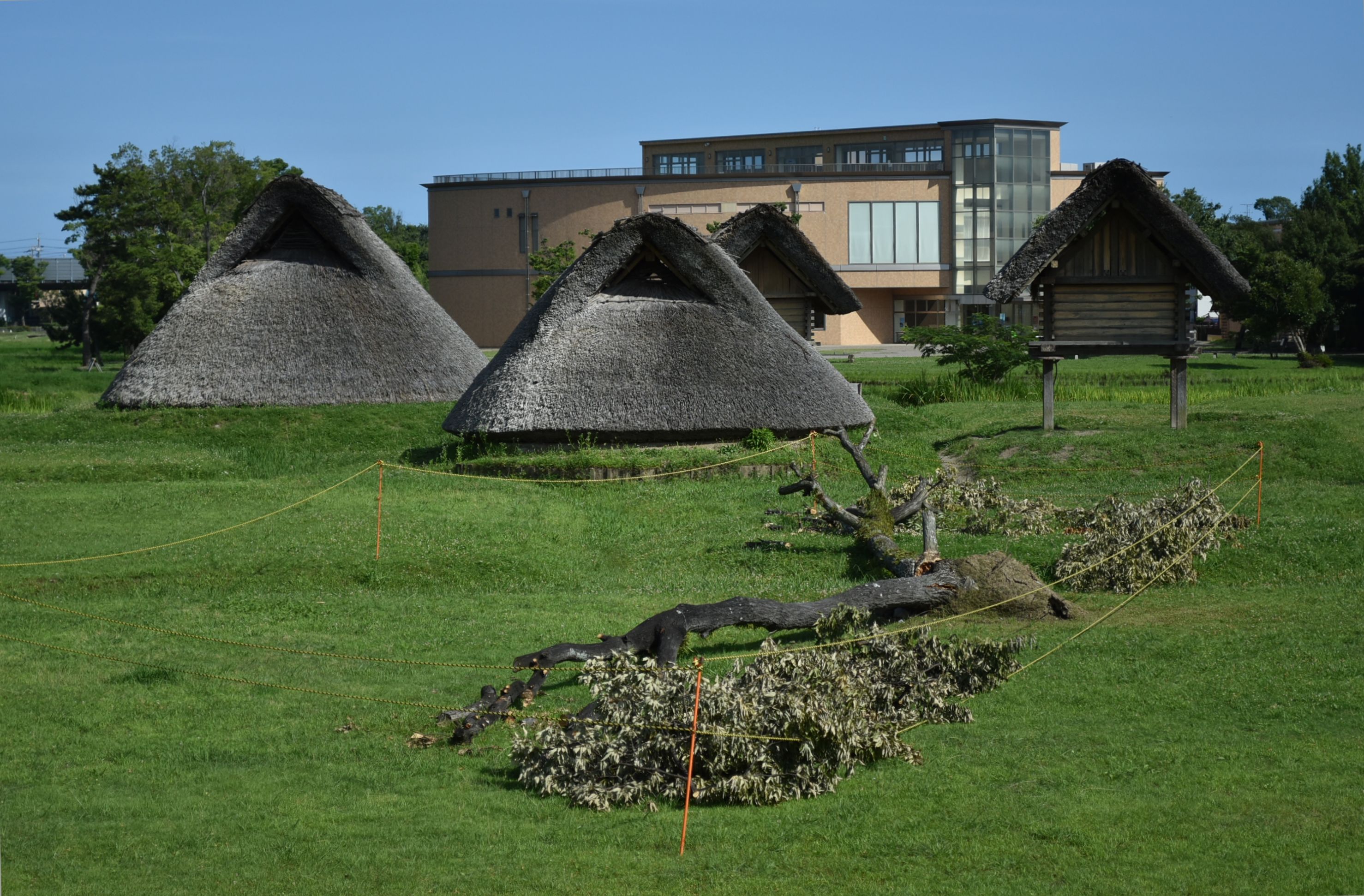
Toro Archaeological Site
In 1943, workers digging foundations for a wartime munitions factory in Shizuoka struck something unexpected: rows of wooden stakes and waterlogged timbers, impossibly old, preserved in the saturated earth as though they had been buried yesterday. What they had uncovered was the remains of a farming village two thousand years old, complete with pit-house dwellings, raised storehouses, and over fifty rice paddies stretching across seventy thousand square meters. The Toro site, as it came to be known, was the first place in Japan where Yayoi-period wet-rice paddy fields were excavated, and the discovery electrified a nation still reeling from war. The excavation that followed in 1947 and 1948 drew such intense scholarly interest that it prompted the founding of the Japanese Archaeological Association itself -- an entire professional body born from the study of a single site.
Unearthed Between Bombs and Bulldozers
The timing of Toro's discovery could not have been more dramatic. Japan in 1943 was deep in the Pacific War, pouring resources into military production. Construction crews building a munitions plant in Suruga Ward stumbled onto the ancient remains, but full investigation had to wait until after the war ended. When excavation began in 1947, the sheer scale of what lay beneath the soil became clear. Twelve pit-house dwellings emerged from the earth, along with two raised-floor storehouses and a vast expanse of ancient rice paddies. The preservation was remarkable. Wooden farming tools -- hoes, rakes, and digging implements -- had survived for two millennia in the waterlogged ground, their forms still sharp enough to reveal the joinery techniques of their makers. A second excavation survey in 1965 preceded the construction of the Tomei Expressway through the area, and a major re-excavation from 1999 to 2003 uncovered additional details about the settlement's layout and daily life.
The Village That Defined an Era
Toro became the reference point for understanding Yayoi culture across Japan, even though its location in the Tokai region was peripheral to what scholars traditionally considered the Yayoi heartland in northern Kyushu. The site served as a type site -- a benchmark against which other Yayoi discoveries were measured. The pit-dwellings followed a consistent design: four wooden posts sunk into the ground supported beams at the top, with rafters radiating down to ground level, the whole structure covered in thatch. Inside, the floor sat level with the surrounding earth, and a hearth was sunk into the center. The raised storehouses told a different story of sophistication -- they were built using mortise and tenon joinery, planked construction that required iron tools to achieve. An entrance ladder carved from a single log gave access to the elevated floor. These were not crude shelters but carefully engineered buildings designed for specific purposes: living, storing grain, and weathering the seasons.
Seventy Thousand Square Meters of Rice
The rice paddies were the revelation. Over fifty individual paddy fields spread across an area of seventy thousand square meters, fed by refined irrigation channels that controlled water flow with a precision that modern farmers would recognize. This was not subsistence scratching at the soil -- it was organized agriculture on a community scale, evidence that Yayoi-period farmers in the first century CE possessed sophisticated knowledge of hydrology, seasonal planting, and cooperative labor. The paddies painted a portrait of a settled, organized society, one with enough surplus to build storehouses and enough stability to invest in permanent infrastructure. But this stability had limits. The Toro community met its end not through conquest or decline but through a catastrophic flood of the Abe River, which swept through the settlement and buried it under layers of silt -- the same silt that would preserve its remains for two thousand years.
An Open-Air Window into the Past
Today, the Toro site is preserved as a public archaeological park in Shizuoka's Suruga Ward, its reconstructed pit-houses and raised storehouses rising from recreated rice fields that visitors can walk among. The Shizuoka City Toro Museum stands at the edge of the park, housing and displaying artifacts from the excavations. In 2016, 775 artifacts from the site were designated as Important Cultural Properties of Japan, a recognition of their exceptional historical significance. The site itself has been a designated Special Historic Site since 1952, one of the highest levels of protection the Japanese government grants to archaeological heritage. For a place discovered by accident in the chaos of wartime construction, Toro has become one of the most important windows into Japan's agricultural origins -- proof that beneath the modern sprawl of Shizuoka, the foundations of Japanese civilization lie waiting just below the surface.
From the Air
Located at 34.956N, 138.408E in the southern part of Shizuoka City, Suruga Ward, Japan. The site sits in a flat alluvial plain near the Abe River, approximately 2 km inland from Suruga Bay. From the air, look for a green open park area surrounded by dense urban development -- the reconstructed thatched pit-houses and rice paddies are distinctive against the city grid. The Tomei Expressway runs nearby. Nearest airport: Mt. Fuji Shizuoka Airport (RJNS) approximately 20 nm southwest. Shizuoka Heliport is closer. Expect typical coastal plain conditions with good visibility except during summer haze or typhoon season.