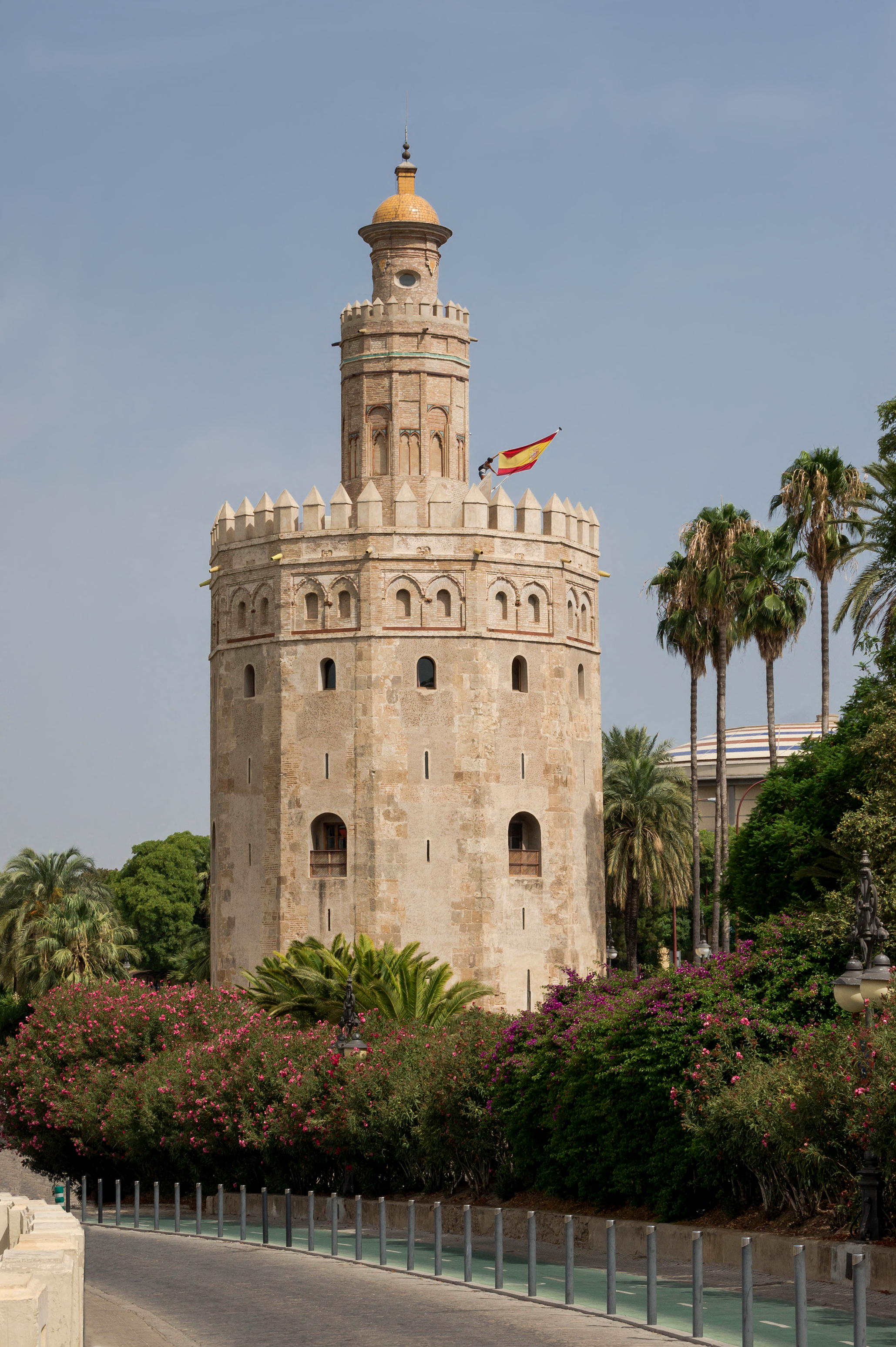
Torre del Oro
Its name means Tower of Gold, and for eight centuries travelers have debated why. The Torre del Oro stands on the east bank of the Guadalquivir in Seville, a twelve-sided watchtower built by the Almohad Caliphate around 1220 to control access to the city by river. The golden shimmer that gave it its name came not from precious metal but from its building materials -- a mixture of mortar, lime, and pressed hay that caught the Andalusian sun and threw warm light across the water. By the time the tower's glow faded, its strategic importance had already been written into the history of the Reconquista.
Three Towers in One
The Torre del Oro is really three buildings stacked atop each other, each from a different era. The first and lowest level, dodecagonal in plan, was built in 1220-1221 by order of Abu l-Ula, the Almohad governor of Seville. It anchored a section of defensive wall connecting to the nearby Torre de la Plata -- the Tower of Silver -- and barred the approach to the Arenal district and the Alcazar beyond. The second level, also twelve-sided but only eight meters tall, was added by Peter of Castile in the 14th century, a dating confirmed by archaeological studies. The third and uppermost level is the youngest and the only circular one: it was built in 1760 by the Brussels-born military engineer Sebastian Van der Borcht, the same architect who designed the Royal Tobacco Factory of Seville, after the original Almohad top was damaged beyond repair by the 1755 Lisbon earthquake.
The Chain Across the River
The tower's most dramatic role came in 1248, during the siege of Seville. A massive chain stretched from the Torre del Oro to an anchor point on the opposite bank, forming a boom that blocked all river traffic. The chain was the last line of defense connecting Seville to Triana across the Guadalquivir. When Ramon de Bonifaz sailed his Castilian fleet upriver and broke through the chain, he severed that lifeline and doomed the city to surrender. The opposite anchor point has since vanished -- possibly demolished, possibly collapsed during the same earthquake that damaged the tower centuries later. But the Torre del Oro survived, standing witness to the end of Moorish Seville.
Saved by the People
The 1755 Lisbon earthquake -- which devastated cities across the Iberian Peninsula -- left the tower badly damaged. The Marquis of Monte Real proposed demolishing it entirely, arguing that the ruins obstructed carriage traffic and blocked the approach to the bridge of Triana. The people of Seville objected. They appealed directly to the king, who intervened to save the tower. Repairs began in 1760: the base was reinforced with rubble and mortar, a new main entrance was created through the wall passage, and Van der Borcht's cylindrical upper body replaced the ruined Almohad crown. The work changed the tower's silhouette from what appears in 16th- and 17th-century engravings, but it preserved what the city refused to lose.
From Prison to Museum
The tower served as a prison during the Middle Ages, and its thick walls and riverside isolation made it well suited to the purpose. Today it houses a small naval museum displaying navigational instruments, ship models, historical documents, engravings, and nautical charts tracing Seville's relationship with the Guadalquivir and the sea beyond. In 1992, the Torre del Oro was twinned with the Tower of Belem in Lisbon to celebrate the Universal Exposition in Seville -- a symbolic pairing of two riverside towers that once guarded the approaches to two Iberian empires. The tower was restored again in 2005, its dodecagonal profile still catching the light along the Guadalquivir, still glowing faintly gold in the right conditions.
From the Air
Located at 37.38N, 6.00W on the east bank of the Guadalquivir River in central Seville. The distinctive twelve-sided tower is visible along the riverbank. The Torre de la Plata is nearby to the northeast. Nearest airport: Seville-San Pablo (LEZL), approximately 10 km northeast. Best viewed at 1,000-2,000 ft AGL following the Guadalquivir through the city. The Triana district is directly across the river.