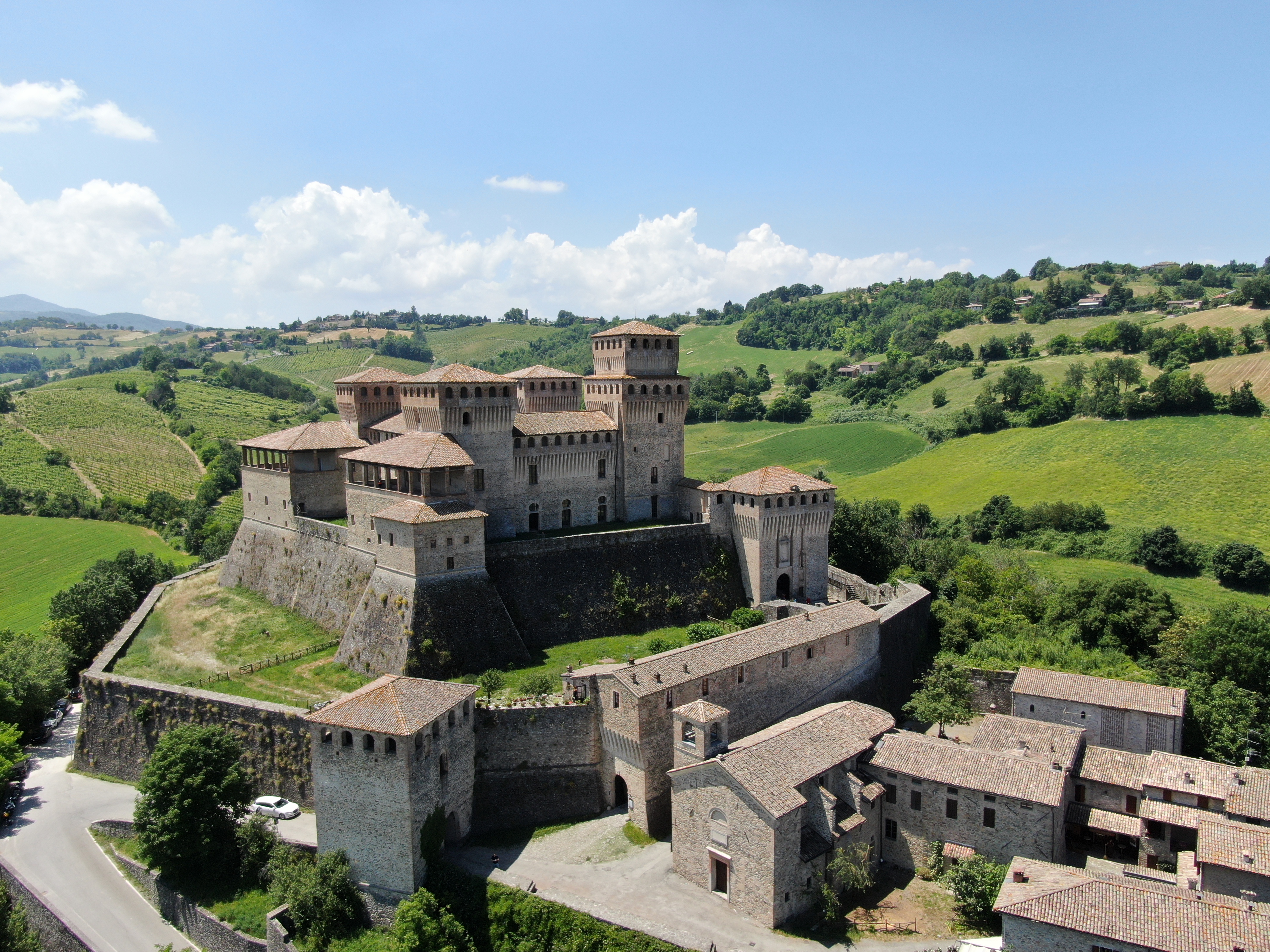
Torrechiara Castle
In the Camera d'Oro -- the Golden Bedchamber -- of Torrechiara Castle, a woman runs through painted landscapes. The frescoes in the lunettes portray Bianca Pellegrini d'Arluno crossing the estates she shared with her lover, Count Pier Maria II de' Rossi, searching for him across their lands. The paintings, attributed to Benedetto Bembo, are among the most celebrated examples of secular bedchamber decoration in Italy, and they reveal something unusual about this castle: it was built not primarily for war but for a love affair. Between 1448 and 1460, on a terraced hill overlooking the Parma River valley, Rossi created a fortress that was also a monument to private passion. He and Bianca are both buried here, in the Oratory of San Nicomede in the northeast tower.
A Fortress Dressed for Romance
The architecture makes the castle's dual purpose visible. Four rectangular towers connected by a double line of crenellated walls create a genuine military stronghold, influenced by the castles of the House of Sforza and particularly the Visconti-Sforza Castle at Novara. The inner courtyard -- the Cortile d'onore, or Courtyard of Honour -- speaks to the castle's residential ambitions. Each tower carries a name that reveals its character: the Torre di San Nicomede, with its chapel, guarded the approach from Langhirano. The Torre del Giglio -- Lily Tower -- bore Bianca Pellegrini's coat of arms. The Torre della Camera d'Oro contained the famous golden bedchamber. And the Torre del Leone -- Lion Tower -- served as the keep, its name drawn from Rossi's own heraldry. The Salone dei Giocolieri, the Jugglers Hall, shares the first floor with the Camera d'Oro, and additional rooms named Aurora, Meriggio, Vespro, and Sera -- Dawn, Midday, Evening, and Night -- trace the passage of time through the castle's interior.
The Pilgrim and the Count
Pier Maria II de' Rossi was the fourth Count of San Secondo, a nobleman whose political life was entangled with the shifting alliances of 15th-century northern Italy. Bianca Pellegrini d'Arluno was his mistress, and the castle was built explicitly as her residence -- a private world set apart from the count's public obligations. The Camera d'Oro frescoes tell their story with remarkable intimacy. Bianca appears repeatedly in the lunettes, moving through recognizable landscapes of the Po Valley and the Apennine foothills, her presence in each scene charged with the longing of separation. The chamber opens onto a panoramic loggiato that frames the valley below in a view that has changed little since the 15th century. Bianca died at Torrechiara around 1480. Rossi retired here in 1482 and died later that year. That they were buried together in the castle's oratory -- not in a public church or family crypt -- speaks to the depth of a bond that defied the conventions of their time.
Centuries of Changing Hands
After Rossi's death, the castle began its long journey through Italian history's revolving door of ownership. It changed hands multiple times over the centuries, its strategic hilltop position making it valuable to whoever controlled the territory between Parma and the Apennine passes. In 1911, it was declared a national monument. The following year, the Italian State purchased it -- unfurnished, its rooms echoing with absence -- and opened it to the public. An earthquake of magnitude 5.2 struck the region on December 23, 2008, causing significant damage, particularly to the external walls of the San Nicomede tower and the battlements. Some rooms closed for structural renovation, but the work also revealed opportunities for restoration. The Oratory of San Nicomede was rebuilt on the ground level, and the original Sala della Sera was reconstructed and restored. When the castle reopened in July 2014, visitors could walk through spaces that had been closed or ruined for decades.
Ladyhawke's Castle
International audiences encountered Torrechiara without knowing its name. In 1985, scenes from the fantasy film Ladyhawke -- starring Rutger Hauer, Michelle Pfeiffer, and Matthew Broderick -- were shot at the castle, its medieval towers and Courtyard of Honour providing an authentic backdrop for a tale of cursed lovers. The coincidence is almost too perfect: a castle built for a real love story becoming the setting for a fictional one. Today the Courtyard of Honour hosts the Torrechiara Festival, dedicated to the great soprano Renata Tebaldi, whose voice once filled the space where knights drilled and lovers walked. The nearby church of Saint Lawrence and the Abbey of Santa Maria della Neve offer additional reasons to linger in this quiet corner of the Parma province, where the Apennine foothills fold into vineyard-covered terraces and the air carries the scent of the cured hams that have made neighboring Langhirano famous.
From the Air
Located at 44.655N, 10.274E on a prominent terraced hilltop south of Parma, overlooking the Parma River valley. The castle is clearly visible from the air -- four towers connected by crenellated walls on a hillcrest surrounded by vineyards and farmland. Best viewed at 2,000-3,000 feet AGL. Nearest airport: Parma (LIMP/PMF), approximately 18 km north. The Po Valley stretches to the north while the Apennine foothills rise to the south. The town of Langhirano lies in the valley below.