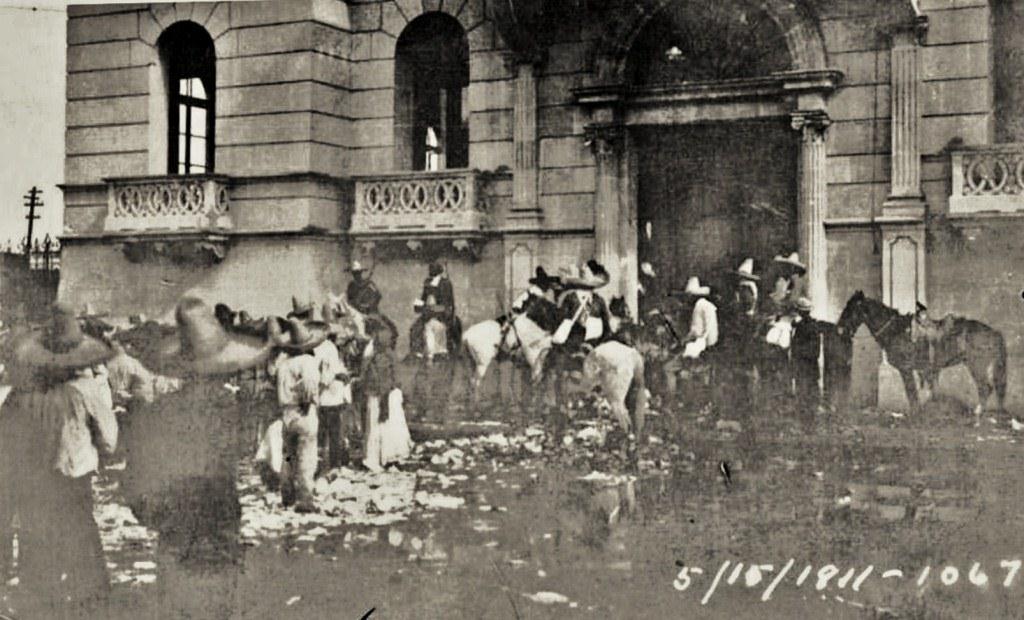
Torreón Massacre
On the morning of May 15, 1911, Woo Lam Po's warning came true. Three days earlier, the secretary of the Chinese reform association in Torreón had circulated a letter among community leaders: violence was coming. The Maderista rebels were approaching the city, and the speeches preceding them left no doubt about what would follow. By six o'clock that Monday morning, rebel soldiers and a mob of over 4,000 civilians were pouring into Torreón's Chinese district. Ten hours later, 308 people were dead -- 303 Chinese and 5 Japanese residents who were killed because they were mistaken for Chinese -- roughly half the Chinese community in the city -- their bodies stripped and buried together in a trench while Mexican dead received proper burial in the city cemetery.
Prosperity as a Death Sentence
Chinese immigrants had been arriving in Torreón since the 1880s, drawn by the same forces that attracted everyone else: two intersecting railroads, the Nazas River's irrigation potential, and a cotton boom that was transforming a desert crossroads into a commercial hub. By 1900, about 500 of the city's 14,000 residents were Chinese, mostly from Guangdong Province. They established groceries, laundries, gardens, and restaurants. The reform politician Kang Youwei visited in 1906 and saw enough promise to establish a bank that sold stock and real estate and even built the city's first tram line. That prosperity bred resentment. Mexican businessmen formed a chamber of commerce specifically to counter foreign competition. Anti-Chinese sentiment became open enough to feature in Independence Day speeches by September 1910, and Chinese-owned establishments were vandalized in the weeks that followed.
The Incitement
On Cinco de Mayo 1911, a revolutionary leader and stonemason named Jesús C. Flores stood before a crowd in nearby Gómez Palacio and laid out a bill of grievances against the Chinese: they were taking Mexican women's jobs, monopolizing the grocery trade, hoarding money to send back to China, and competing for local women's affections. He concluded that expelling all Chinese from Mexico was a patriotic duty. Flores was not a fringe figure ranting to an empty plaza. He was articulating what many already felt, giving permission to impulses that economic anxiety and racial prejudice had been sharpening for years. When the Maderista forces surrounded Torreón on May 13, Flores was among them, and before the rebels entered the city he delivered another speech calling the Chinese "dangerous competitors" and declaring it would be best to exterminate them.
Ten Hours
The massacre began when rebel forces overran the Chinese-owned gardens surrounding the city, killing 112 people at work in the fields. Men on horseback dragged Chinese residents into town by their queues, shooting or trampling those who fell. When the mob reached the business district, they killed indiscriminately -- men, women, and children. Bodies were mutilated and dragged through the streets behind horses. The mob reached the Chinese bank, killed all 25 employees, and hurled severed body parts into the road. But even amid this horror, some Torreón residents risked their lives to protect their neighbors. A tailor stood on a rooftop and misdirected the mob away from 70 Chinese people hiding inside the building below. Hermina Almaráz, a Maderista leader's daughter, sheltered 11 and told soldiers they could enter her home only over her dead body. Another tailor stood in the rain outside his laundry and lied about the eight Chinese workers hidden inside. At four o'clock, Emilio Madero rode into the city and decreed the death penalty for anyone who killed a Chinese person. The killing stopped.
Reckoning Without Justice
Madero gathered the survivors into a building under armed guard. A military tribunal convened the same day and concluded that the Maderistas had "committed atrocities," though soldiers claimed self-defense. The Qing dynasty government hired an American attorney, Lebbeus Wilfley, to investigate. His findings confirmed what everyone already knew: the massacre was an unprovoked act of racism. China demanded 30 million pesos in reparations -- 100,000 for each person killed -- and an official apology. Rumors circulated that a Chinese warship had been dispatched to Mexican waters. The reparations were never fully paid. The violence against Chinese communities in Mexico did not end with Torreón. In the revolution's first year alone, 324 Chinese were killed across the country. By 1919, another 129 had died in Mexico City and 373 in Piedras Negras. The persecution culminated in 1931 with the expulsion of all remaining Chinese from Sonora. Torreón's Chinese community, which had built a bank, gardens, shops, and a tram line from nothing, was never reconstituted.
From the Air
Coordinates: 25.54°N, 103.45°W. Torreón sits in the Comarca Lagunera of Coahuila at roughly 1,100 m elevation. The urban area is prominent from the air, spread across desert terrain where the Nazas River once fed shallow lakes. The Chinese district was in the central business area. Nearest airport: Torreón International (MMTC/TRC). The railroad junction that made the city an immigration magnet and a military target remains a defining feature of its layout.