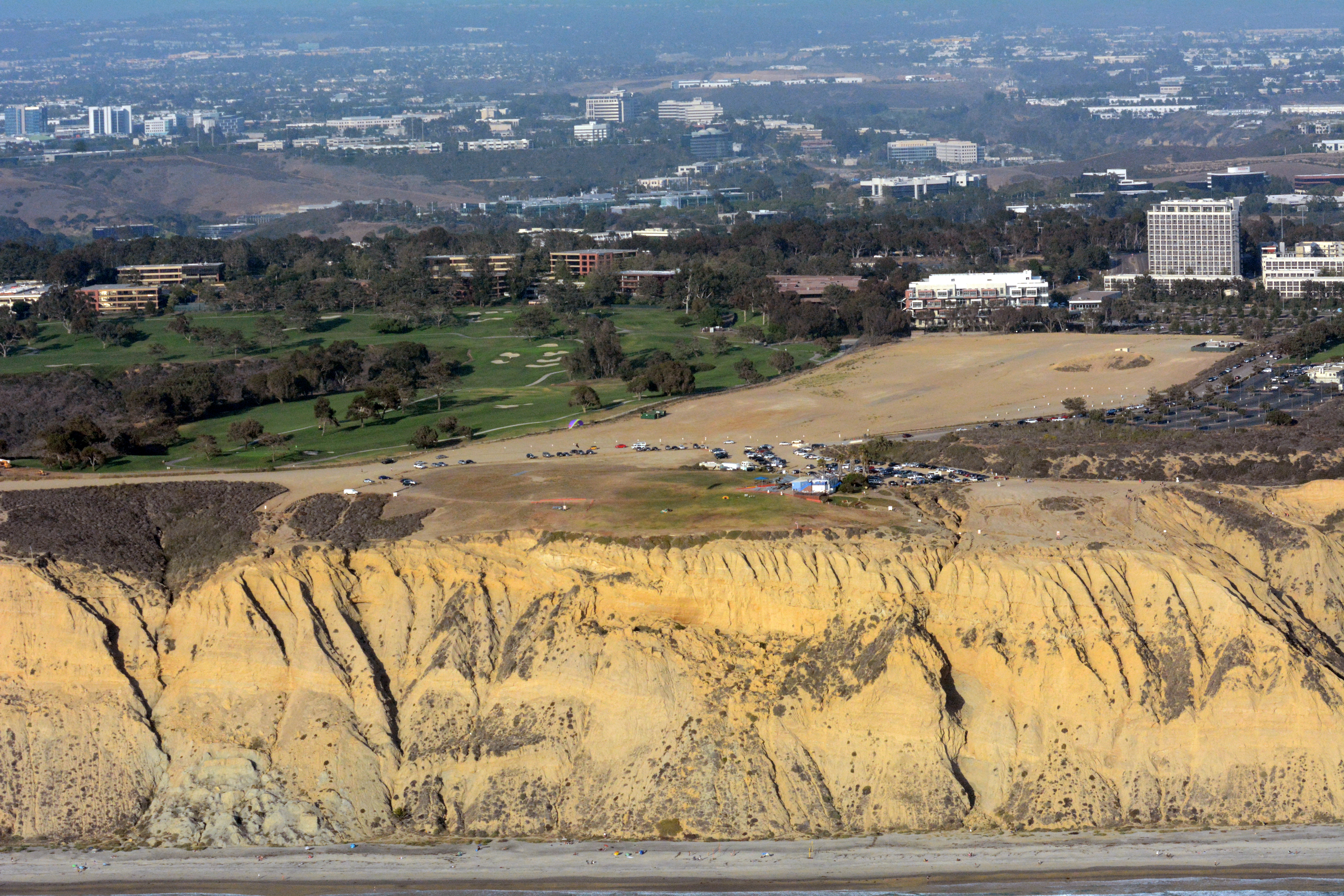
Torrey Pines Gliderport
There is something fitting about the fact that Charles Lindbergh — the man who in 1927 made the first nonstop solo transatlantic flight — came to the cliffs above Torrey Pines three years later and did something quieter: he soared. On February 24, 1930, Lindbergh climbed into a sailplane at the Torrey Pines Gliderport and flew without an engine, riding the ridge lift that rises from the cliffs above the Pacific as reliably as the waves below. It was his first soaring flight. The site where it happened is now on the National Register of Historic Places, designated a National Landmark of Soaring, and called the 'Kitty Hawk of the West.'
Anne Morrow's License
Slightly less famous than Charles Lindbergh's February 1930 soaring flight is what happened a month earlier, on January 29, 1930, at the same site. Anne Morrow Lindbergh — who was then Anne Morrow, not yet married to Charles — earned her glider pilot license at Torrey Pines, becoming the first American woman to earn a first-class glider license. She was twenty-three years old.
The sequence of events is worth noting: Anne Morrow earned her glider license at Torrey Pines in January, and Charles Lindbergh made his first soaring flight there in February. The Torrey Pines site was clearly, in those early months of 1930, at the center of American soaring aviation. The site's combination of reliable ridge lift, accessible cliff edge, and good weather made it a proving ground for the glider pilots who were developing the techniques and equipment of motorless flight.
Anne Morrow Lindbergh went on to become a celebrated aviator in her own right, flying with Charles Lindbergh on survey flights over the Arctic and the Atlantic, and a writer whose books — particularly 'Gift from the Sea,' written decades later at a different coastal location — earned her a reputation independent of her husband's fame. Her first-class glider license, earned at the cliff above the Pacific, was one of the first marks she made on aviation history.
The Kitty Hawk of the West
The National Register of Historic Places designation, the California Register listing, and the National Landmark of Soaring recognition all reflect the Torrey Pines Gliderport's significance in the history of American aviation. The comparison to Kitty Hawk — where the Wright Brothers made the first powered airplane flights in 1903 — is not modest, but it is not without basis. Soaring flight, which uses natural air movement rather than engine power to sustain and extend a flight, is a technically demanding discipline that requires both skill and the right geography.
The geography at Torrey Pines is unusually good. The sandstone cliffs that rise 300 feet above the Pacific face the prevailing onshore wind, which is deflected upward as it hits the cliff face, creating a reliable band of lift that a skilled pilot can use to fly back and forth along the cliff face indefinitely, gaining and losing altitude in the lift and sink areas of the airflow. On good days, soaring pilots at Torrey Pines can stay aloft for hours without engines, using the same physics that birds exploit over sea cliffs around the world.
The site also hosts hang gliding and paragliding — lighter, simpler aircraft that use the same ridge lift but require less infrastructure than sailplanes. The Torrey Pines Gliderport's single grass runway, 1,500 by 30 feet with the designation 9/27, serves the sailplane operations, while the cliff edge launch area serves the hang gliders and paragliders who launch directly into the rising air. The 'Cliff Hanger Cafe,' perched at the cliff edge, gives spectators a view of the operations and of the ocean below.
Between Wars
The Torrey Pines Gliderport has not always been purely a civilian facility. During World War II, the site became Camp Callan, an anti-aircraft artillery training installation that occupied the coastal bluffs to train gunners for the war's demands. The transformation from peacetime soaring venue to wartime military installation was typical of the period — California's geography made it useful for training in ways that had nothing to do with its peacetime purposes.
After the war, the soaring tradition returned. The gliderport has continued to operate as a civilian facility, maintaining its National Register designation while hosting the same kinds of flights that Lindbergh made in 1930 — sailplanes riding the coastal lift, hang gliders launching from the cliff edge, and tandem paragliders carrying passengers who have never flown before into the reliable air above the Pacific.
The cliff at Torrey Pines is the same cliff it has always been. The Torrey pines — the rarest native pine in America, endemic to this small coastal strip — still grow above and below the gliderport. The ocean still generates the onshore winds that rise up the cliff face. And the people who come to the cliff edge to fly without engines are still doing, in their way, what Anne Morrow and Charles Lindbergh did in the first months of 1930: trusting the air above the Pacific to hold them.
From the Air
Torrey Pines Gliderport sits at 32.89°N, 117.25°W on the bluffs north of La Jolla, directly above Blacks Beach. The gliderport's grass runway (9/27) is visible from altitude as a cleared area on the cliff top, with the Torrey Pines State Reserve forest immediately to the north. Pilots transiting the area should be aware of soaring, hang gliding, and paragliding operations along the cliff face below. Nearest airports: KMYF (Montgomery-Gibbs Executive, 8 miles east) and KSAN (San Diego International, 12 miles south). The cliff edge is a reliable visual reference on coastal approaches heading south.