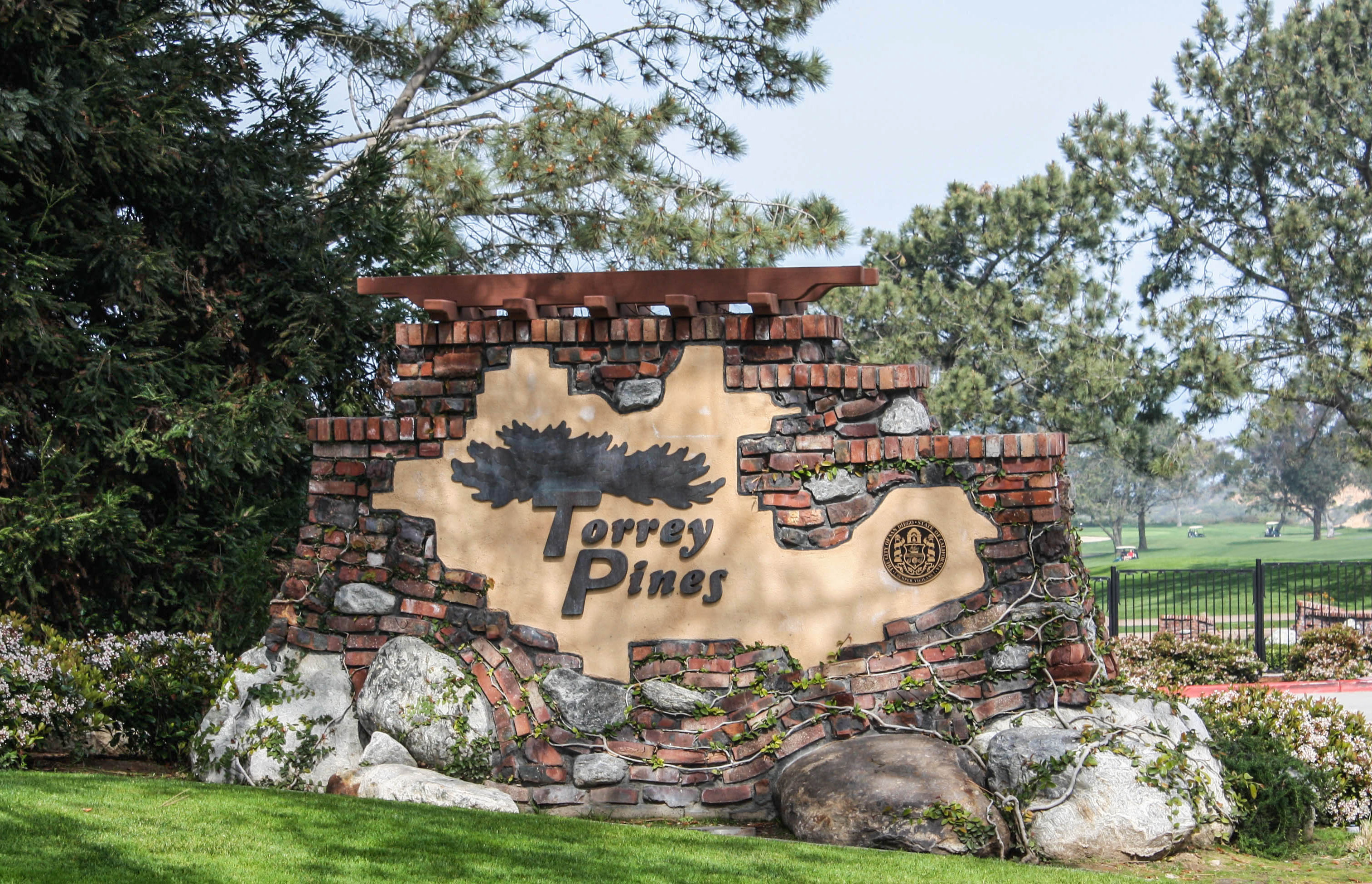
Torrey Pines Golf Course
Tiger Woods was playing on a broken leg. That's not a metaphor — he had a stress fracture in his left tibia and a torn anterior cruciate ligament, injuries that would have ended most athletes' seasons months earlier. But on June 16, 2008, at the 18th hole of the South Course at Torrey Pines Golf Course, Woods made birdie to force a Monday playoff with Rocco Mediate. Then he won it. It remains the last U.S. Open to go to a full 18-hole playoff, a format the USGA abandoned a decade later — meaning that afternoon on the cliffs above La Jolla may be the final chapter of a competitive tradition stretching back to golf's earliest championships.
A Military Past, a Public Future
Before there was a fairway here, there was a war. During World War II, the land along these coastal cliffs became Camp Callan, a U.S. Army installation training antiaircraft artillery crews. When the war ended and the Army moved on, the city of San Diego inherited the mesa. In 1957, they opened Torrey Pines Golf Course — two 18-hole layouts, North and South, designed by William Francis Bell — as a municipal facility, meaning anyone with a tee time and green fees could play one of the most spectacular pieces of ground in American golf. The course sits on dramatic bluffs above the Pacific, with views across the water to Santa Catalina Island on clear days. The rare Torrey pine — found naturally in only two places on Earth, this stretch of San Diego coast and Santa Rosa Island — frames the holes from the rough. The South Course stretches to 7,802 yards from the back tees, making it the longest course regularly used for a PGA Tour event.
The People's Major
Since the late 1960s, Torrey Pines has hosted the PGA Tour's Farmers Insurance Open, originally known as the San Diego Open. Held each January or February, the tournament has been a fixture on the professional calendar for more than half a century. But the course truly entered the national imagination when it earned the right to host the U.S. Open — not once but twice. Jon Rahm won the 2021 edition. The 2008 championship produced the more dramatic story: Woods in obvious pain throughout the week, visibly limping after every swing, somehow finding it within himself to compete at the highest level. After making par on the 91st hole of the playoff while Mediate made bogey, Woods claimed his third U.S. Open and fourteenth major title. He would not win another major until the 2019 Masters, eleven years later. The 2008 Torrey Pines championship remains one of the defining moments in the sport's recent history.
Open to All
What makes Torrey Pines unusual among elite golf venues is its democratic nature. It is a municipal course — operated by the City of San Diego's Park and Recreation Department — which means the same South Course where Tiger Woods limped to glory is open to ordinary golfers. Tee times are competitive and the green fees are not modest, but there is no membership requirement, no private club, no exclusivity beyond what supply and demand impose. San Diego residents get priority in the booking system. On any given morning, retirees from Pacific Beach share the first tee with visiting players who have flown in specifically for the experience, drawn by the views, the history, and the chance to play where championships have been decided. The North Course offers a slightly more accessible challenge for players working up to the South's demands.
The Name and the Tree
The course takes its name from the Torrey pine, and the trees take their name from John Torrey, a nineteenth-century American botanist. The pine is a scraggly, wind-shaped species that grows in twisted silhouettes against the coastal sky — not the stately cathedral pines of the Pacific Northwest but something more compact and gnarled, shaped by the salt air and the constant pressure of Pacific winds. The species was already rare when conservation efforts began in the late nineteenth century; today, it survives primarily in Torrey Pines State Natural Reserve just to the north of the golf course. Walking the fairways here, between the ocean views and the silhouetted pines, gives even casual golfers a sense of playing inside a landscape that exists nowhere else.
From the Air
Torrey Pines Golf Course sits at approximately 32.90°N, 117.25°W on coastal bluffs above the Pacific in northern San Diego. From the air, the two 18-hole layouts are clearly visible along the cliff edge south of Torrey Pines State Natural Reserve. Nearest airport is KSAN (San Diego International) 12 miles south; KMYF (Montgomery-Gibbs Executive) is 8 miles east. Approach from the ocean offers dramatic views of the course and the reserve together. Recommended viewing altitude is 1,500–3,000 feet MSL to distinguish individual holes. Marine layer common in mornings.