Torsaker Witch Trials
Britta Rufina almost joined the dead. The priest's wife stood watching as seventy-one of her neighbors -- sixty-five women and six men -- were led from the church at Torsaker to a hilltop the locals would come to call Haxberget, the Mountain of the Stake. It was 1675, and the wave of witch hysteria that had swept across Sweden since 1668 had finally reached this parish in the forests of Angermanland. What happened next would become the single bloodiest day in Swedish judicial history, and Britta Rufina, who nearly faced accusation herself, would ensure the world never forgot it.
The Great Noise
Sweden's witch panic did not erupt from ancient superstition. It began with a specific accusation: in 1668, a woman named Gertrud Svensdotter accused Maret Jonsdotter of witchcraft in the province of Dalarna. In a country where the Lutheran church operated as an arm of the state, the accusation became policy. Clergy were ordered to warn their congregations about the crimes of witches, and special commissions were established to investigate. The hysteria spread with the efficiency of a government directive, sweeping northward through parishes that had rarely seen witch hunts before. When Johannes Wattrangius, the priest of Torsaker, grew convinced that witchcraft had infected his flock, he summoned Laurentius Christophori Hornaeus from neighboring Ytterlannas parish to lead the investigation. Around one hundred people were accused. The prisoners were kept at various locations throughout the village, given almost no food, though their families were permitted to bring them meals. Some of the convicted managed to escape. Pregnant women were spared execution. But for the seventy-one who remained, there would be no reprieve.
The Mountain of the Stake
The eyewitness account that survives comes through an unusual chain of memory. Sixty years after the executions, Jons Hornaeus -- grandson of the investigating priest -- sat down and wrote what his grandmother Britta Rufina dictated. Her words carry the weight of someone who had watched her community destroy itself. After the final sermon, the condemned were led from the church. Only two among the seventy-one could manage to sing a psalm, and they repeated it over and over as the procession moved forward. Many fainted from weakness and despair along the way, and their own family members carried them to the execution site, a hilltop equidistant from the parish's three churches. On the mountain, the prisoners were beheaded away from the pyres -- so their blood would not soak the wood and make it difficult to light. When they were dead, their families undressed the bodies and lifted them onto the stakes. The fires burned until they went out on their own. Then the families walked home, Britta Rufina recalled, showing no emotion at all, as though they had been completely numbed.
Justice Without Authority
Even by the standards of 1675, the Torsaker executions were illegal. The local commission had no authority to carry out death sentences. Under Swedish law, they were required to submit their verdicts to the higher court for confirmation, and that court typically overturned the majority of capital sentences. The Torsaker commission bypassed this entirely, executing prisoners without waiting for approval from their superiors. When word reached the capital, the commission was summoned to answer for its actions. Local authorities in Torsaker defended them, but the damage was done -- and there would be no further executions in the parish. The witch panic itself, however, continued its march southward. It reached Stockholm, where it persisted until 1676 and culminated in the execution of Malin Matsdotter during the Katarina witch trials. Only then did authorities finally prove that the child witnesses -- the boys whose accusations had fueled the entire hysteria -- had been lying.
The Silence After
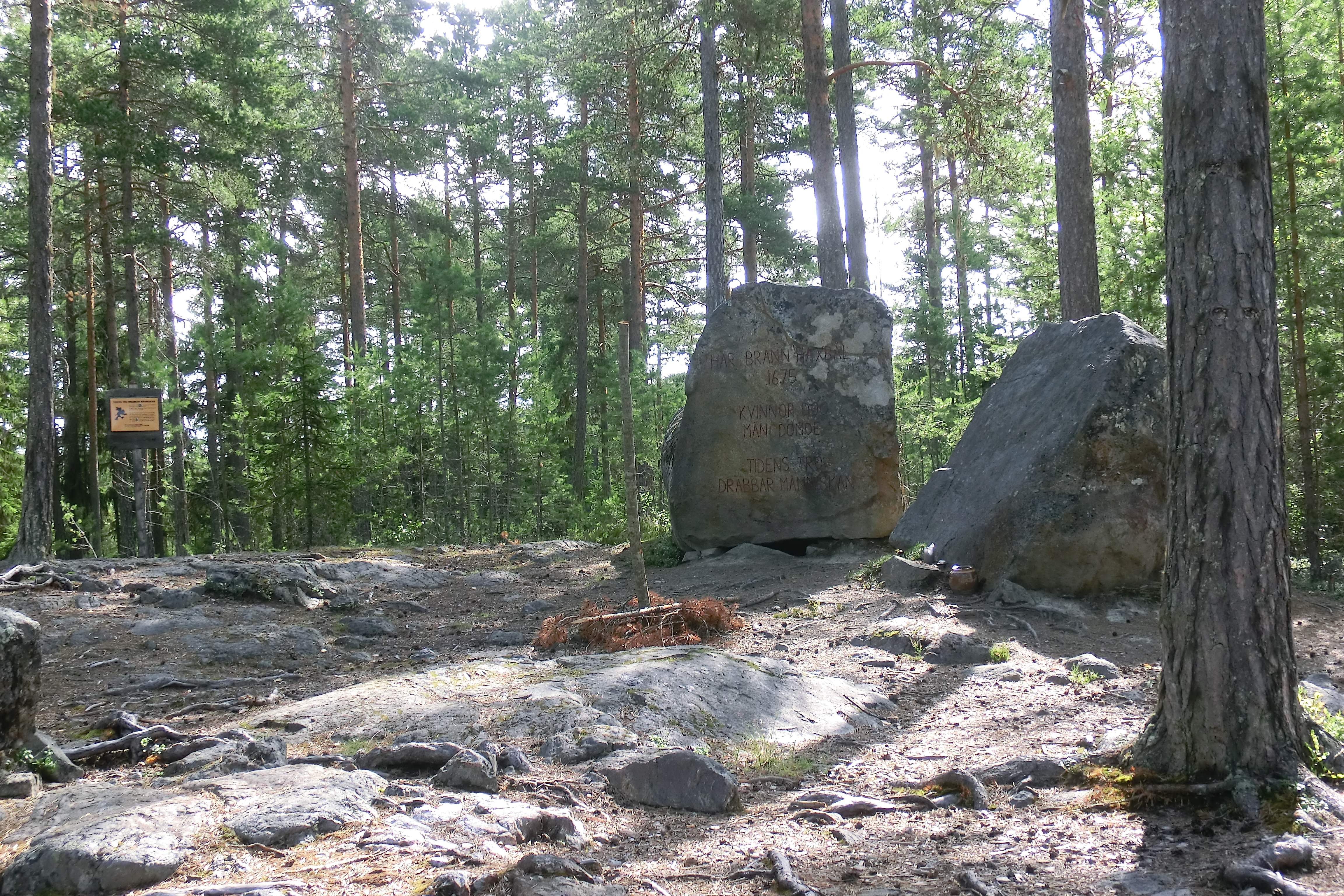
In 1677, priests across Sweden were ordered to announce that the witches had been expelled from the country forever, a proclamation designed less to celebrate victory than to prevent any further accusations. In Torsaker, a darker epilogue unfolded: the boys who had pointed at women in the church, the so-called visgossarna or "tale boys" whose testimony had condemned dozens to death, were found with their throats cut. Whether this was justice, revenge, or despair, the historical record does not say. Three hundred years later, in 1975, a memorial stone was erected in Torsaker to honor the seventy-one people who died on that single day. The stone stands as a quiet acknowledgment of a community that turned on itself under the pressure of state-sponsored fear -- and of the priest's wife whose testimony, passed down through generations, ensured the truth survived longer than the lies that started it all.
From the Air
Located at 63.05N, 17.68E in Angermanland, northern Sweden. The parish sits in forested terrain along the Angerman River valley. Nearest significant airport is Kramfors-Solleftea Airport (ESNK), approximately 20 km southwest. The memorial stone at Haxberget is not visible from altitude, but the cluster of churches in the Torsaker area and the river valley provide orientation. Best viewed at 3,000-5,000 feet in summer when the long northern daylight illuminates the landscape.