Toshimaen: The Carousel That Crossed Three Continents
Theodore Roosevelt rode it. Marilyn Monroe rode it. Al Capone rode it. Built in Munich in 1907 by Hugo Haase in the Art Nouveau style, Carousel El Dorado debuted at Oktoberfest before touring European carnivals and crossing the Atlantic to Coney Island's Steeplechase Park. When that park closed in 1964, the carousel was slated for scrap. Instead, it made one more crossing -- this time across the Pacific to a neighborhood amusement park in Nerima, Tokyo, where it would spin for nearly fifty more years. The carousel's story is the story of Toshimaen itself: resilient, unlikely, and far more interesting than anyone expected.
From Munich to Coney Island to Tokyo
Carousel El Dorado was no ordinary merry-go-round. Its rotating floor was divided into three concentric rings, each spinning at a different speed -- the outermost slowest, the innermost fastest. Its figures did not jump. Its ornamentation was pure Art Nouveau, elaborate enough that the Japan Society of Mechanical Engineers designated it a Mechanical Engineering Heritage item in 2010. After its European tour and decades at Steeplechase Park in Coney Island, the carousel faced the scrapyard when Steeplechase closed in 1964. Toshimaen purchased it for roughly 100 million yen in 1969, loaded the disassembled pieces into six shipping containers, and sent them to Japan. The restoration took two years and 200 million yen, guided by Japanese carpenters who specialized in traditional wooden structures, along with art teachers and electrical engineers. During the restoration, workers found an original Steeplechase Park admission ticket tucked inside the mechanism. Carousel El Dorado resumed operation on April 3, 1971.
Ninety-Four Summers in Nerima
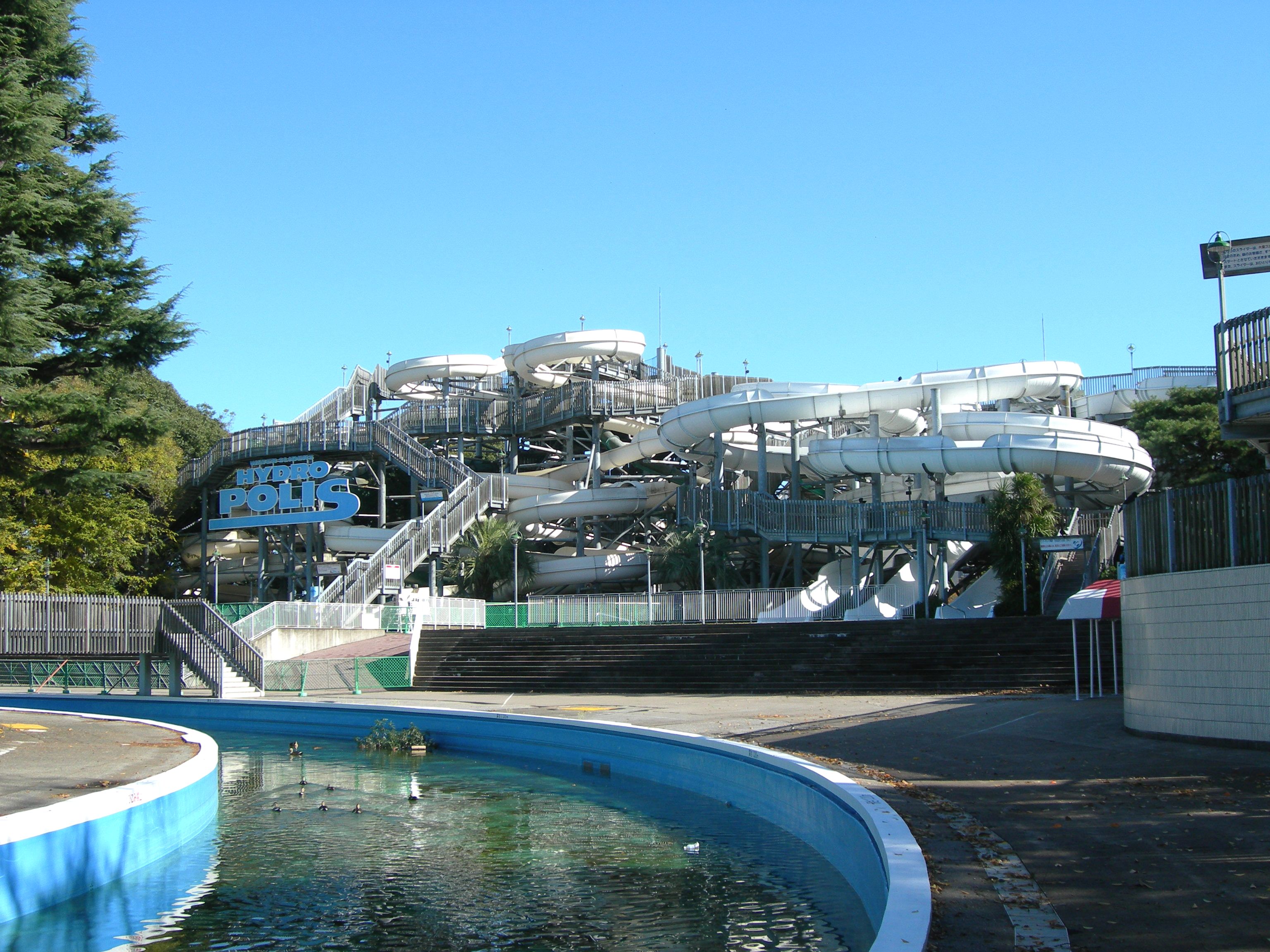
Toshimaen opened in 1926 in the Nerima ward of Tokyo, owned by the Seibu Group. Over its ninety-four-year life, the park grew into a neighborhood institution with three roller coasters, a water park featuring twenty-five slides and six pools, and that globe-trotting carousel. In 1965, Toshimaen became the first amusement park in the world to install a river pool -- a 350-meter doughnut-shaped channel where visitors could float in a continuous loop. There was a children's pool shallow enough for toddlers, a wave pool, and Hydropolis, a complex of water slides. The park even had its own hot spring facility, discovered accidentally during underground surveys for the Toei Oedo subway line. That hot spring kept operating even after the park itself closed. For generations of Tokyo families, Toshimaen was the summer destination -- close enough to reach by train from Toshimaen Station on the Seibu Toshima Line, far enough from the city center to feel like an escape.
The Last Day and the Wizard's Arrival
Toshimaen closed permanently on August 31, 2020, ending nearly a century of operation. The Nerima Ward Assembly submitted an opinion to the Governor of Tokyo requesting that Carousel El Dorado remain in the planned Nerima Castle Ruins Park on the site, but the carousel was dismantled and placed in a Seibu Group warehouse. Not all of the former park's twenty-two hectares were given over to redevelopment. The Tokyo Metropolitan Government purchased the majority of the site, planning a large public park that would serve as a disaster preparedness base. On the remaining land, Warner Bros. Studio Tour Tokyo -- The Making of Harry Potter opened on June 16, 2023, the second such studio tour in the world after the one in London and the second Harry Potter-themed attraction in Japan after Universal Studios Japan's Wizarding World in Osaka. The site where children once rode a century-old carousel from Coney Island now hosts the Great Hall of Hogwarts.
What Remains, What Waits
Carousel El Dorado sits in storage, its Art Nouveau ornamentation wrapped and crated, its three concentric rings still. Whether it will spin again is uncertain, but the carousel has survived worse -- world wars, financial collapses, a trans-Pacific crossing in six containers. The hot spring facility discovered during subway construction continues to welcome bathers. And in the larger story of Tokyo's western wards, the Toshimaen site captures something essential about the city: the constant reinvention, the layering of one era's entertainment over another, the way a piece of 1907 Munich craftsmanship can end up in a Tokyo suburb and become so deeply embedded in the neighborhood's identity that its absence is felt like a missing tooth. Somewhere in a warehouse, El Dorado waits.
From the Air
Located at 35.745N, 139.645E in the Nerima ward of western Tokyo. From altitude, the former Toshimaen site is identifiable by the Warner Bros. Studio Tour Tokyo complex and the developing parkland adjacent to it. The site sits near the Shakujii River. Best viewed at 3,000-5,000 feet AGL. Tokyo Haneda Airport (RJTT) lies approximately 15 nautical miles to the south. Chofu Airport (RJTF) is approximately 8 nautical miles to the southwest. The Seibu Toshima rail line is visible running adjacent to the site.