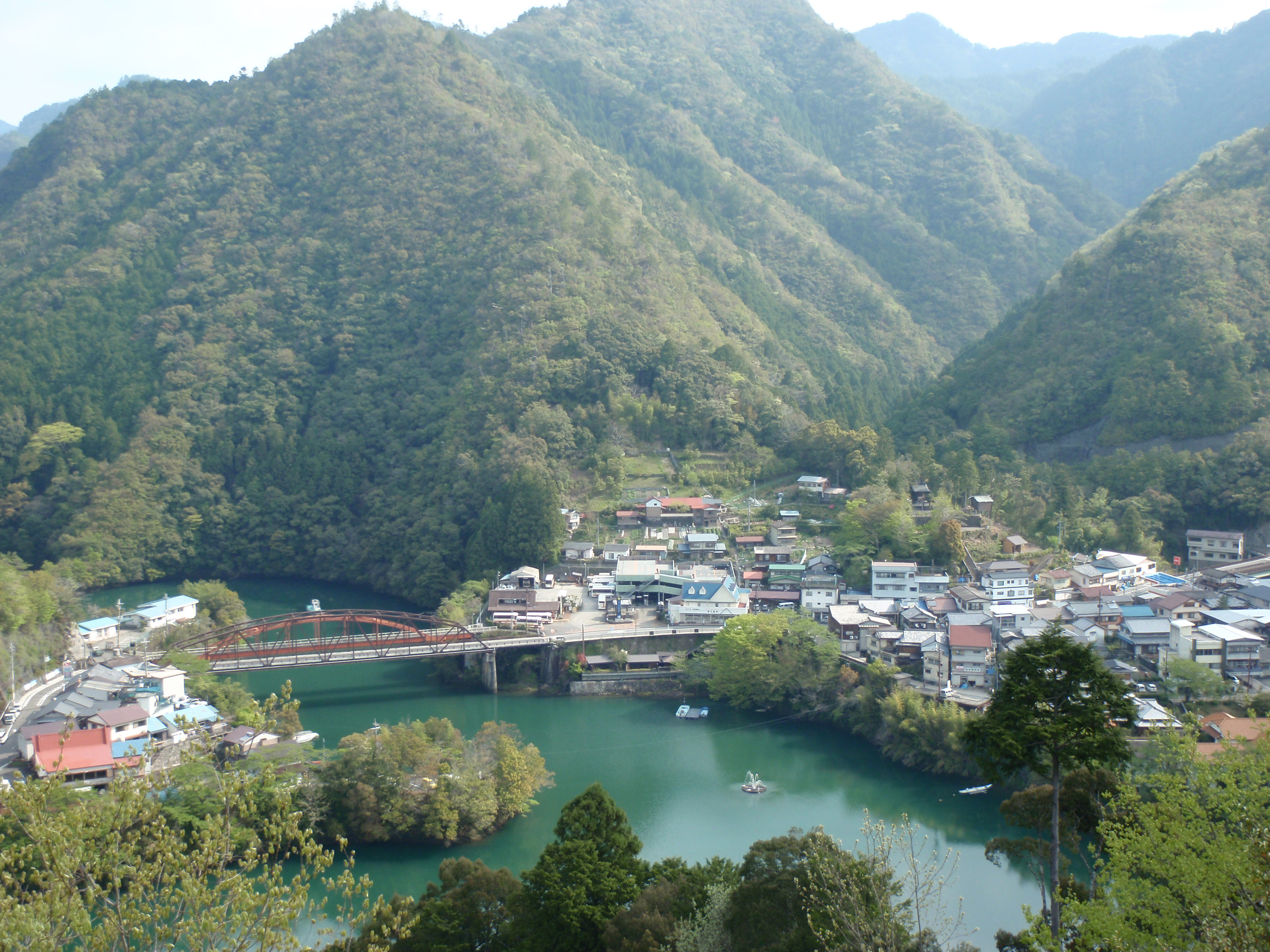
Totsukawa: Japan's Largest Village at the End of Every Road
The name is a play on words that contains its own geography. Totsukawa -- the village of the river distant from any harbor, distant from any capital. Written in kanji, the characters for the river's original name and the word for capital both share a reading of "to," and someone centuries ago folded that coincidence into the village's identity. It fits. Totsukawa sits in the deepest interior of the Kii Peninsula in Nara Prefecture, 672 square kilometers of vertical terrain where 96 percent of the land is forested mountainside. There is no flat ground to speak of. There is no train station. The roads are narrow and winding and arrive only after considerable effort. Japan's largest village by area is also one of its most isolated, and that isolation has shaped everything -- from the samurai who hid here seven centuries ago to the hand-pulled gondolas that still dangle over the river gorges.
Refuge of the Southern Court
In 1333, Emperor Go-Daigo overthrew the Kamakura Shogunate and launched the Kenmu Restoration, but the victory was short-lived. Dissatisfied samurai, led by Ashikaga Takauji, turned against the emperor, who fled south into Yamato Province -- the rugged mountains that now form Nara Prefecture. He established the Southern Court in the wilderness, and Totsukawa became one of its strongholds. Prince Morinaga sought refuge among the villagers, and old documents from Emperor Gomurakami and Prince Okura -- still preserved in the village -- contain directives calling on the people of Totsukawa to assist the imperial cause. The villagers were recognized by successive emperors as skilled martial artists and hunters, their abilities sharpened by a landscape that demanded physical toughness simply to survive.
The Bridge and the Monkey Gondolas
The Tanize Suspension Bridge, built in 1954, stretches 297 meters across a gorge in northern Totsukawa, swaying 54 meters above the river. It is one of Japan's longest steel-wire pedestrian suspension bridges, and every family in the village contributed money toward its construction. But the bridge is a modern solution to an ancient problem. Before bridges, the villagers crossed the river in yaen -- small wooden gondolas hung from ropes above the water, propelled by hand. A rider pulls a rope inside the gondola to move from shore to shore, and the motion apparently resembles a wild monkey climbing a vine, which is how the contraption got its name: yaen, from the Japanese for wild monkey. The average crossing took about ten minutes. The gondolas are no longer used for daily transport, but several remain operational as tourist novelties -- a chance to dangle above a mountain river and haul yourself across by hand.
Water, Fire, and Exile
In 1889, catastrophic flooding devastated Totsukawa. The disaster killed 168 people, destroyed 610 houses, and wiped out roughly 70 percent of the village's farmland. For a community already living at the margins of cultivable terrain, the loss was existential. Of the approximately 10,000 residents, 2,667 chose to leave -- not for a neighboring valley, but for Hokkaido, more than 1,500 kilometers to the north. It was one of the longest-distance mass relocations in Japanese history. The settlers named their new home Shintotsukawa, literally New Totsukawa, and the government attempted to replicate the old village's settlement patterns in the new location. The two communities maintain ties to this day, connected by the shared memory of a flood that split a village across the length of the country.
Sacred Heights and Healing Waters
Tamaki Shrine sits at the summit of a mountain in Totsukawa, said to have been built by Emperor Sujin in 37 BC, surrounded by towering Japanese cedar trees. UNESCO recognized it as part of the Sacred Sites and Pilgrimage Routes in the Kii Mountain Range. Below, in the middle of the village, Totsukawa Onsen feeds several bathhouses with untreated hot spring water piped directly from the source -- no recycling, no heating, no chemical treatment. The oldest bathhouse dates to 1581. On the village outskirts, the Sasa-no-taki waterfall drops 32 meters through forested gorge terrain and is ranked among Kodansha's 100 Best Waterfalls in Japan, though the base is closed to visitors due to falling rock hazards. Everything in Totsukawa exists at extremes -- height and depth, isolation and devotion, the stillness of cedar groves and the roar of water falling through stone.
From the Air
Located at 33.99N, 135.79E in the mountainous interior of the Kii Peninsula, Nara Prefecture, Japan. The village occupies a series of deep river gorges with extremely rugged terrain -- virtually no flat ground visible from altitude. The Totsukawa River and its tributaries cut through heavily forested mountains, and the Tanize Suspension Bridge may be visible as a thin line spanning a gorge in the northern section. Nearest airport is Nanki-Shirahama (RJBD), approximately 50 km to the southwest. Nara city and Kansai International Airport (RJBB) lie to the north. The terrain is among the most mountainous in the Kii Peninsula, with elevations ranging from valley floors to peaks over 1,000 meters. Approach with caution due to complex terrain and limited visual references.