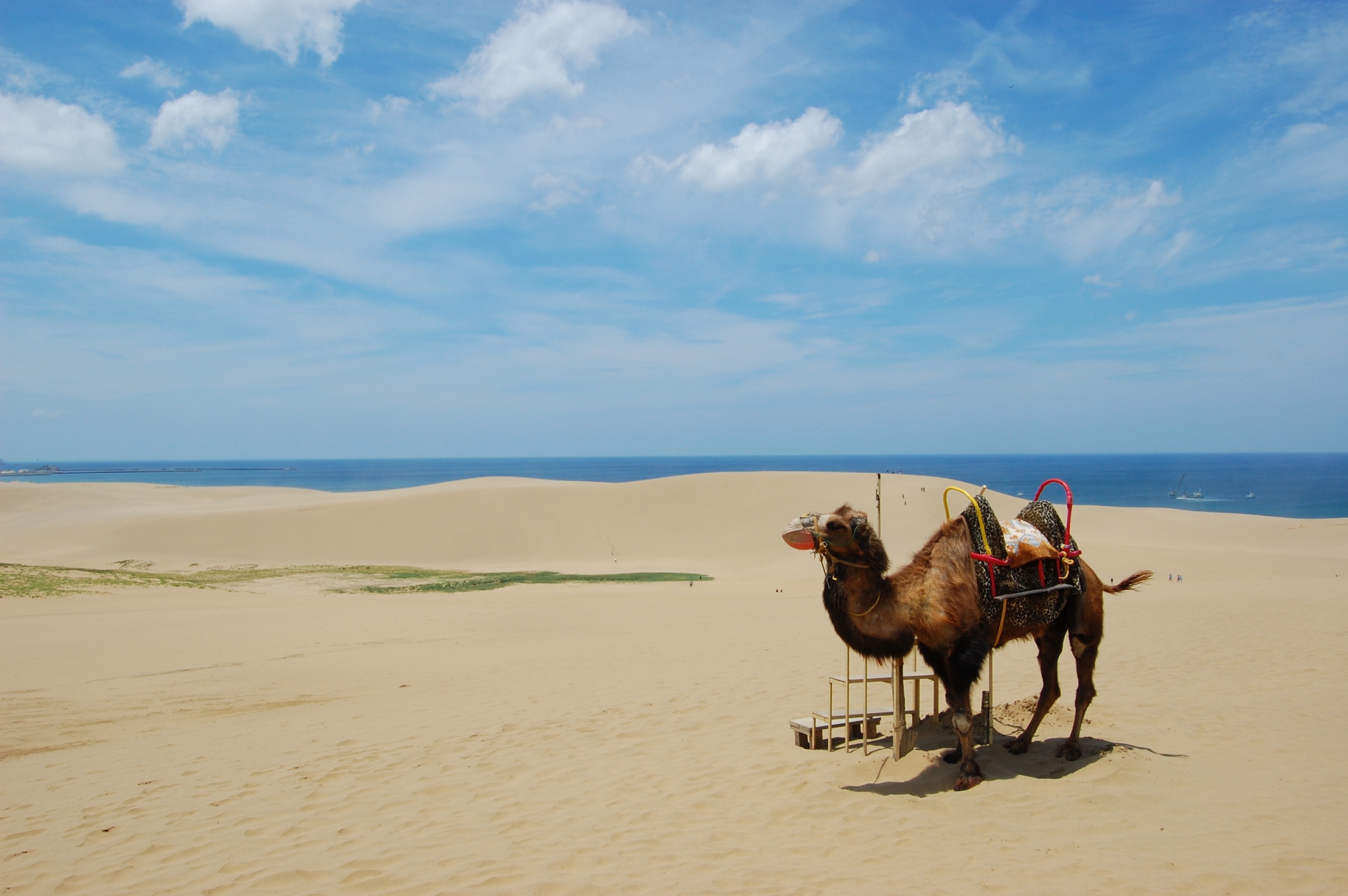
Tottori Sand Dunes
Japan is a country of forests, mountains, and rice paddies, which makes the Tottori Sand Dunes genuinely disorienting. Nine miles of rolling sand stretch along the Sea of Japan coast in Tottori Prefecture, rising in dunes that reach 90 meters in elevation difference, complete with camels available for tourist rides. The scene belongs to North Africa, not western Honshu. Yet this is the largest sand dune system in Japan, part of the UNESCO-designated San'in Kaigan Geopark, and it has been building itself grain by grain for 100,000 years.
A Hundred Millennia of Wind and Water
The dunes were born from a collaboration between river and sea. The Sendai River carried sediment down from the Chugoku Mountains to the coast, depositing it into the Sea of Japan. Strong winds off the water then swept the sand inland, sculpting it into the formations that exist today. The process has been continuous for roughly 100,000 years, making these dunes not just a geological curiosity but a living landscape that reshapes itself daily. The most famous section, the 545-hectare Hamasaka Dunes on the eastern side of the Sendai River, is where most visitors experience the terrain. Lake Tanegaike, separated from the sea when the dunes rose between them, sits to the southeast, a freshwater body owed entirely to sand.
Grinding Bowls and Wind Ripples
The dunes have their own vocabulary. Bowl-shaped depressions carved by wind are called suribachi, meaning "grinding bowls." The largest, known as O-suribachi, rises to a height of 40 meters, its slopes steep enough to make climbing a workout. On those slopes, two distinct patterns appear: saren, flowing collapse marks that look like hanging blinds where sand has slid in sheets, and fumon, delicate striped ripple patterns created by winds blowing at roughly five to six meters per second. The surface is not always dry. At the deepest point of the suribachi, groundwater seeps upward through the sand, sometimes forming a shallow pool that locals call an "oasis." It appears and disappears with the seasons, a reminder that beneath the desert aesthetic lies a water table fed by the same mountains that supplied the sand.
The Paradox of a Shrinking Desert
After World War II, the Japanese government launched an ambitious reforestation program across the country. Pine trees planted along the coast near Tottori began stabilizing the sand, and vegetation crept inward. The dunes started shrinking. Concrete barriers built along the coast to prevent erosion accelerated the process by trapping sand that would otherwise have replenished the formations. By the early 2000s, the irony was clear: Japan had succeeded too well at greening its landscape, and the country's most famous dunes were disappearing under grass and trees. Authorities reversed course, adopting measures to halt the shrinkage. The dunes attract significant tourism to a prefecture that has few other marquee attractions, and losing them would mean losing the economic engine of the region.
Do Not Write in the Sand
The dunes became famous enough to attract a problem that surprised officials: graffiti. Visitors began carving messages and drawings into the sand at a scale that damaged the natural surface patterns the dunes are celebrated for. Letters scratched into the slopes could persist for weeks before wind erased them, and the footpaths left by unauthorized hikers accelerated erosion in sensitive areas. In 2009, Tottori Prefecture enacted the "Ordinance to Protect and Nurture Japan's Premier Tottori Sand Dunes," making unauthorized markings punishable by fines of up to 50,000 yen. The law was a first of its kind, treating sand as a natural monument worthy of the same protections given to ancient temples and historic castles. The wind, after all, is the only artist permitted to draw here.
From the Air
The Tottori Sand Dunes stretch along the coast at 35.54N, 134.23E, easily identifiable from the air as a wide band of golden sand between the Sea of Japan and the green interior of Tottori Prefecture. The dunes are unmistakable at any altitude, contrasting sharply with the surrounding vegetation and dark blue ocean. Look for the Sendai River bisecting the dune field. Nearest airport: Tottori Sand Dunes Conan (RJOR) approximately 5nm west. Best viewed at 1,500-3,000 feet AGL for the full sweep of the dune system along the coast.