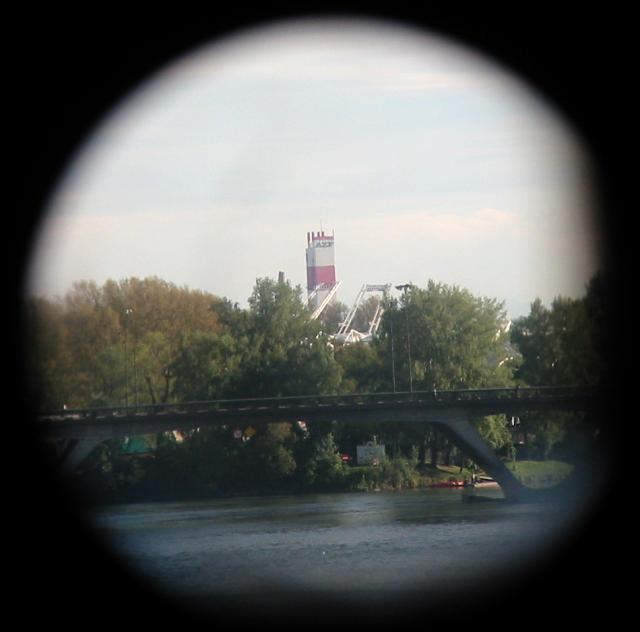
Toulouse Chemical Factory Explosion
Ten days after the September 11 attacks, the ground shook in Toulouse. On September 21, 2001, three hundred tonnes of ammonium nitrate detonated at the AZF fertilizer factory, a subsidiary of the energy giant Total, on the city's southern edge. The blast registered 3.4 on the Richter scale with the explosive force of 20 to 40 tons of TNT. It killed 31 people, seriously wounded 30 more, and caused 2,500 lesser casualties. The sound bounced off the surrounding hills so convincingly that police initially believed five separate bombs had gone off simultaneously. In a city still reeling from the shock of what had happened in New York less than two weeks earlier, the line between industrial accident and act of war was, for several terrifying hours, impossible to draw.
The Blast That Broke the Windows
The AZF factory sat dangerously close to the city. Le Mirail, one of Toulouse's most densely populated neighborhoods, lay just one kilometer away. When hangar 221 detonated, the explosion obliterated the entire factory and left a crater seven meters deep and forty meters across. The shockwave radiated outward through the urban landscape, shattering roughly two-thirds of all windows in Toulouse. Seventy people suffered eye injuries from flying glass alone. Around ten percent of the city's inhabitants had to be evacuated. The total insurance damages exceeded 1.5 billion euros, making it one of the costliest industrial disasters in French history. For the people of Toulouse, the physical destruction was compounded by disorientation: the acoustic distortions created by the city's hills made it impossible to tell where the explosion had come from, spreading panic across neighborhoods that had not been directly hit.
The Shadow of September
The timing was agonizing. With the world still processing the September 11 attacks, France's Environment Minister Yves Cochet announced on October 4 that the explosion "may have been a terrorist attack." Investigators identified Hassan Jandoubi, a plant subcontractor killed in the blast, as a person of interest. Police declared he had "possible Islamic fundamentalist sympathies." But the investigation was immediately compromised. French anti-terrorist authorities were prohibited by the Toulouse prosecutor from searching Jandoubi's home for five days after the incident. By the time officers arrived, his girlfriend had reportedly disposed of his clothes and photographs. Authorities publicly described the delay as damaging to the investigation, and the question of what happened at the AZF factory became entangled with the fears and suspicions of a post-9/11 world in ways that proved difficult to untangle.
The Verdict That Satisfied No One
In May 2006, the official investigation released its final report supporting a chemical accident theory: sodium dichlorocyanurate had been accidentally mixed with ammonium nitrate and spilled onto the main nitrate pile approximately twenty minutes before the explosion. The conclusion pointed to human error and inadequate safety protocols rather than deliberate sabotage. But the verdict never fully resolved the controversy. The initial terrorism angle, the botched early investigation, and the sheer scale of destruction left a residue of doubt that persisted for years. Multiple books were written challenging the official findings. The case wound through the French courts for over a decade, with convictions, appeals, and acquittals that left many victims' families feeling that justice had been neither served nor definitively denied.
A City's Scar
The AZF site today is an open wound that Toulouse has slowly transformed into something else. The crater was filled, the rubble cleared, and the land has been redeveloped. But for those who lived through September 21, 2001, the memory is stitched into the geography of the city. The proximity of the factory to residential neighborhoods — a consequence of decades of urban sprawl creeping toward industrial zones that had once seemed safely distant — became a national conversation about industrial safety and urban planning in France. The disaster accelerated regulatory changes for the storage and handling of ammonium nitrate, the same compound that would later cause catastrophic explosions in West, Texas, in 2013 and Beirut in 2020. Toulouse's tragedy was an early warning that the modern world often ignored until it was repeated, at greater cost, elsewhere.
From the Air
Located at 43.57°N, 1.43°E in the southern suburbs of Toulouse, France. The former AZF factory site is along the Garonne River on the city's south side. Best identified at 3,000-5,000 ft AGL. Nearest airport: LFBO (Toulouse-Blagnac International), the major hub just northwest of the city. The Airbus assembly facilities are also visible nearby.