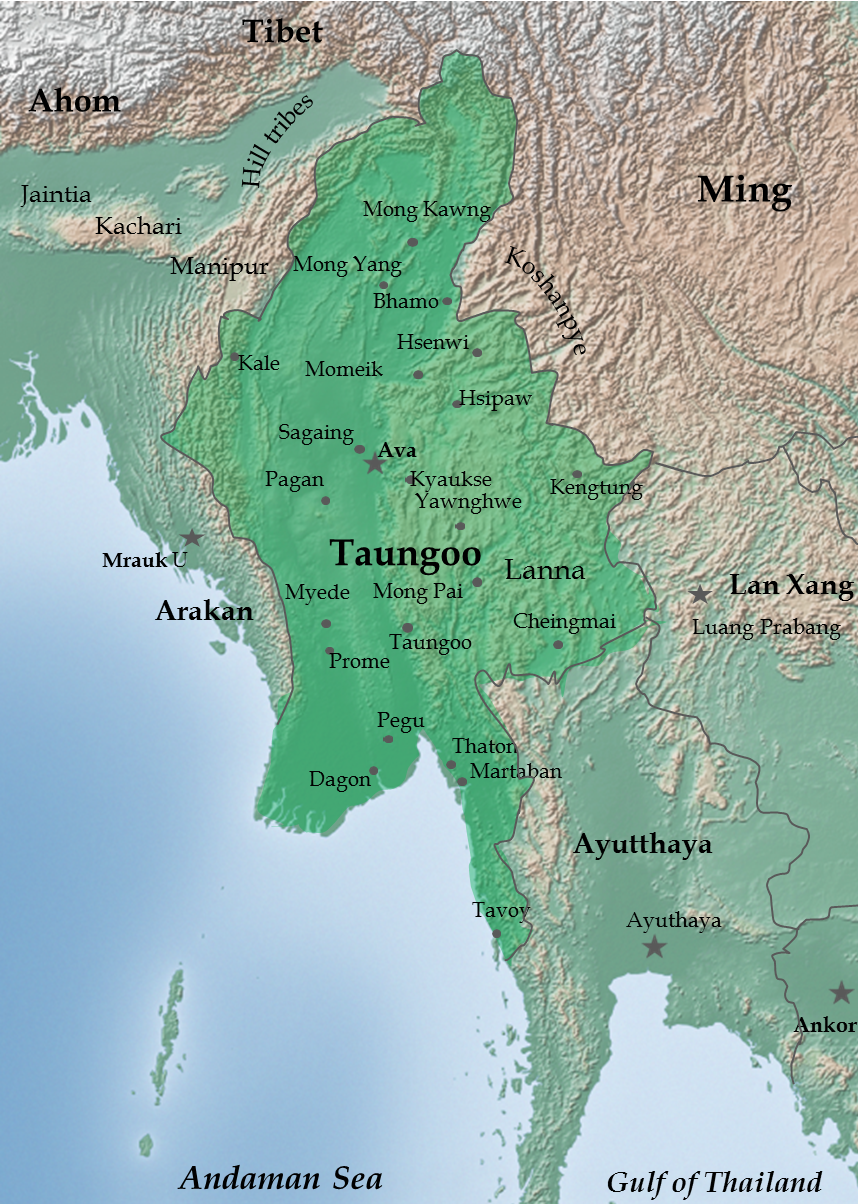
Toungoo Dynasty
In 1510, a king named Mingyi Nyo declared himself ruler of a small territory centered on Taungoo, an unremarkable town far up the Sittaung River in central Burma. The Ava Kingdom to the north was crumbling, its capital overrun by Shan warlords, and Burmese-speaking refugees were streaming south looking for safety. Mingyi Nyo gave them a place to gather. Within two generations, his descendants would control the largest empire Southeast Asia had ever seen, stretching from Assam and Manipur in the west to the Cambodian frontier in the east, from the borders of Yunnan to the Malay coast. That empire's rise was spectacular, its collapse instructive, and the administrative systems it created would shape Burmese governance for the next three centuries.
A Unifier from the South
Mingyi Nyo's son, Tabinshwehti, inherited a modest kingdom and an outsized ambition. Pushing south from Taungoo, he overran the Irrawaddy Delta and crushed the Mon capital of Bago, then had himself crowned king of all Burma at the ancient capital of Bagan in 1544. The geopolitical landscape around him was shifting fast: the Shan had consolidated power in the north, the Ayutthaya Kingdom dominated the Chao Phraya basin to the east, and Portuguese traders had arrived from the sea after conquering Malacca. Tabinshwehti moved his capital to Bago to tap the coastal trade, then turned his armies west against Arakan and east against Ayutthaya. Both campaigns ended in defeat. Rebellions followed, and in 1550 Tabinshwehti was assassinated, leaving an empire only half-built.
Bayinnaung's Thirty-Year March
What Tabinshwehti started, his brother-in-law Bayinnaung completed with a relentlessness that still impresses military historians. Ascending the throne in 1550, Bayinnaung spent the next thirty years on an almost continuous campaign of conquest. He took Manipur in 1560, Ayutthaya in 1564, extended Toungoo authority over the Shan States, Lan Xang, and Lan Na, and pushed the empire's borders from Laos to the coast of the Andaman Sea. At its peak, the Toungoo realm exercised suzerainty over territory that no single Southeast Asian power had controlled before or would again. Bayinnaung was preparing a final assault on the western kingdom of Arakan when he died in 1581. His son Nanda Bayin inherited an empire held together largely by his father's personal authority, and within eighteen years it had shattered into rebellion.
The Second Act at Ava
Empires that collapse once sometimes get a second chance. Bayinnaung's grandson Anaukpetlun and his father Nyaungyan Min retreated to Ava (modern Inwa) and began stitching the kingdom back together. By 1613, Anaukpetlun had reunited Burma and decisively defeated Portuguese adventurers who had been carving out fiefdoms along the coast. The Restored Toungoo dynasty, as historians call this second phase, ruled from 1599 to 1752, and while it never matched the territorial reach of Bayinnaung's conquests, it proved far more durable. The kings at Ava replaced hereditary chieftainships throughout the Irrawaddy valley with appointed governors, reduced the power of Shan chiefs, and in 1635 launched Burma's first comprehensive census. Anaukpetlun's successor Thalun used the census data to estimate the Irrawaddy valley's population at around two million, a figure that informed taxation and military conscription for decades.
The Machine That Ran Burma
The Restored Toungoo dynasty's greatest legacy was not territory but governance. Senior princes from subordinate states were required to live at the capital under close supervision, a hostage system that discouraged rebellion while binding the provinces to the center. Provincial deputies answered directly to the crown, village chiefs were integrated into the administrative hierarchy, and the ahmudan system of corvee labor organized manpower around the capital with a precision unusual for the region. The Burmese monkhood in Upper Burma was brought under tighter personnel and financial regulation. These reforms created a political framework so effective that when the Konbaung dynasty overthrew the Toungoo line in 1752, it kept most of the administrative structures in place, running Burma on Toungoo blueprints well into the nineteenth century.
A Long, Slow Unraveling
The end came not with a dramatic invasion but with decades of slow erosion. By the 1720s, Toungoo kings had retreated into what historians call "palace rule," increasingly detached from the provinces they nominally governed. The Meitei people of the Chindwin River basin began raiding deeper into central Burma through the 1730s, and the crown seemed unable to respond. In 1740, the Mon people of Lower Burma launched a rebellion and established the Restored Hanthawaddy Kingdom at Bago. Encouraged by French interests in India, the Mon forces pushed north. In 1752, Hanthawaddy armies captured Inwa, and the 266-year-old dynasty came to an end. The fall has been attributed to institutional rot at the center, factional infighting over succession, and the destabilizing effects of growing trade on elite income. But the structures the Toungoo built outlasted the dynasty itself, a reminder that the most important things an empire leaves behind are often not its borders but its bureaucracies.
From the Air
Taungoo (modern Toungoo) lies at 18.93N, 96.43E along the Sittaung River in central Myanmar. The flat river valley and railway line are visible from altitude. Ava (Inwa), the Restored dynasty's capital, lies approximately 200 nm north near Mandalay. Nearest airports: Mandalay International (VYMD) and Yangon International (VYYY). Best viewed at 8,000-15,000 feet AGL for context of the river valley geography that shaped the empire's core territory.