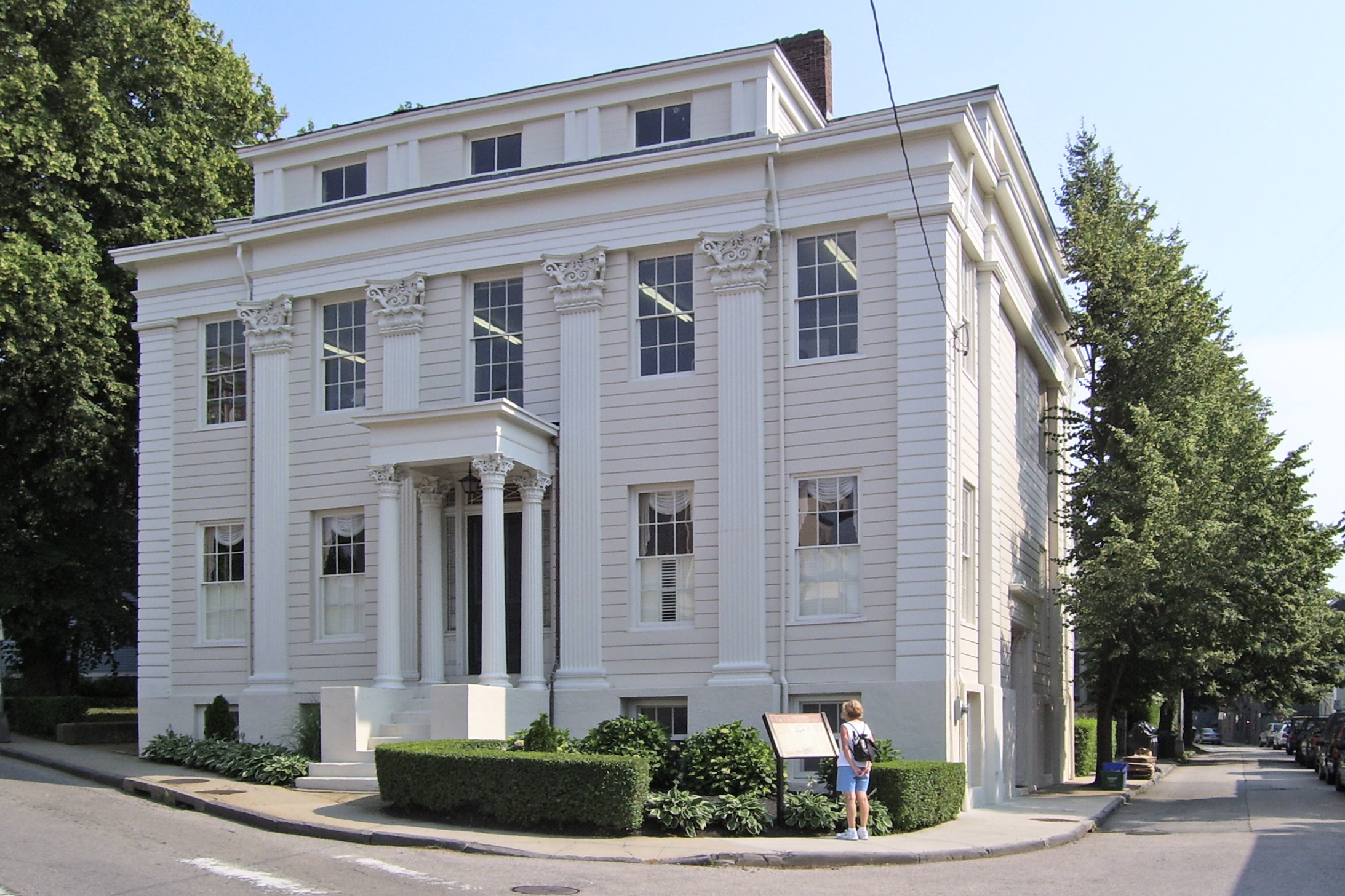
Touro Synagogue
George Washington's letter arrived in Newport in August 1790. Addressed to the Hebrew Congregation, it contained a phrase that would echo across centuries: the government of the United States "gives to bigotry no sanction, to persecution no assistance." Washington was responding to Moses Seixas, warden of the Touro Synagogue, who had written to express the congregation's support for the new president. Every year, the congregation still reads Washington's letter aloud -- in the same building where Seixas first opened it, a building that has stood on the same Newport hilltop since 1763, the oldest surviving synagogue in the United States.
Refugees and Merchants
Fifteen Spanish and Portuguese Jewish families arrived in Newport in 1658, likely by way of Curacao and Suriname, where Sephardic communities had taken root in the Caribbean trade networks. They chose Newport deliberately. Roger Williams had founded Rhode Island as a haven for religious dissenters, and the colony's commitment to freedom of conscience was more than rhetoric -- it was policy. For over a century, the small community worshipped in private homes, unable to afford a proper synagogue. They dedicated a cemetery in 1677, and the Jewish Cemetery at Newport still stands as one of the oldest Jewish burial grounds in North America. By the mid-1700s, Newport's Jewish community had grown prosperous enough to build. Aaron Lopez, a Portuguese-born merchant and the wealthiest man in Newport, laid the cornerstone.
Peter Harrison's Masterwork
The synagogue was designed by Peter Harrison, a British-born architect considered one of colonial America's finest. Harrison had designed King's Chapel in Boston and Christ Church in Cambridge, but Touro is regarded as his most accomplished work. The interior is elegant and deliberate: twelve Ionic columns, each carved from a single tree, support the women's gallery above. They represent the twelve tribes of Israel. The building faces east toward Jerusalem. The Torah ark sits against the east wall, topped by a mural of the Ten Commandments in Hebrew painted by Newport artist Benjamin Howland. Construction lasted from 1759 to 1763, overseen by Cantor Isaac Touro, a Dutch-born rabbi for whom the synagogue is named. The building was formally dedicated on December 2, 1763.
Abandoned and Reborn
The American Revolution scattered Newport's Jewish community. As British forces occupied the city, the congregation entrusted its Torah scrolls and building deed to Congregation Shearith Israel in New York for safekeeping. The keys to the building passed to the Goulds, a local Quaker family. For decades, the synagogue sat largely empty, opened only occasionally for visiting summer worshippers. It was not until the 1880s, when a new wave of Eastern European Jewish immigrants revitalized Newport's Jewish life, that regular services resumed in 1883. The congregation shifted from Sephardic to predominantly Ashkenazi, reflecting the changing demographics of American Jewry. In 1946, Touro Synagogue was designated a National Historic Site, recognizing both its architectural significance and its role in the story of American religious liberty.
A Promise Kept
Washington's 1790 letter to the congregation was not merely polite correspondence -- it was a declaration of principle at a time when such principles were far from guaranteed. Jewish communities in Europe still faced severe restrictions. Washington's words set a standard that the young republic would spend centuries trying to live up to. The original letter, now owned by the Morris Morgenstern Foundation, is valued between five and ten million dollars. The Touro congregation's annual reading has drawn speakers including Supreme Court justices Ruth Bader Ginsburg and Elena Kagan, and Brown University presidents Ruth Simmons and Christina Paxson. The tradition transforms a tourist attraction into something more -- a recurring act of civic renewal.
Whose Synagogue?
In 2012, a legal battle erupted over who actually owns Touro Synagogue. Newport's Congregation Jeshuat Israel attempted to sell a pair of ceremonial silver bells, called rimonim, to the Museum of Fine Arts in Boston for $7.4 million to fund restoration. New York's Congregation Shearith Israel sued, claiming ownership of both the building and its contents based on the 18th-century transfer of the deed. A federal judge initially ruled for Newport, but in 2017, the First Circuit Court of Appeals reversed the decision, awarding ownership to the New York congregation. The Supreme Court declined to hear the case in 2019. Today the building remains an active synagogue serving about 175 families under the name Congregation Ahavath Israel, worshipping in a space where the walls hold more than two and a half centuries of unbroken American history.
From the Air
Located at 41.49°N, 71.31°W in the historic district of Newport, Rhode Island, on Aquidneck Island. The synagogue is a small Georgian-style building on Touro Street, not easily distinguished from altitude but situated in Newport's colonial-era street grid between Bellevue Avenue and the harbor. Newport Bridge (Claiborne Pell Bridge) is a prominent landmark spanning Narragansett Bay to the west. The colonial Point neighborhood and Newport Harbor are immediately east. Newport State Airport (KUUU) is 2 miles northeast. T.F. Green International Airport (KPVD) in Warwick is 25 miles north-northwest. Recommended viewing altitude: 2,000-3,000 feet to appreciate Newport's historic waterfront context.