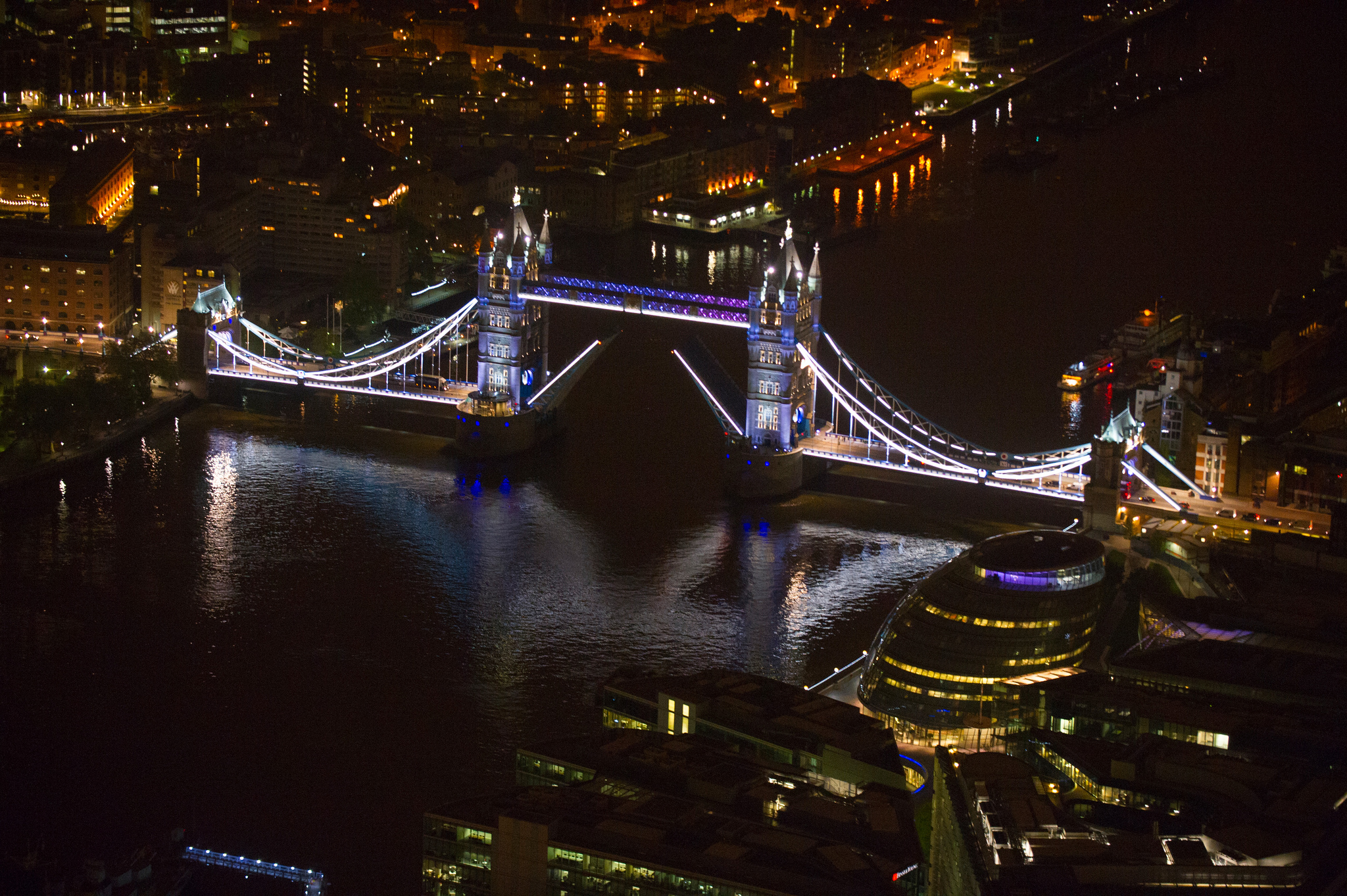
Tower Bridge
By the 1870s, the problem was undeniable: 39 percent of London's population lived east of London Bridge, a mass of humanity equivalent to the combined populations of Manchester and Liverpool, with no river crossing of their own. Building a conventional bridge would block the Pool of London, where tall-masted ships docked in the world's busiest port. The solution, when it came, was a piece of engineering theatre: a bridge that could split in half and rise to let ships pass, disguised in Gothic stonework to complement the Tower of London next door.
Fifty Designs for a Bridge
The need for a new crossing east of London Bridge had been debated for decades when, in 1876, the City Corporation formed a Special Bridge or Subway Committee to find a solution. Over fifty designs were submitted, including proposals for a high-level bridge, a tunnel, and various movable structures. The winning design, by City Architect Horace Jones and engineer John Wolfe Barry (son of Charles Barry, who designed the Houses of Parliament), combined a bascule bridge -- whose two leaves could be raised to let ships through -- with suspension spans on either side and a high-level walkway connecting the two towers, so pedestrians could cross even when the bridge was open. Jones's original design clad the steel structure in Portland stone and Cornish granite, giving it a Victorian Gothic appearance that matched the medieval fortress beside it. Construction began in 1886 with the driving of 70,000 tons of concrete into the Thames riverbed to support the piers.
Steam, Hydraulics, and One Thousand Tons
Each bascule leaf weighs over 1,000 tons, yet the original mechanism could raise them to their full 86-degree angle in under five minutes. The power came from steam engines driving hydraulic accumulators, a system designed by the engineers Hamilton Owen Rendel and William Armstrong. Pressurised water stored in six massive accumulators drove the engines that lifted the bascules. The system was so reliable that it operated from the bridge's opening in 1894 until 1976, when the steam engines were replaced by an electro-hydraulic system. The original Victorian engine rooms, preserved as part of the Tower Bridge Exhibition, remain some of the finest examples of industrial-era engineering in London. In its early years, the bridge opened up to 50 times a day to allow ships through. Today, it opens around 800 times a year.
The Walkway Nobody Used
The high-level walkways, 143 feet above the river, were designed to keep pedestrian traffic flowing when the bascules were raised. They were a magnificent idea that the public refused to use. Reaching them required climbing 200 steps inside the towers, and most Londoners preferred to wait the few minutes for the bascules to close rather than make the climb. The walkways also attracted pickpockets and prostitutes, giving them a reputation that discouraged respectable visitors further. They were closed in 1910, just sixteen years after the bridge opened. When they reopened in 1982 as part of the Tower Bridge Exhibition, they were glazed in and finally found their audience -- tourists, who come for the views and the glass floor sections installed in 2014 that allow visitors to look straight down at the traffic and river below.
Incidents and Icons
Tower Bridge has accumulated a rich catalogue of near-misses and stunts. In 1952, the bascules began to rise while a number 78 double-decker bus was still crossing; driver Albert Gunton accelerated and jumped the gap, earning a 10-pound reward from the City Corporation. In 1968, a Royal Air Force Hawker Hunter jet flew between the upper and lower walkways -- an unauthorized act for which its pilot, Alan Pollock, was arrested and discharged from the service. The bridge has been struck by ships, snarled by traffic, and featured in countless films, its silhouette so distinctive that tourists frequently confuse it with London Bridge. The charitable trust that maintains it, Bridge House Estates, was founded in 1282, making it one of the oldest charitable organizations in the world. Tower Bridge is its most famous ward: a piece of Victorian problem-solving so flamboyant that it became the symbol of London itself.
From the Air
Located at 51.506N, 0.076W, Tower Bridge is one of the most distinctive structures visible from the air over London, identifiable by its twin Gothic towers and suspended walkway. The Tower of London sits immediately to the northwest. The Pool of London stretches between Tower Bridge and London Bridge upstream. Nearest airports: EGLC (London City, 4nm E), EGLL (Heathrow, 15nm W). Best viewed at 1,500-3,000 ft AGL.