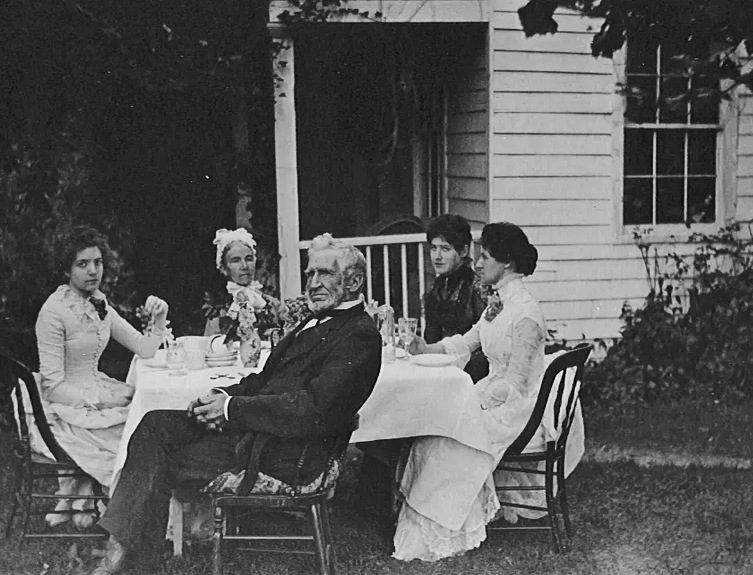
Tower House Historic District
The double wedding on November 11, 1852, united more than two couples. When Levi Tower married Mary Shuffleton and his business partner Charles Camden wed Tower's sister Philena, they sealed a partnership that would shape Shasta County for decades. The ceremony took place at the Free Bridge House, a name that would soon give way to Tower House, marking the spot where Mill Creek and Willow Creek flow into Clear Creek. Just four years earlier, Major Pierson Barton Reading had struck gold at Reading's Bar downstream, and the rush was on. But Tower and Camden saw something beyond the glitter in the pan: a crossroads where travelers needed rest, food, and water. Their vision built a small empire. Their rivalries and misfortunes would scatter it to the winds.
The Unlikely Partners
Levi Tower came from Cumberland, Rhode Island, sailing to California aboard the Edward Everett in 1849 when gold fever swept the nation. Charles Camden's path was more circuitous. Born in England in 1817, he worked in New York City at seventeen, then traveled to South America as an engineer in Chile and Peru before news of California's gold drew him west. The two men met in Shasta County and recognized in each other a shared talent for business. By 1852, they had partnered to build something more lasting than a mining claim: the Tower House, a 21-room, three-story hotel at the confluence of creeks that would become a hub for travelers heading to French Gulch, Yreka, Weaverville, and beyond. The lands beneath their feet had belonged to the Wintu people, whose presence persisted in the person of Kate Camden, a Wintu girl the family raised after hiring her to help with the Camden daughters.
An Orchard in the Mountains
Tower understood that gold fever would fade but hunger would not. After completing the hotel, he planted a thousand fruit trees: apples, pears, peaches, plums, cherries, apricots, and nectarines. Four hundred grapevines joined them, along with a plant nursery. The Tower House Hotel became famous not just for its rooms but for its table, laden with fruit from the surrounding orchards. By the 1870s, when Central Valley summers drove wealthy families north seeking relief from the heat, the Tower House had transformed into a summer resort. Fine food and solid construction drew guests who could afford the journey. Tower's peaches became legendary, captured in an 1860 photograph showing him proudly displaying his harvest. But fortune is fickle with fire, and Tower learned this lesson twice over.
Flames and Failure
Success bred ambition. Tower purchased the Globe Hotel in Shasta and another hotel in Redding, expanding his empire beyond the mountain crossroads. He served as Shasta County Supervisor from 1856 to 1858, a respected figure in the growing community. Then disaster struck. In an era of oil lamps and candles, fire was always waiting. The Shasta hotel burned in 1853. The Redding hotel was lost to flames in 1855. Tower's marriage had already dissolved in 1854, a scandal in those times. The accumulated losses forced his hand. In 1858, Tower sold the Tower House Hotel to Camden, though he continued to lease the orchards that still turned a profit. Tower never recovered his former standing. He died in San Francisco on November 12, 1865, aged just 45, from typhoid fever. The hotel that bore his name would outlast him by more than half a century before fire claimed it too in 1919.
Camden's Empire of Water
Charles Camden proved more resilient than his partner. While Tower gambled on hotels, Camden built infrastructure. His gold claim on Clear Creek produced $80,000 over 18 years, but his real genius was water. The Camden Water Ditch, a small-scale aqueduct system, brought water from Clear Creek to his house and mine. Then he scaled up, building a larger water system that sold water to miners and mining towns downstream. Water rights in gold country were worth more than gold itself. Camden's Iron Mountain Mine, a co-claim with William Magee and James Sallee, yielded rich deposits of iron, silver, and copper, producing primarily iron and silver from 1880 to 1895. He invested in the Spring Valley Water Company of Northern California and joined the Society of California Pioneers. Despite his wealth, Camden and Philena lived modestly, expanding their home in 1867 but never abandoning the hills where they had made their fortune. Camden died in 1912, outliving his partner by nearly half a century.
What Survives
The Tower House Historic District was placed on the National Register of Historic Places on July 2, 1973. The Camden House, one of Shasta County's oldest surviving homes, anchors the district just west of Whiskeytown National Recreation Area. The stagecoach roads that once connected French Gulch to Tower House, and Tower House to Shasta, Yreka, Weaverville, and Humboldt Bay, have given way to modern highways. The orchards are gone. The grand hotel that gave the place its name burned over a century ago. But the Camden House endured, surviving even the devastating Carr Fire of 2018, which burned the yard while the house itself was saved. Today, the district preserves the memory of two men who saw beyond the gold rush: one who reached too far and fell, another who dug in and built something that would last. Their double wedding at the Free Bridge House in 1852 marked the beginning of a story that still echoes through these mountain creeks.
From the Air
Tower House Historic District is located at coordinates 40.664N, 122.636W in Shasta County, just west of Whiskeytown National Recreation Area. The site sits where Mill Creek and Willow Creek flow into Clear Creek. From the air, the area appears as forested mountain terrain with the historic Camden House visible at lower altitudes. Best viewed at 2,000-4,000 feet AGL. Nearest airports include Redding Municipal (KRDD), approximately 12 miles east. The Whiskeytown Lake reservoir is visible to the east. Clear weather recommended.