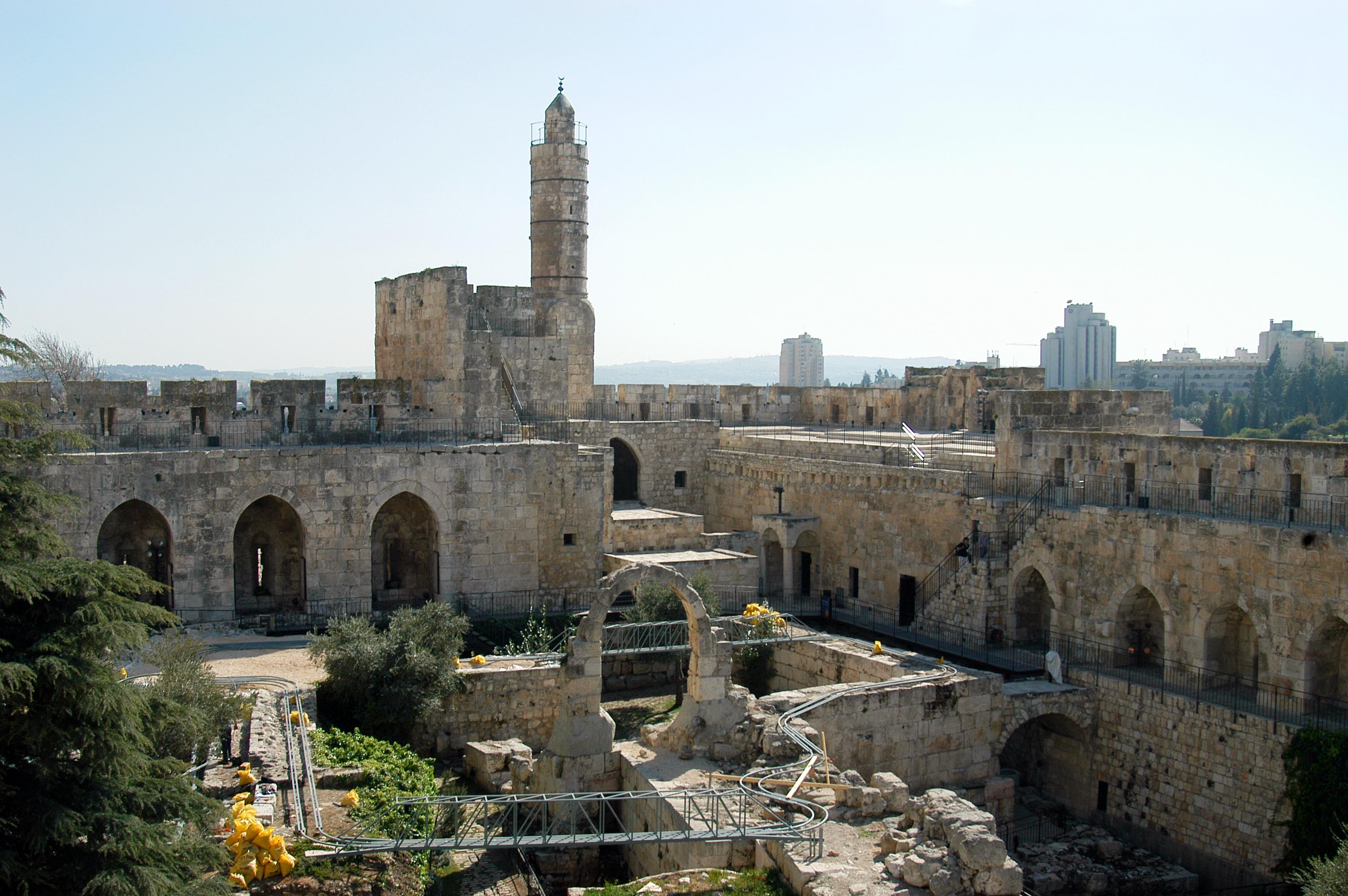
Tower of David
Every conqueror of Jerusalem left a mark on this citadel, and not one of them managed to erase the marks of those who came before. The Tower of David rises near the Jaffa Gate, where the Old City's western wall meets the road that has connected Jerusalem to the coast for millennia. Its name is a misnomer, born from a Byzantine-era mistake: 5th-century Christians believed the site was King David's palace and gave the tower his name, though the structure they were looking at was built by Herod the Great a thousand years after David's reign. The error stuck. Today the citadel holds archaeological remains spanning 2,700 years, and its ramparts offer a 360-degree panorama of a city that has been fought over more than any other on Earth.
Herod's Towers of Grief and Ambition
In 37-34 BCE, Herod the Great added three massive towers to the Hasmonean fortifications at the vulnerable northwest corner of Jerusalem's Western Hill. He named them after people he had lost or destroyed. Phasael, the tallest at 44 meters, honored his brother who had committed suicide in captivity. Mariamne bore the name of his second wife, whom he had executed and buried in a cave west of the tower. Hippicus commemorated a friend. The towers defended not just the city but Herod's own palace on nearby Mount Zion. Of the three, only the base of one survives, its 16 courses of massive Herodian ashlar blocks still visible at ground level, partially hidden by a later glacis. Whether this remnant is Phasael or Hippicus remains a debate among archaeologists, with Hillel Geva, who excavated the citadel, arguing for the latter.
Destroyed, Rebuilt, Destroyed Again
After Rome crushed the Jewish revolt in 70 CE, the legions preserved Herod's three towers as testament to the fortifications they had overcome, and the site became a Roman barracks. Byzantine monks moved in during the 4th century, and it was they who attached King David's name to the place. Muslim rulers refurbished the citadel after the Siege of Jerusalem in 636-637, and it proved sturdy enough to withstand the First Crusade in 1099, surrendering only when its defenders were guaranteed safe passage. Crusaders built a lookout tower atop it to guard the road to Jaffa. Then came Saladin in 1187, followed by the Ayyubid emir An-Nasir Dawud who destroyed the citadel in 1239, the Khwarazmians who leveled all of Jerusalem in 1244, and the Mamluks who demolished what remained in 1260. Each destruction was followed by rebuilding, the most significant in 1310 by Mamluk sultan Al-Nasir Muhammad, who gave the citadel much of its present shape.
Ottoman Stones, British Proclamations
Suleiman the Magnificent expanded the citadel between 1537 and 1541, adding a grand entrance and cannon emplacement. For 400 years it served as a garrison for Turkish troops. The Ottomans also built a mosque in the southwest corner and erected a minaret between 1635 and 1655, a slender tower that became so prominent on the skyline that by the 19th century it had inherited the name "Tower of David" from the Herodian structure below. During World War I, General Edmund Allenby captured Jerusalem and formally proclaimed the victory standing on a platform at the citadel's outer eastern gate. The British Mandate period brought a different use: the Pro-Jerusalem Society cleaned and renovated the fortress, reopened it as a cultural venue, and in the 1930s established a museum of Palestinian folklore displaying traditional crafts and clothing.
From Military Post to Living Museum
The 1948 Arab-Israeli War returned the citadel to its ancient military purpose. Jordan's Arab Legion used its commanding views to watch across the armistice line into Jewish Jerusalem, a role it held until the Six-Day War of 1967. After Israeli forces took the Old City, the citadel's cultural life resumed. In 1989, the Jerusalem Foundation opened the Tower of David Museum of the History of Jerusalem inside the original chambers, and the courtyard's archaeological remains, dating back 2,700 years, became part of the exhibition. Using maps, holograms, videos, and models, the museum traces 4,000 years of Jerusalem's story, from its origins as a Canaanite settlement to the modern era. By 2002, more than 3.5 million visitors had toured the exhibits. The ramparts remain open, offering views that sweep from the golden Dome of the Rock to the towers of the New City.
A Citadel That Outlasts Its Conquerors
What makes the Tower of David extraordinary is not any single layer but the accumulation. Hasmonean foundations from the 2nd century BCE sit beneath Herodian ashlar blocks, which support Mamluk stonework, which carries Ottoman additions. Iron Age pottery and fishbones have been found alongside Second Temple quarry marks. A Chihuly glass chandelier now hangs in the entrance hall. The citadel hosted art exhibitions in the 1920s during what became known as the Tower of David Period in Israeli art, and today it serves as a venue for sound-and-light performances projected onto its ancient walls. It is a place that refuses to belong to a single era or a single people, a building that has been destroyed and rebuilt so many times that the act of survival has become its defining characteristic.
From the Air
Located at 31.776N, 35.228E, adjacent to the Jaffa Gate on the western side of Jerusalem's Old City. The citadel's Ottoman minaret is a distinctive vertical landmark visible from the air alongside the Dome of the Rock to the east. Ben Gurion International Airport (LLBG) is approximately 50 km northwest. Best viewed from 5,000-8,000 ft AGL to see the citadel's position guarding the western approach to the Old City.