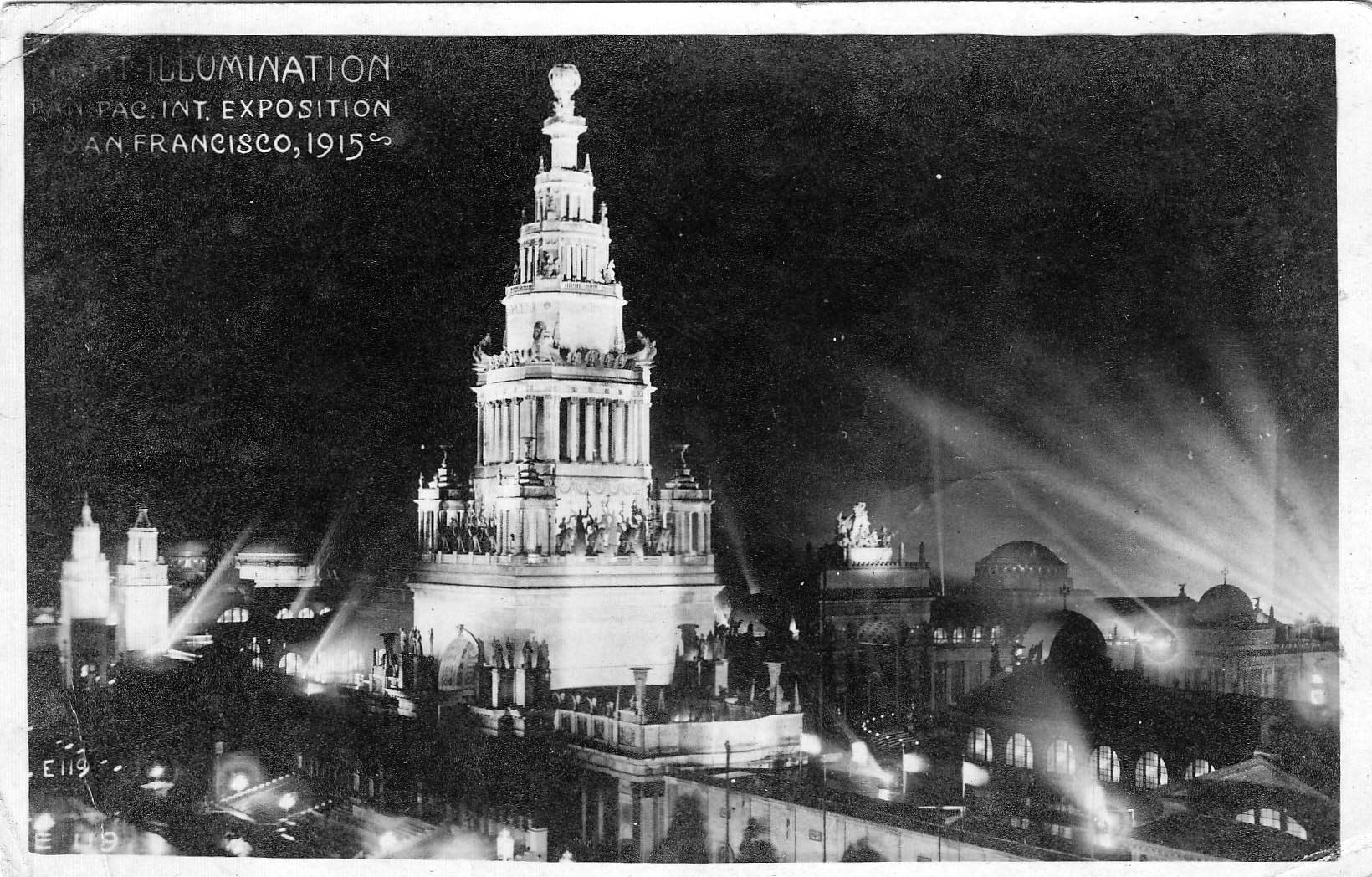
Tower of Jewels (PPIE)
It was made of plaster and burlap stretched over a skeleton of wood and steel. It was 435 feet tall. It was covered in more than 100,000 faceted glass jewels that caught the San Francisco sunlight and scattered it into a thousand points of color. And it was designed to be destroyed. The Tower of Jewels was the centerpiece of the 1915 Panama-Pacific International Exposition, a structure so dazzling that visitors gave it a name its creators had not intended -- adding 'of Jewels' to what had simply been called 'The Tower.'
Hastings' Impossible Tower
Architect Thomas Hastings of the firm Carrere and Hastings designed the Tower as a combination triumphal arch and soaring column, the gateway to the Court of the Universe at the heart of the Exposition. The fair itself was San Francisco's declaration of recovery from the devastating 1906 earthquake and fire, and the Tower embodied that ambition -- impermanent materials assembled into something meant to take visitors' breath away. At 435 feet, it dominated the exposition grounds along the Marina District waterfront. In front of the Tower, the Fountain of Energy flowed at the center of the South Gardens, flanked by the Palace of Horticulture and Festival Hall.
100,000 Points of Light
The Novagems -- cut glass faceted discs nearly two inches in diameter -- transformed the Tower from architecture into spectacle. By daylight, they sparkled and shimmered with every shift in the bay breeze. At night, more than fifty spotlights illuminated them from below, turning the Tower into a luminous column visible across the bay. The effect was unlike anything visitors had seen at any previous world's fair, and the Novagems became the single most memorable feature of the entire Exposition. When the fair ended and demolition began, the jewels were carefully removed from the Tower before the wrecking crews moved in. Each was fitted with a small brass medallion certifying that it had hung on the Tower during the Exposition, then individually boxed and sold for one dollar.
Beautiful Because It Was Temporary
The Tower of Jewels was built of staff -- a mixture of plaster and burlap-like fiber that was the standard material for world's fair architecture. It was never meant to survive longer than the Exposition itself. This impermanence was part of its power: the Tower's beauty was inseparable from its fragility, a monument that existed only for the duration of a celebration. Nearly all of the Exposition's buildings were demolished afterward; the Palace of Fine Arts, reconstructed decades later, is the only major survivor. Where the Tower once stood, the Marina District's residential streets now run. But those one-dollar Novagems, scattered across the country in attics and display cases, carry the Tower's memory forward -- tiny fragments of a structure that was, for one extraordinary year, the most beautiful building in America.
From the Air
The Tower stood at approximately 37.804N, 122.442W in what is now San Francisco's Marina District, near the Palace of Fine Arts. The original site is now residential. Nearest airports: KSFO (12nm south), KOAK (11nm east). Best viewed at 2,000-3,000 ft AGL.