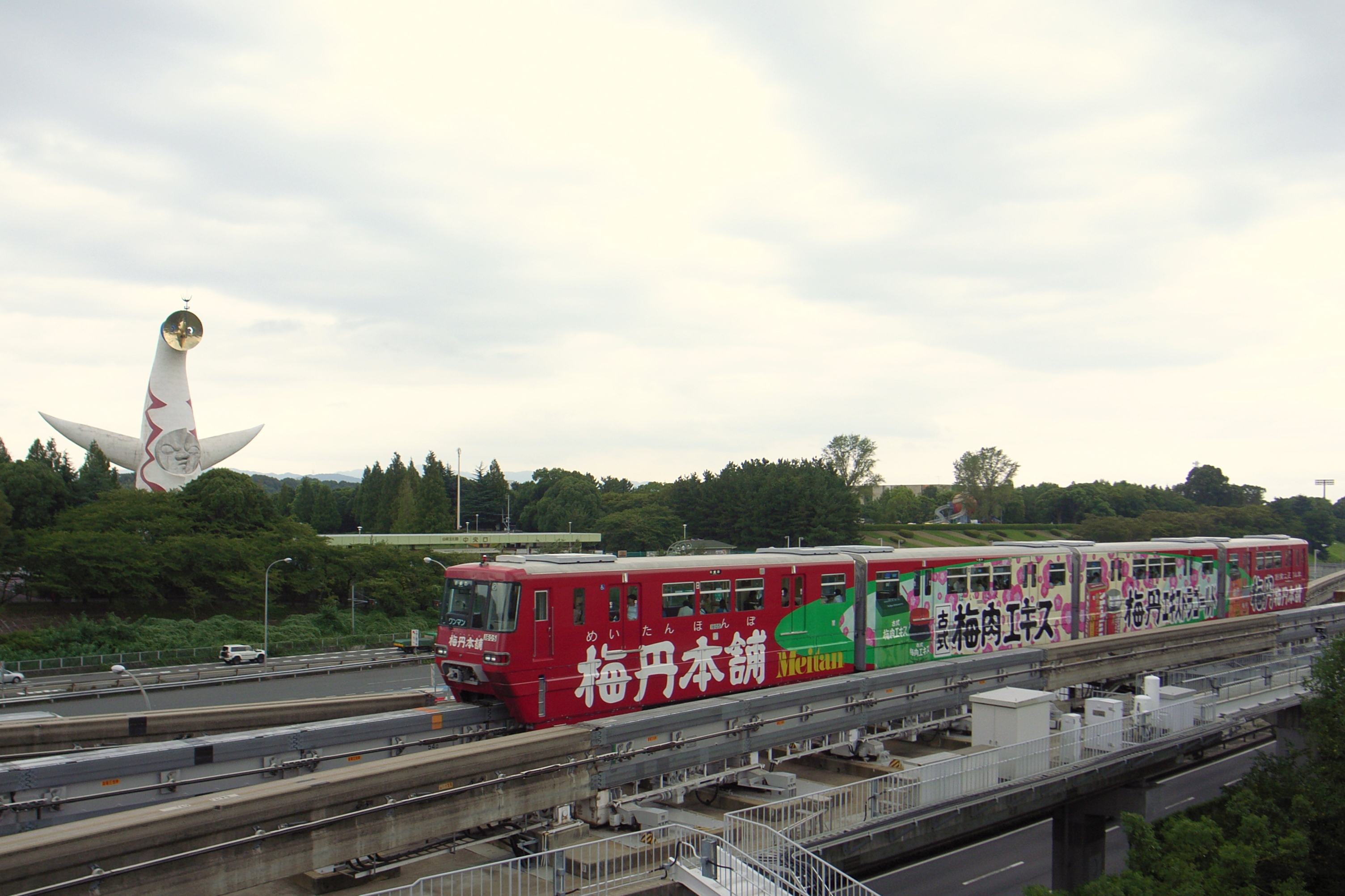
Tower of the Sun
Three faces stare out from a single white body rising 70 meters above a suburban park in Suita, Osaka. One looks forward with wide, unblinking eyes. One gleams gold at the summit, gazing skyward. One lurks on the back, black and ancient, turned toward what has already passed. The Tower of the Sun was supposed to be temporary -- a centerpiece for Expo '70 that would come down when the fair ended. Instead, Taro Okamoto's defiant, bizarre, magnificent sculpture refused to go away. More than fifty years later, it remains the most recognizable landmark in Osaka Prefecture, designated a Tangible Cultural Property of Japan in 2020, and more beloved now than the day it was built.
The Artist Who Punched Through the Roof
The 1970 World Exposition in Osaka was Japan's declaration to the world that it had arrived as a modern technological power. The theme was "Progress and Harmony for Mankind," and the centerpiece was architect Kenzo Tange's enormous Festival Plaza, sheltered beneath a futuristic canopy called the Big Roof. Into this celebration of sleek modernism, organizers invited Taro Okamoto to contribute a sculpture. What he delivered was the opposite of everything around it -- primitive, organic, confrontational. The Tower of the Sun was so tall that its tip punched through a circular hole cut in Tange's ceiling, the golden face emerging above the roof line like a creature breaking free. Science fiction writer Sakyo Komatsu, one of the Expo organizers, suggested the tower's name after remarking that it reminded him of an irreverent scene in the 1955 novel Season of the Sun.
Three Faces, Four Suns
Okamoto designed the tower to represent the full sweep of time. The Face of the Sun, centered on the front of the white body, represents the present -- its expression alert, confrontational, impossible to ignore. At the summit, the 11-meter-wide Golden Mask represents the future, its antenna serving as a lightning rod. On the back, the Black Sun represents the past. But there was a fourth face. During the Expo, a subterranean gallery called PRAYER housed the Underground Sun, representing the inner spiritual world of humans. When the fair closed, this face vanished. It was moved to an unknown location, and despite decades of searching, the original sculpture has never been found. A reconstruction has been exhibited since the tower reopened in 2018, but the mystery of the missing fourth face endures. The jagged red markings painted across the tower's front represent thunder, and its two 25-meter arms spread wide as if embracing -- or challenging -- the sky.
The Bloodstream Inside
Step inside the tower and you enter a different world. The interior houses the Tree of Life, a 41-meter-tall sculpture representing the evolution of all living things. Models of 292 organisms climb the trunk and branches -- glowing amoebas at the base, fish and reptiles on the lower limbs, mammals higher up, and humans at the very top, rendered smallest of all. It is Okamoto's reminder that human beings are the newest, most fragile branch on an ancient tree. After Expo '70, the interior was closed to the public for nearly half a century. In 2003, a special opening for 1,970 lottery winners drew over 24,000 applicants. After years of earthquake reinforcement and careful restoration of the Tree of Life, the tower permanently reopened in March 2018, allowing visitors to ascend through evolution itself.
The Tower That Would Not Leave
The Big Roof was dismantled. The national pavilions were torn down. The Festival Plaza emptied out and became the green lawns of Expo '70 Commemorative Park. But the Tower of the Sun stayed. Its Golden Mask, originally built from 337 steel plates, weathered decades of rain and wind until it was replaced with a stainless steel replica in 1992. Half of the original plates survive in storage within the park. The tower has seeped into Japanese popular culture in ways Okamoto could not have predicted -- inspiring a Pokemon character, serving as a giant mecha in manga, appearing in films by Hirokazu Kore-eda, and lending its name to novelist Tomihiko Morimi's debut work. The Osaka Monorail runs directly past its face, giving commuters a daily reminder that in a park built to celebrate human progress, the most enduring thing turned out to be the strange, ancient-looking creature that defied progress entirely.
From the Air
The Tower of the Sun is located at 34.810N, 135.532E in Expo '70 Commemorative Park, Suita, Osaka Prefecture. At 70 meters tall with outstretched arms and a distinctive white body, it is visible from the air as a unique landmark within the green parkland. The Osaka Monorail line curves past the tower, providing an additional visual reference. Nearest airports are Osaka International/Itami (RJOO, approximately 8 km east) and Kansai International (RJBB, approximately 45 km south). Best viewed at 2,000-4,000 feet AGL. The surrounding park contrasts sharply with the dense urban development of Suita and northern Osaka.