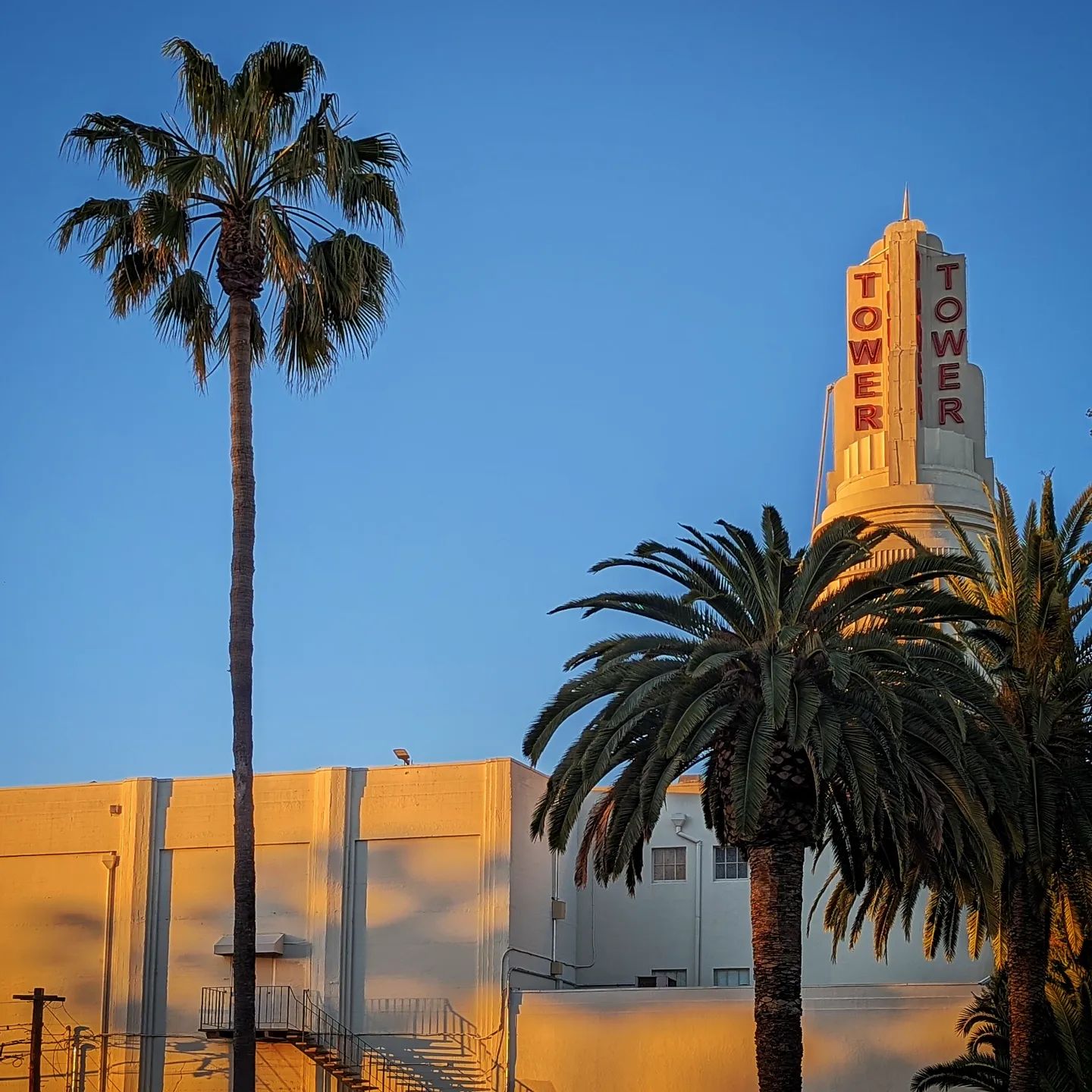
The Marquee That Refused to Go Dark
The first movie the Tower Theatre ever screened was Algiers, a 1938 romantic thriller starring Charles Boyer and Hedy Lamarr, in which a jewel thief trapped in the Casbah risks everything for one more taste of the world outside. It was an apt opening for a building designed to make people feel they had stepped into another world entirely. Architect William B. David, who specialized in California theaters, had drawn the Tower in the Streamline Moderne style -- all sweeping curves, horizontal lines, and the aerodynamic optimism of an era that believed the future would be smooth and fast. Nearly nine decades later, the Tower Theatre still stands on Broadway in Sacramento, the oldest continuously running picture palace in the city, its neon marquee glowing over a neighborhood that took its name from the building itself.
A Showman's Gamble
Joseph Blumenfeld came from a theater family. A second-generation owner, he understood that in 1938 a movie house needed to be more than a dark room with a projector -- it needed to be a destination. The Tower Theatre was his answer to that conviction. David's Streamline Moderne design gave the building a look that was fashionable and futuristic, with the kind of visual confidence that told passersby something important was happening inside. The single-screen auditorium opened to a Sacramento audience that was, like the rest of Depression-era America, hungry for escape. At twenty-five cents a ticket, the Tower offered two hours of somewhere else. Blumenfeld's gamble was that the building itself would be part of the draw, and he was right. The theater became an anchor for the surrounding blocks, lending its name to what is now the Tower District, one of Sacramento's most distinctive neighborhoods.
Dividing the Dream
By 1972, the single-screen era was ending. Audiences still came, but not in the numbers that one large auditorium demanded. The Tower underwent a renovation that split it into a three-screen cinema, a common survival strategy that sacrificed grandeur for efficiency. The original proportions of David's auditorium were carved into smaller rooms, each capable of running a different film and drawing a different crowd. It was a practical decision, and it kept the doors open when dozens of single-screen theaters across California were going dark for good. What the renovation could not touch was the exterior -- the Streamline Moderne facade, the marquee, the vertical tower sign that gave the building its identity. From the street, the Tower still looked like 1938. Inside, it had quietly joined the multiplex age.
Corporate Hands, Local Soul
Reading International, a theater chain, purchased the Tower in 1998, folding a Sacramento landmark into a portfolio of cinemas spanning three continents. The corporate stewardship brought upgrades -- digital projectors arrived in 2012, replacing the film reels that had spooled through the Tower's machines for seventy-four years. But the theater's identity resisted absorption. It remained a repertory-minded venue, the kind of place that programmed independent films and hosted premieres that the multiplexes at the mall would never book. In 2016, Reading sold the Tower to an endowment fund as a long-term investment, a transaction that suggested the building's value was not just commercial but cultural. The theater was worth holding, even if its returns were measured in decades rather than quarters.
Sacramento Premieres
Two premieres in particular cemented the Tower's reputation as Sacramento's living room for cinema. Colin Hanks chose the theater for the debut of his 2015 documentary All Things Must Pass, a film about the rise and fall of Tower Records -- a company that, like the theater, took its name from a Sacramento tower and became an institution. Hanks grew up in Sacramento and understood the symbolism of screening a film about a beloved Sacramento brand in a beloved Sacramento building. Two years later, Greta Gerwig brought Lady Bird to the Tower for its Sacramento premiere. Gerwig's film was set in the city, a semi-autobiographical portrait of adolescence in a place that its protagonist simultaneously loves and longs to escape. Screening it at the Tower closed a loop: a film about Sacramento identity, shown in a building that helped define it.
Still Running
The Tower Theatre's survival is not sentimental -- it is stubborn. Picture palaces were built to be cathedrals of a mass medium, and when that medium fractured into home video, streaming, and phones held six inches from the face, most of those cathedrals emptied. The Tower adapted without surrendering what made it worth saving. The Streamline Moderne exterior remains a Sacramento landmark, its curves and lines expressing a confidence in the future that feels almost quaint but never dated. Inside, the three screens still show films to audiences who chose to leave their houses, drive to Broadway, and sit in the dark with strangers. It is the oldest continuously running movie theater in Sacramento, a fact that matters less as a statistic than as a daily practice. Every evening the marquee lights up, the Tower makes the same argument it made in 1938: that watching a movie in a beautiful room, together, is worth the trip.
From the Air
Located at 38.56N, 121.49W on Broadway (Land Park/Curtis Park area) in Sacramento. The theater's vertical tower sign and marquee are visible from low altitude along the Broadway corridor. Sacramento Executive Airport (KSAC) lies 1.5nm south; Sacramento International (KSMF) is 11nm northwest. Best viewed at 1,500-2,500 feet AGL following Broadway southeast from downtown.