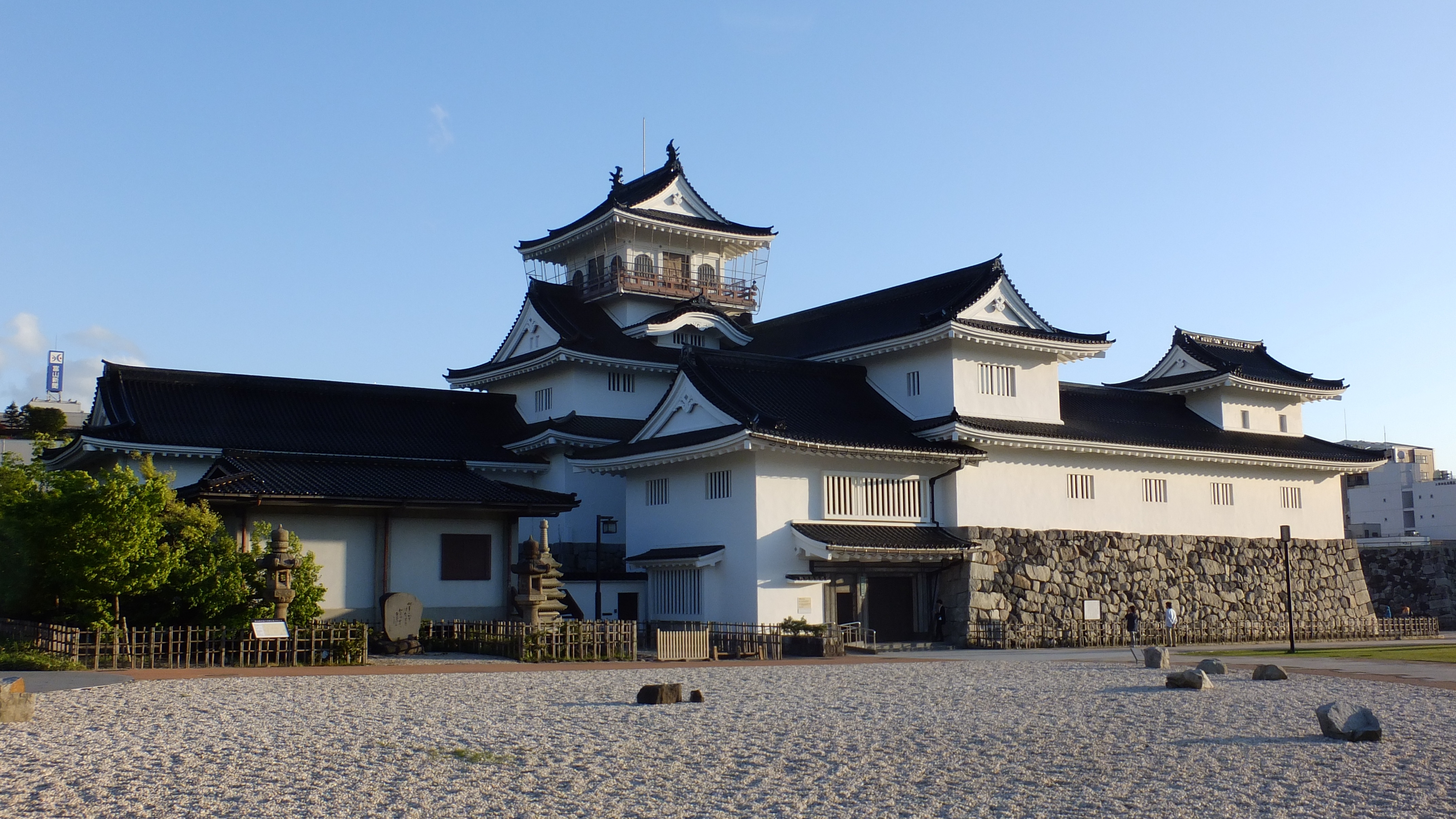
Toyama Castle: The Fortress That Wouldn't Stay in One Clan's Hands
Few castles in Japan changed hands as often as Toyama. Built in 1543 by the Jinbo clan on the marshy banks of the Jinzu River, the fortress at the geographic heart of Etchu Province became the prize in a decades-long tug-of-war between rival warlords. Uesugi Kenshin took it. Oda Nobunaga took it back. Toyotomi Hideyoshi besieged it with more than 100,000 soldiers and forced its surrender in a single week. The Maeda clan finally settled in, only for nature and modernization to do what armies could not -- an earthquake shattered its walls in 1858, the Meiji government dismantled what remained in 1871, and American firebombs leveled the site on August 2, 1945. Today a concrete replica of the donjon stands in the center of Toyama city, housing a museum of local history. The castle that nobody could hold became a park that belongs to everyone.
A Fortress Between Rivals
Etchu Province in the mid-sixteenth century was a landscape defined by conflict. A wide plain threaded with large rivers, it sat at the geographic center of what is now Toyama Prefecture, bracketed by mountains and open to the Sea of Japan. The Jinbo clan, retainers of the weakening Hatakeyama clan, governed the western half of the province from a fortification they raised in 1543 on the banks of the Jinzu River. Their eastern rivals, the Shiina clan, served the same overlord but harbored the same ambitions. As the Hatakeyama waned in power during the fifteenth century, the two clans fought an unending war for control, with the Buddhist militant movement known as the Ikko-ikki playing one side against the other. In this volatile triangle of shifting loyalties, the fortress on the Jinzu -- Toyama Castle -- was less a permanent seat of power than a revolving door.
Warlords at the Gate
By the 1550s, the Jinbo clan had overwhelmed the Shiina, but their dominance was short-lived. The Shiina allied with the legendary Uesugi Kenshin, who captured Toyama Castle in 1570 after a fierce struggle. When Uesugi's castellan suppressed an Ikko-ikki attack in 1571, the castle's strategic importance was confirmed. But Kenshin's death reshuffled the board. Oda Nobunaga extended his reach into Etchu, returning the Jinbo to power in 1578. When their leader lost control to his own retainers just three years later, Nobunaga had no patience for incompetence. He installed his general Sassa Narimasa, who transformed Toyama Castle from a provincial fort into a serious stronghold, expanding the moats and towers and launching flood-control works that turned the surrounding marshland into productive rice paddies. The castle's most dramatic chapter came in August 1585, when Toyotomi Hideyoshi invaded Etchu with over 100,000 soldiers. Toyama Castle surrendered after just one week. Hideyoshi handed it to the Maeda clan, who would keep it for centuries.
The Maeda Centuries and the Castle's End
Under the Tokugawa shogunate, the Maeda became lords of Kaga Domain, one of the wealthiest in Japan. Maeda Toshinaga rebuilt Toyama Castle and used it as a retirement residence until a fire consumed much of it in 1609. His grandson Maeda Toshitsugu, awarded a 100,000-koku holding in 1639, initially had no castle of his own. Unable to raise funds to build from scratch, he negotiated with Kaga Domain in 1659 to trade some of his lands for Toyama Castle and its surrounding territory. In 1661, he received shogunal permission to rebuild, laying out a new castle town around its walls. His descendants ruled Toyama until the Meiji Restoration brought the feudal era to a close. But the castle's physical decline had already begun: the devastating Hietsu earthquake of 1858 shattered many of its structures, and in 1871 the new Meiji government ordered the demolition of what remained.
Ground Zero and Resurrection
The castle grounds took on a second life as a government site when the Toyama Prefectural office was built on the former inner bailey. That building burned in 1899, was rebuilt in 1900, and burned again in 1933. The site became a public park, hosting rallies in the years before and during World War II. On August 2, 1945, Toyama was the target of a massive American air raid that devastated the city. The castle site sat at the center of the destruction. Nine years later, in 1954, a ferro-concrete reproduction of the donjon was raised on the old foundations, not as a fortress but as the Toyama Local History Museum. Inside, visitors find tea ceremony utensils and antiques rather than weapons. Only one original gate survives, along with fragments of the old moats and stone walls -- quiet traces of the centuries when Toyama Castle was the most contested prize in Etchu Province.
A Castle Park in a Modern City
Today Toyama Castle Park sits at the center of a modern prefectural capital, its moats reflecting the reconstructed donjon against the backdrop of the Northern Alps. The castle was listed among the Continued Top 100 Japanese Castles in 2017, a recognition that honors not just architectural merit but historical significance. The Jinbo, Uesugi, Oda, Sassa, Toyotomi, and Maeda all raised their banners here across barely a century of warfare. That turbulent history is compressed into a green park where office workers eat lunch beside remnants of stonework that once held back armies. The Jinbo clan vanished from history after losing the castle, though their name survives in an unexpected place: Jinbocho, a neighborhood in Tokyo named for a clan member who entered the service of Tokugawa Ieyasu. Even in disappearance, Toyama Castle's former masters left traces.
From the Air
Located at 36.6933N, 137.211E in the center of Toyama city, on the wide Toyama Plain along the Jinzu River. The castle park and reconstructed donjon are visible from altitude as a green rectangle in the urban core. The Northern Alps form a dramatic mountain wall to the east and south. Toyama Airport (RJNT) lies approximately 5 nautical miles south of the castle. The Jinzu River curves through the city to the northwest. Best viewed at 3,000-5,000 feet AGL on approach from the Sea of Japan coast, with the contrast between urban grid and castle park moats visible in clear conditions.