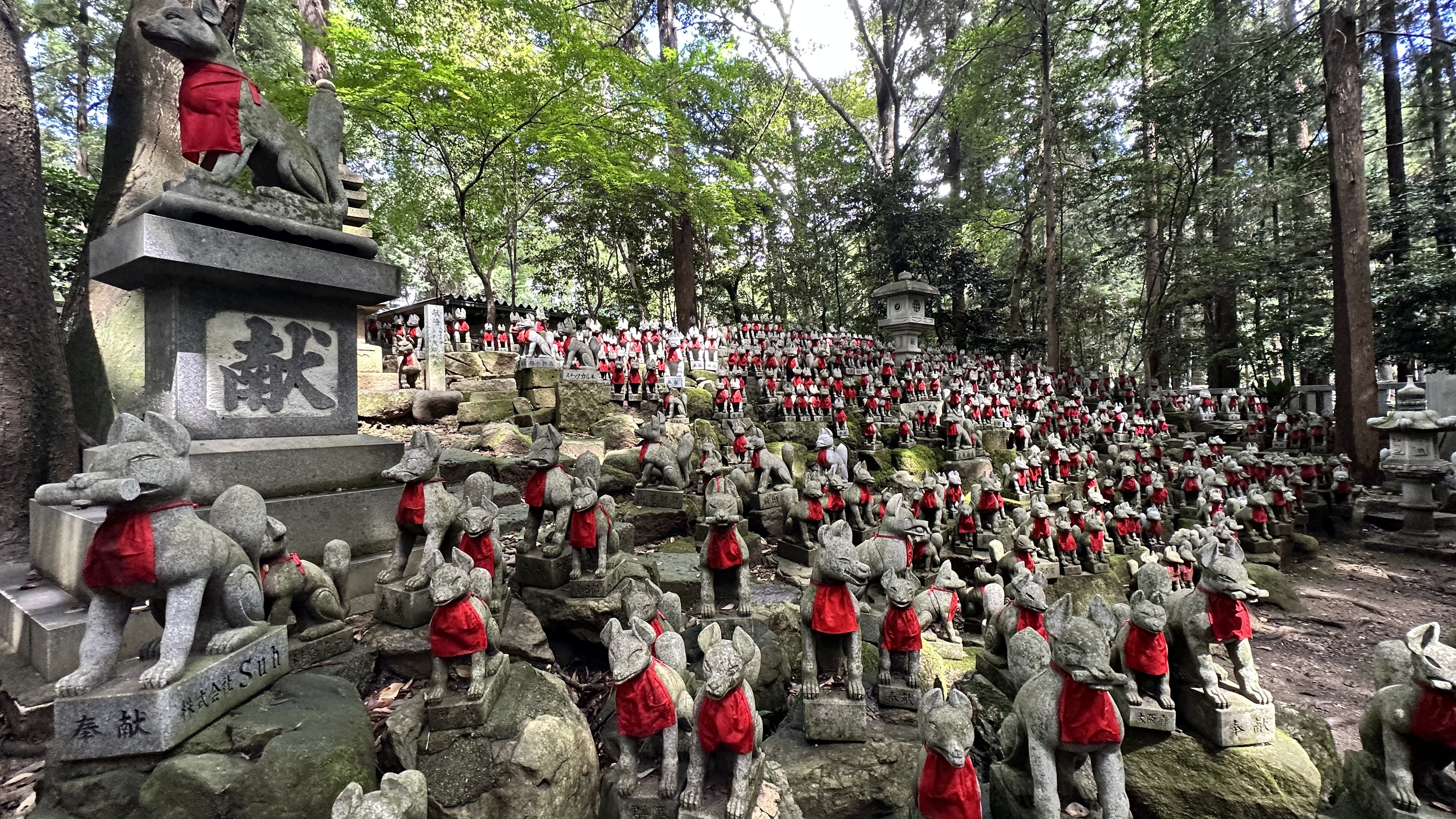
Toyokawa Inari
Walk through a vermillion torii gate -- the universal marker of a Shinto shrine -- and you will find yourself inside a Zen Buddhist temple. This is the paradox at the heart of Toyokawa Inari, formally known as Myogon-ji, where the boundaries between Japan's two great spiritual traditions dissolved long ago. Founded in 1441 in eastern Aichi Prefecture, this Soto Zen temple draws millions of visitors who come not for its official main image of the thousand-armed Kannon, but for something far more unusual: a goddess who was once a demon, who rides a white fox, and who promises prosperity to the faithful.
The Goddess on the White Fox
Toyokawa Inari's guardian deity is Toyokawa Dakini Shinten -- Dakiniten for short. Her origins are startling. In Buddhist mythology, the dakinii were a race of malevolent demonesses who devoured human flesh. The buddha Vairocana, taking the wrathful form of Mahakala, subjugated them and turned them toward the Buddhist path. When these spirits arrived in Japan through the esoteric Shingon and Tendai schools, they were folded into the retinue of Yama, judge of the dead. Over time, many dakini figures merged into a single goddess called Dakiniten, who developed her own independent following from the end of the Heian period onward. Because dakini were associated with foxes -- the sacred messengers of Inari, the Shinto kami of rice, fertility, and worldly success -- Dakiniten's worship became inseparable from Inari devotion. By the medieval period, the names were used interchangeably.
A Vision in Song China
The temple's founding story reaches back to 1264, when the Zen monk Kangan Giin traveled to Song China to present his master Dogen's recorded sayings to Chinese monks in the Caodong lineage. Legend holds that as Giin prepared to depart China in 1267, he experienced a vision: a goddess riding a white fox, holding a wish-granting jewel in one hand and a shoulder pole laden with sheaves of rice in the other. She identified herself as Dakiniten and pledged to be his eternal protector. Giin carved a statue based on this vision. That statue passed through generations of disciples until it reached the priest Tokai Gieki, who in 1441 enshrined both it and an image of the bodhisattva Avalokitesvara at a new temple in Toyokawa. He named Dakiniten the guardian of the entire complex. The goddess depicted here is distinct from the standard iconography -- instead of a sword, she carries bundles of rice stalks on a pole over her right shoulder, an image of abundance rather than martial power.
The Old Man and His Magic Pot
Toyokawa Inari was also known as Heihachiro Inari, thanks to one of its most beloved legends. When the founder Gieki was establishing his temple, an old man appeared carrying a small cauldron and offered to cook for the monastery. His pot proved to be miraculous -- from it poured endless food, enough to feed tens or even hundreds of people from a single vessel. When pressed about his abilities, the old man replied simply that he had three hundred and one servants at his command. He stayed faithfully by Gieki's side for the rest of the priest's life, then vanished without a trace, leaving only his magical pot behind. Devotees came to believe Heihachiro was a fox spirit in human form, an avatar of Dakiniten herself. The story captures the temple's essential character: the supernatural woven seamlessly into the domestic, the divine manifesting through generosity.
Warlords and Merchants at the Gate
The temple's spiritual magnetism attracted some of Japan's most powerful figures. During the Sengoku period, Imagawa Yoshimoto, Oda Nobunaga, Toyotomi Hideyoshi, and Tokugawa Ieyasu all patronized Toyokawa Inari -- four titans of Japanese history who sought Dakiniten's protection as they battled for control of the nation. As peace settled over the land during the Edo period, the temple's patron base shifted from warlords to merchants. Pilgrims from the commercial classes flocked here, drawn by Dakiniten's reputation as a bringer of prosperity and protector against calamity. That pilgrimage tradition continues into the modern era, making Toyokawa Inari one of Japan's most visited temples.
Where Two Traditions Breathe as One
The torii gate at Toyokawa Inari's entrance is a relic of shinbutsu-shugo, the pre-modern fusion of Buddhism and Shinto that once defined Japanese religious life. Although government edicts in the Meiji era forcibly separated the two traditions, Toyokawa Inari preserved this layered identity. It remains formally a Soto Zen Buddhist institution with no official Shinto affiliation, yet foxes -- Inari's unmistakable emissaries -- are everywhere. The Reikozuka, or Spirit Fox Mound, overflows with over a thousand stone kitsune statues deposited by devotees over the years. Visitors come to pray for business success, safe travels, and good fortune, echoing the same desires that drew merchant pilgrims centuries ago. In this temple, categories dissolve: Buddhist and Shinto, demon and protector, fox spirit and faithful servant, all share the same sacred ground.
From the Air
Located at 34.825N, 137.392E in the city of Toyokawa, eastern Aichi Prefecture. The temple complex is identifiable from the air by its large traditional rooflines and surrounding tree cover in the urban center of Toyokawa. The nearest major airport is Chubu Centrair International (RJGG), approximately 70 km to the west. Nagoya Airfield (RJNA) is about 60 km to the northwest. Hamamatsu Air Base (RJNH) lies roughly 40 km to the east. The temple sits near the Toyokawa River. Recommended viewing altitude: 2,000-3,000 feet AGL for temple complex visibility.