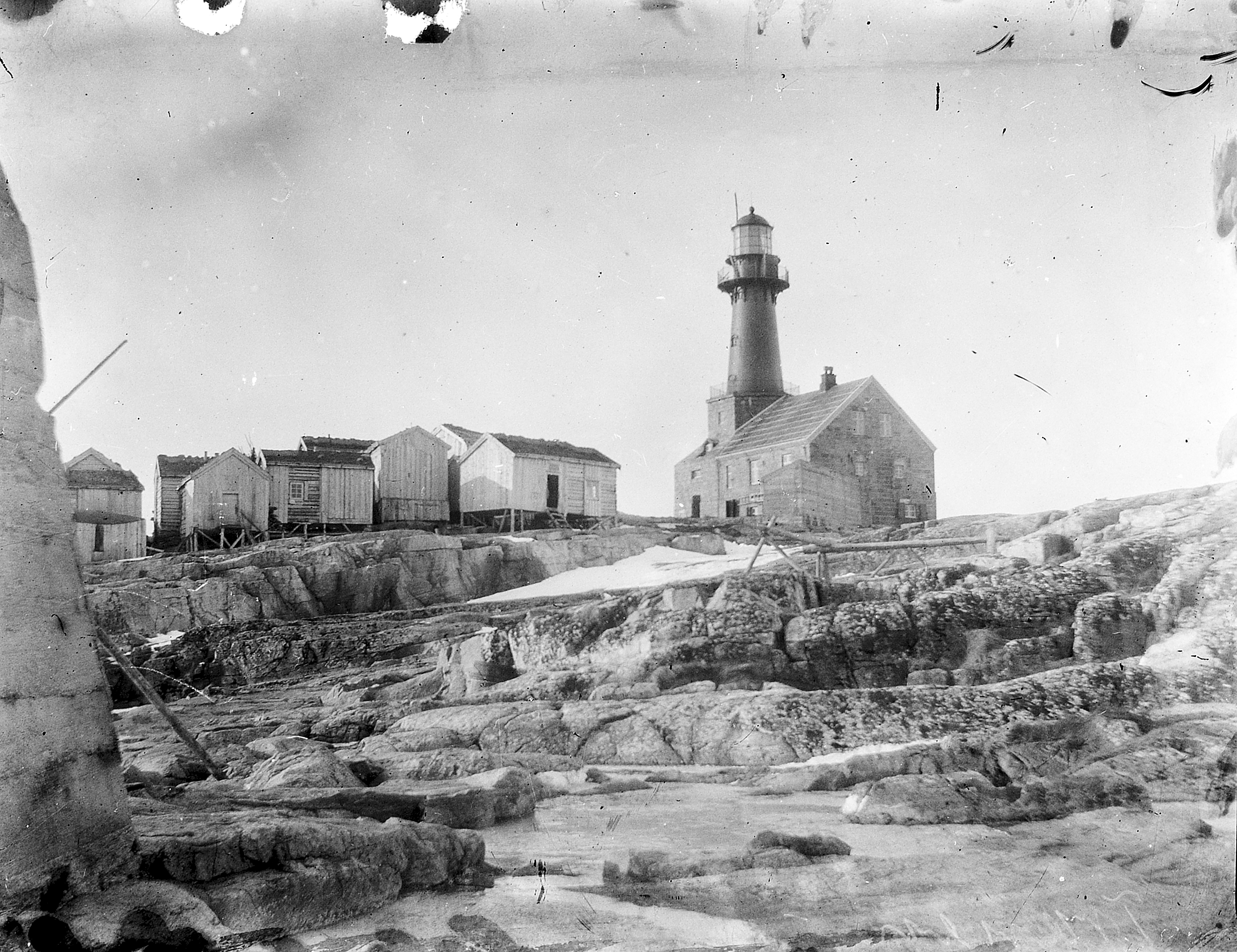
Træna Lighthouse
Every fifteen seconds, a single white flash cuts across the Trænfjorden. It has done so since 1877, when Norwegian maritime authorities decided that the scatter of islands west of Nordland's coast needed a permanent eye watching over the shipping lanes. The lighthouse they built on Sørholmen, a rocky islet ten kilometers southwest of Husøya, is not the tallest on Norway's coast, nor the most famous. But for the fishing boats and freighters threading through the Træna archipelago, its 88,000-candela beam has been the difference between safe passage and disaster for nearly a century and a half.
Iron and Granite at the Edge of the World
Træna is one of Norway's oldest known settlements, with evidence of human habitation stretching back over 9,000 years. The archipelago sits roughly 33 kilometers off the Helgeland coast, exposed to the full fury of the Norwegian Sea. Building a lighthouse here in 1877 was an act of stubborn engineering. Workers hauled granite to Sørholmen to lay the foundation, then erected an 18-meter tower of red cast iron that would resist the salt-laden winds battering the islands year-round. The choice of materials was deliberate: granite anchors, iron endures. The tower's red paint makes it visible against overcast skies, a practical consideration in a place where grey days outnumber blue ones by a wide margin.
A Light Between Two Worlds
Positioned at 66.43 degrees north, Træna Lighthouse sits just south of the Arctic Circle, in the borderland between the temperate and the polar. The light itself rests at an elevation of 36.8 meters above sea level, a height that gives its beam a nominal range of 12.2 nautical miles. For the lighthouse keepers who lived on Sørholmen through the dark months of winter, this was profoundly isolated work. The nearest community, Husøya, lay ten kilometers of open water to the northeast, and the mainland village of Lovund in Lurøy Municipality was seventeen kilometers to the east. When automation arrived in 1974, it ended nearly a century of manned operation, but the light continued its rhythm unchanged: one flash, fifteen seconds of darkness, one flash again.
The Archipelago's Quiet Guardian
The Træna archipelago comprises over a thousand islands, islets, and skerries, most of them uninhabited. Fishing has sustained the community here for millennia, and the waters around the islands remain productive grounds for cod, herring, and other species. For centuries, sailors navigated by landmark and instinct. The lighthouse formalized what local knowledge had always understood: these waters demand respect. Today, Træna is also known for the Træna Music Festival, held each July on the islands, drawing visitors to what is one of Norway's most remote populated archipelagos. The lighthouse, visible from the festival grounds on clear nights, continues its work indifferently, pulsing its white signal across the fjord as it has since the reign of Oscar II.
Persistence in an Age of Satellites
Modern navigation relies on GPS, electronic charts, and radar. Yet Norway maintains its network of coastal lighthouses, Træna among them. The reason is pragmatic: electronics fail, batteries die, and satellite signals can be disrupted. A cast iron tower on a granite base, powered and automated, requires almost nothing to keep functioning. The Norwegian Coastal Administration continues to list Træna Lighthouse in its official register of active navigational aids. Its beam remains a fixed point in a landscape defined by water and weather, a reassurance that some things endure simply because they were built well and placed where they were needed most.
From the Air
Located at 66.43°N, 11.97°E on the island of Sørholmen in the Træna archipelago, Nordland county, Norway. Best viewed at 2,000-3,000 feet altitude. The red cast iron tower stands out against the grey-green islands. The Træna archipelago with its thousand-plus islands is a striking visual feature. Nearest airports: Sandnessjøen Airport, Stokka (ENST) approximately 60 km southeast; Brønnøysund Airport, Brønnøy (ENBN) approximately 100 km south. Expect frequent low clouds and strong winds off the Norwegian Sea.